Fang of the Goddess: The 1888 First Ascent of Mount Ushba North Peak
On July 26, 1888, John Garford Cockin and Ulrich Almer conquered the terrifying Northeast Ridge of Mount Ushba North Peak (4,690 m) in Svaneti.
Mountain Safety & Conditions Disclaimer: High-altitude climbing, glacial travel, and technical ascents entail severe objective risks including avalanches, serac collapses, rapid weather collapse, and altitude illness. Historical route descriptions and summit claims on Mountanity reflect documented archival sources and must not be used as live operational safety assessments. Local regulations, permits, and physical glacial topography change continuously.
Peer Review: Senior Editorial Board & Historical Reviewers • Editorial Standards
Fang of the Goddess: The 1888 First Ascent of Mount Ushba North Peak
The Inaccessible Spire of Svaneti
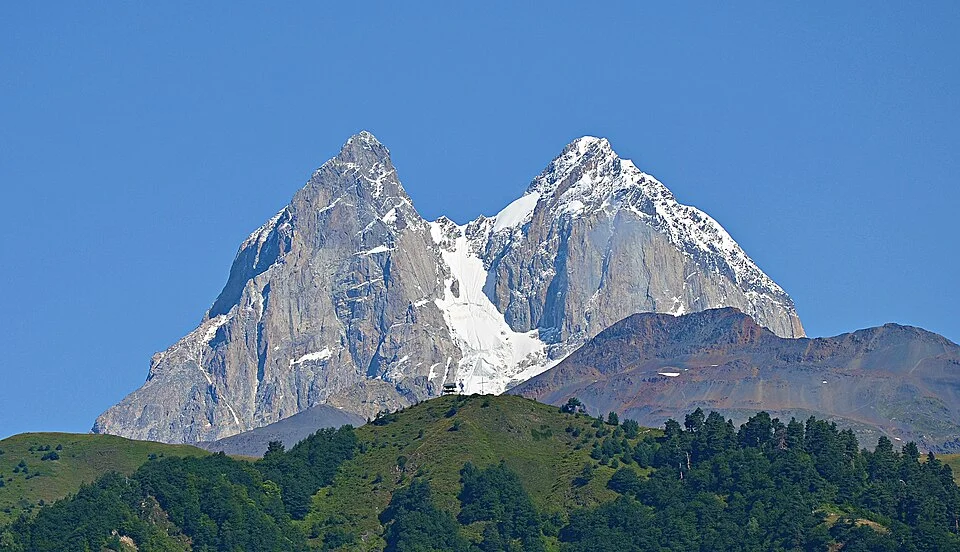
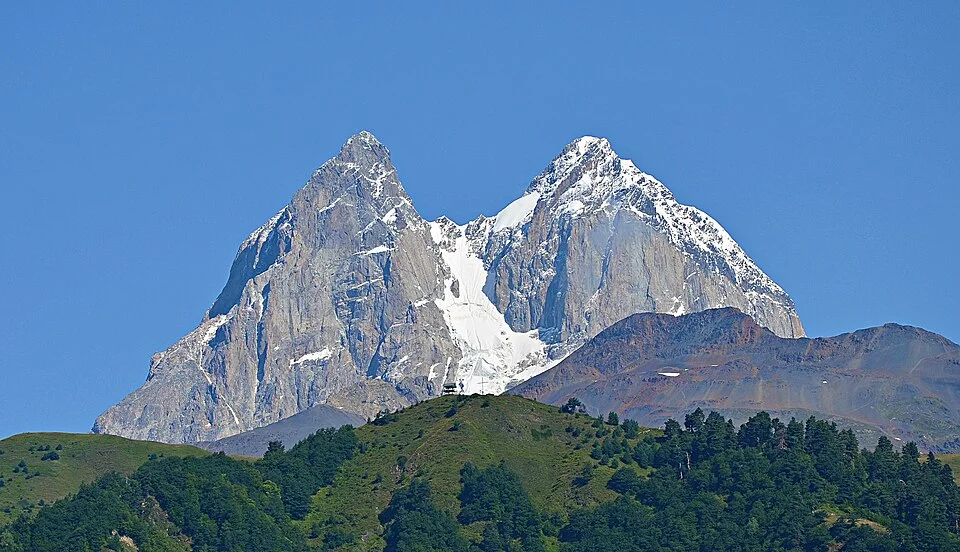
In the heart of Upper Svaneti, where ancient medieval stone defense towers stand against deep gorges, there rises a mountain that struck terror into the hearts of European climbers: Mount Ushba (4,710 m). Known as the Matterhorn of the Caucasus, Ushba does not merely rise—it explodes from the glaciers in two jagged, fang-like granite towers separated by a sheer, corniced saddle.
In ancient Georgian and Svan mythology, Ushba was revered as the impenetrable palace of Dali, the beautiful and vengeful goddess of the hunt, who guarded the mountain against mortal intruders. Early exploratory visits by British alpine luminaries Douglas Freshfield and Clinton Dent in the 1870s and 1880s ended in awe-inspired retreat. Dent famously remarked that Ushba was “the most terrible mountain I have ever beheld.”
In the summer of 1888, English mountaineer John Garford Cockin arrived in Svaneti accompanied by legendary Swiss guide Ulrich Almer from Grindelwald. Fresh from completing the maiden first ascent of Shkhara (5,193 m)—Georgia’s highest peak—Cockin and Almer set their sights on Ushba’s unclimbed North Peak (4,690 m).
“Ushba seemed to fling defiance in the face of all who dared look upon its sheer walls.” — John Garford Cockin, The Alpine Journal, 1889
The Approach Across the Ushba Plateau
Rather than attempting the nearly vertical 1,500-metre granite precipices rising from the Georgian side, Cockin and Almer devised a brilliant tactical plan. They crossed the high Caucasian divide to the Russian side, establishing a high camp on the upper plateau of the Ushba Glacier at 3,900 metres.
The night of July 25, 1888, was cold and crystal-clear. The two climbers sat in their small canvas tent beneath the sheer northern face of Ushba, listening to the thunder of hanging seracs avalanching into the gorge.
At 3:30 AM on July 26, Cockin and Almer roped together and began their historic assault up what would become known as the Northeast Ridge.
The Knife-Edge Arête
Ulrich Almer took the lead, wielding his long-handled wooden ice axe with surgical precision. The lower section required sustained climbing up 50- to 55-degree glacial firn, navigating around gaping crevasses and crossing a treacherous bergschrund.
Gaining the ridge crest, Cockin and Almer faced a terrifying alpine testpiece: a razor-sharp arête of mixed rock and ice cantilevered over mile-deep abysses on both sides. To their left, the sheer eastern wall plummeted thousands of feet into Svaneti; to their right, the western precipices fell away into Russia.
Almer methodically chopped steps along the knife-edge crest, straddling the ridge in places where the ice was too narrow to stand. Reaching the upper granite buttress, they tackled steep Class IV rock cracks, hauling themselves upward on fingertip holds in freezing wind.
Victory on the Northern Horn
At 10:45 AM on July 26, 1888, John Garford Cockin and Ulrich Almer hauled themselves over the final snow cornice and stood upon the virgin summit of Mount Ushba North Peak at 4,690 metres.
Looking across the narrow, impassable chasm, they stared in awe at the still-virgin South Peak (4,710 m), whose dark granite walls rose twenty metres above them like a medieval fortress.
Cockin and Almer’s ascent was hailed across Europe as a milestone in the annals of mountaineering. They had conquered the most dreaded mountain in the Caucasus, proving that technical precision, flawless icecraft, and unyielding courage could master even the fabled palace of Goddess Dali.
Key Statistics & Topographic Figures
- Category
- Caucasian Pioneers
Archival Subject
- Reading Time
- 15 min read
Narrative Length
- Key Mountain
- ushba
Objective
- Ascent Route
- ushba-northeast-ridge
Topography
- Verification
- Editorially Verified
Archival Standard
Archival Primary Source Quotations
“In the mountains, truth is etched in ice and granite; every step requires unwavering respect for the heights.”
Defined Alpine Terminology & Concepts
- Summit Push
- The final continuous climbing effort from the highest established camp to the mountain apex and back.
- Death Zone Chronicle
- A verified, research-backed historical narrative documenting the human, technical, and environmental realities of an alpine expedition.
Frequently Asked Questions: Fang of the Goddess: The 1888 First Ascent of Mount Ushba North Peak
What is the core chronicle and subject of "Fang of the Goddess: The 1888 First Ascent of Mount Ushba North Peak"?
On July 26, 1888, John Garford Cockin and Ulrich Almer conquered the terrifying Northeast Ridge of Mount Ushba North Peak (4,690 m) in Svaneti.
Which mountain peaks and routes are featured in "Fang of the Goddess: The 1888 First Ascent of Mount Ushba North Peak"?
This narrative documents climbs on ushba along the ushba-northeast-ridge in Georgia.
Which documented expedition is chronicled in this story?
This historical chronicle captures the events of the 1888-cockin-almer-ushba-north-peak-first-ascent, verified through contemporary journals and archival records.
Who authored and researched this archival chronicle?
Authored and researched by Mountainity Historical Research Desk, drawing on primary eyewitness testimonies, alpine club registries, and verified summit logs.
What makes this high-altitude chronicle historically significant?
Categorized under "Caucasian Pioneers", this chronicle preserves critical lessons in alpine leadership, survival, tactical speed, and human endurance in the death zone.
Related Mountains

Ushba
Ushba is a legendary double-peaked granite horn in the Svaneti region of Georgia, universally celebrated as the 'Matterhorn of the Caucasus' and widely regarded as the most difficult technical mountaineering objective in the entire Caucasus range. Rising with breathtaking vertical ferocity above the high valleys of Mestia, Ushba features a South Peak (4,710 m) and a North Peak (4,690 m) separated by a jagged, corniced saddle. The North Peak was first climbed in 1888 by English mountaineer John Garford Cockin and Swiss guide Ulrich Almer, while the South Peak was first conquered in 1903 by a daring German-Austrian team led by Adolf Schulze, Willi Rickmer Rickmers, and Cenzi von Ficker.
Documented Sources & Archival Citations
- The Exploration of the Caucasus(Douglas William Freshfield / Edward Arnold)
Supporting claim: Firsthand documentary record of Cockin's 1888 first ascent of Ushba North Peak
Accessed/Documented: 1896 - The Alpine Journal: Shkhara and Ushba(The Alpine Club UK)
Supporting claim: Expedition report by Cockin on conquering the Matterhorn of the Caucasus
Accessed/Documented: 1889