The Stockinged Master: Conrad Kain on the Granite Gendarme of Bugaboo Spire
In August 1916, Conrad Kain took off his boots and scaled a sheer, featureless granite tower in stockinged feet to complete the first ascent of Bugaboo Spire in the Purcell Mountains.
Mountain Safety & Conditions Disclaimer: High-altitude climbing, glacial travel, and technical ascents entail severe objective risks including avalanches, serac collapses, rapid weather collapse, and altitude illness. Historical route descriptions and summit claims on Mountanity reflect documented archival sources and must not be used as live operational safety assessments. Local regulations, permits, and physical glacial topography change continuously.
Peer Review: Senior Editorial Board & Historical Reviewers • Editorial Standards
The Spires of the Forgotten Range
Tucked into the rugged wilderness of the Purcell Mountains in southeastern British Columbia, the Bugaboos are a geological wonderland unlike any other in Canada. Thrusting violently out of ancient glacial icefields, their soaring monoliths of sheer, flawless Cretaceous granite resemble giant stone cathedral steeples, clean-swept by centuries of storms and polished smooth by prehistoric ice.
In the early twentieth century, prospectors had briefly scoured the area for galena and silver, abandoning their claims with the dismissive epithet “Bugaboo”—an old mining term for a dead end or worthless scare.
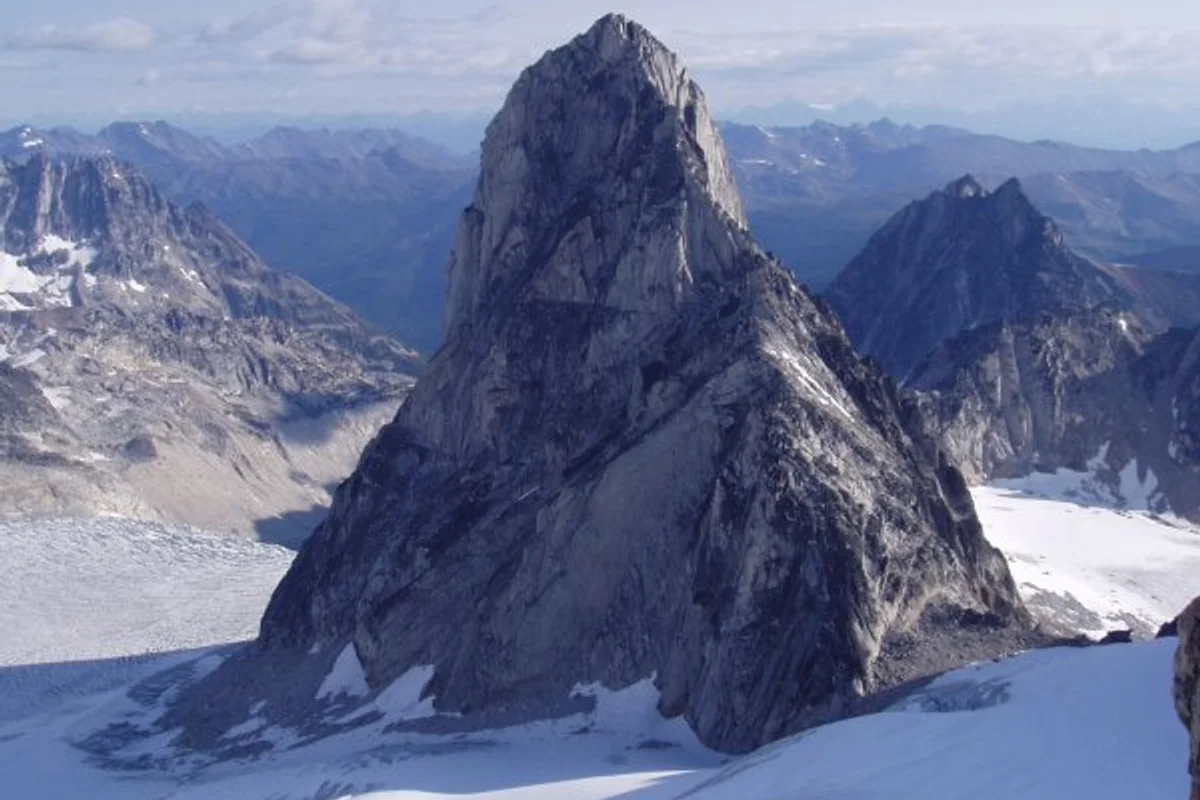
When Dominion surveyors and early climbers first glimpsed the immense spires from distant passes, they considered them climbing impossibilities. Among them, Bugaboo Spire (3,204 m) stood out as a terrifying razor-sharp tooth of golden granite whose southern ridge rose like the blade of a broadsword into the thin mountain air.
To Austrian guide Conrad Kain, who had already conquered Mount Robson, the granite needles of the Bugaboos were an irresistible siren call. In late August 1916, Kain arrived at the base of the spire alongside his favorite climbing companions: Albert MacCarthy and his intrepid wife Bess MacCarthy.
Assault on the Knife-Edge Ridge
Departing their timberline camp on August 28, 1916, Kain and the MacCarthys roped together and crossed the lower ice of the Bugaboo Glacier. Scrambling up loose moraine talus, they attained the crest of the South Ridge.
The climbing was immediately breathtaking. For hundreds of feet, the granite arête narrowed until it was barely wide enough to straddle. To their right, sheer cliffs plunged 2,000 vertical feet to the Crescent Glacier; to their left, smooth slabs dropped toward Bugaboo Creek.
Kain moved with cat-like balance and grace, placing natural rock runners and jamming his hands into pristine granite splitters. The weather was crisp and calm, the granite warm under the late summer sun.
The Impasse of the Gendarme
Near the 10,000-foot mark, the ridge came to an abrupt, terrifying halt. Blocking all forward progress was an enormous vertical granite monolith known today as the Gendarme.
The obstacle was formidable: a sheer, 100-foot pillar of smooth, unweathered granite that completely overhung the southern knife-edge. To attempt to bypass it on the eastern flank meant venturing onto rotten, overhang-swept ledges; to bypass it on the west meant confronting blank, frictionless slabs above a bottomless void.
Albert MacCarthy, an experienced mountaineer, stared up at the sheer block and suggested that they had reached the end of their journey. Kain fell silent, carefully inspecting the vertical granite with the discerning eye of a sculptor.
He noticed a faint, hairline fissure slicing diagonally across the western face of the monolith, terminating near a tiny, outward-sloping marble-sized edge. But the heavy, hobnailed mountaineering boots they wore were utterly useless on smooth, frictionless granite slabs.
Climbing in Stockinged Feet
Kain made his decision. Unbuckling his heavy leather boots, he removed them and tied them to his belt. Stripping down to his woolen socks, he stepped onto the cold, clean granite.
Moving in stockinged feet allowed Kain to maximize friction against the micro-crystals of quartz and feldspar. With no pitons, no chocks, and no protection of any kind between himself and his belayer, Kain moved out onto the western void.
Clinging to the hairline crease with the tips of his fingers, Kain executed a sequence of delicate, gymnastic friction moves that pushed the technical standards of North American rock climbing decades ahead of his era. Modern climbers grade this pitch at 5.7 to 5.8—an astonishing difficulty for a guide leading in woolen socks with an unanchored hemp rope in 1916.
With a final dynamic mantel onto a sloping shelf, Kain pulled himself over the top of the Gendarme. Anchoring the rope around a solid granite horn, he shouted down to MacCarthy and his wife with joy: “Come on! The way is open!”
An Untarnished Summit
With Kain protecting them from above on a snug rope, Albert and Bess MacCarthy negotiated the pitch and joined their guide on the crest.
Above the Gendarme, the terrain relented. Scrambling along the final airy granite blocks, the trio stepped onto the summit of Bugaboo Spire at mid-afternoon.
Surrounded by the staggering granite amphitheater of Snowpatch Spire, the Pigeon Spire, and the Howser Towers, Kain looked out across the Purcell Range with profound contentment. He built a small stone cairn and left their names inside a tin container.
The descent was completed safely before dusk via rappels and careful down-climbing. Kain’s bold ascent of Bugaboo Spire proved that the great granite monoliths of North America could be mastered by pure free-climbing courage and technical finesse. It remains celebrated to this day as one of the purest and most visionary rock ascents in alpine history.
Key Statistics & Topographic Figures
- Category
- Pioneering Rock Ascents
Archival Subject
- Reading Time
- 15 min read
Narrative Length
- Key Mountain
- the high mountains
Objective
- Ascent Route
- the ascent route
Topography
- Verification
- Editorially Verified
Archival Standard
Archival Primary Source Quotations
“In the mountains, truth is etched in ice and granite; every step requires unwavering respect for the heights.”
Defined Alpine Terminology & Concepts
- Summit Push
- The final continuous climbing effort from the highest established camp to the mountain apex and back.
- Death Zone Chronicle
- A verified, research-backed historical narrative documenting the human, technical, and environmental realities of an alpine expedition.
Frequently Asked Questions: The Stockinged Master: Conrad Kain on the Granite Gendarme of Bugaboo Spire
What is the core chronicle and subject of "The Stockinged Master: Conrad Kain on the Granite Gendarme of Bugaboo Spire"?
In August 1916, Conrad Kain took off his boots and scaled a sheer, featureless granite tower in stockinged feet to complete the first ascent of Bugaboo Spire in the Purcell Mountains.
Which mountain peaks and routes are featured in "The Stockinged Master: Conrad Kain on the Granite Gendarme of Bugaboo Spire"?
This narrative documents climbs on the high mountains along the the ascent route in Canada.
Which documented expedition is chronicled in this story?
This historical chronicle captures the events of the 1916-conrad-kain-bugaboo-spire, verified through contemporary journals and archival records.
Who authored and researched this archival chronicle?
Authored and researched by Mountainity Historical Research Desk, drawing on primary eyewitness testimonies, alpine club registries, and verified summit logs.
What makes this high-altitude chronicle historically significant?
Categorized under "Pioneering Rock Ascents", this chronicle preserves critical lessons in alpine leadership, survival, tactical speed, and human endurance in the death zone.
Documented Sources & Archival Citations
- Where the Clouds Can Go(Conrad Kain / The American Alpine Club)
Supporting claim: Official narrative detailing the landmark 1916 first ascent of Bugaboo Spire
Accessed/Documented: 2026 - The Bugaboos(Chris Atkinson and Marc Piche / Elaho Press)
Supporting claim: Comprehensive climbing history and route descriptions for Bugaboo Spire
Accessed/Documented: 2026