The Swiss Guardians of the Rockies: Edward Feuz Jr. and the CPR Guiding Golden Age
Throughout four decades of early twentieth-century mountaineering, Edward Feuz Junior and the Swiss guides of the Canadian Pacific Railway led over 100 first ascents in the Canadian Rockies with a flawless safety record.
Mountain Safety & Conditions Disclaimer: High-altitude climbing, glacial travel, and technical ascents entail severe objective risks including avalanches, serac collapses, rapid weather collapse, and altitude illness. Historical route descriptions and summit claims on Mountanity reflect documented archival sources and must not be used as live operational safety assessments. Local regulations, permits, and physical glacial topography change continuously.
Peer Review: Senior Editorial Board & Historical Reviewers • Editorial Standards
The Birth of Professional Guiding in Canada
In the late summer of 1896, a prominent American mountaineer named Philip Stanley Abbot slipped from a cliff near the summit of Mount Lefroy near Lake Louise and fell to his death—the first recorded fatal mountaineering accident in the Canadian Rockies.
The tragedy sent shockwaves through the executive offices of the Canadian Pacific Railway (CPR). The railway had invested millions in building luxury chateaus and promoting tourism along its transcontinental line, and company president William Van Horne recognized that climbing wild, glaciated limestone peaks without professional guidance was an existential liability.
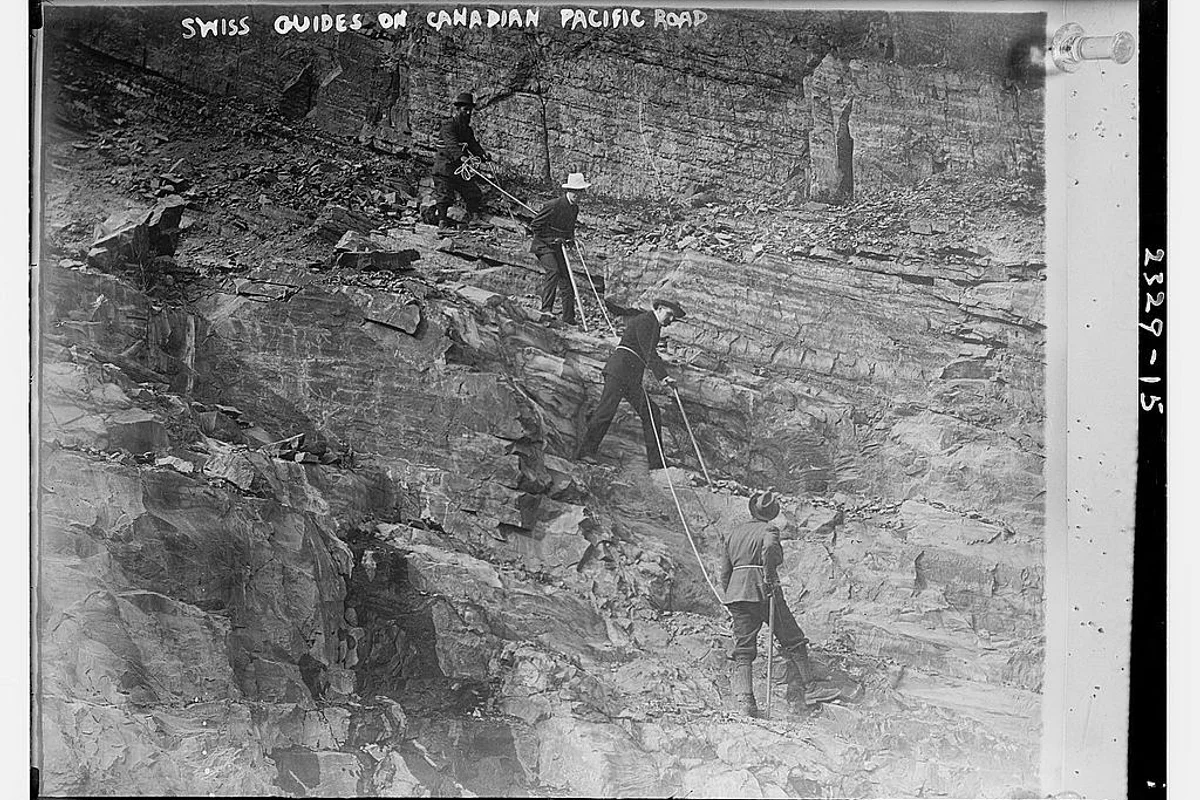
The CPR’s solution was visionary: import certified mountain guides directly from the Swiss Alps. In 1899, two master guides from Interlaken—Peter Sarbach and Edward Feuz Senior—stepped off the train at Lake Louise, equipped with traditional coiled hemp ropes, heavy woolen coats, and ice axes.
Among the young boys who followed their fathers across the Atlantic was nineteen-year-old Edward Feuz Junior. Arriving in 1903, young Feuz was destined to become the dean of Swiss mountain guides in Canada and the undisputed symbol of professional mountain safety.
The Swiss Village of Edelweiss
To encourage the guides to settle permanently in Canada with their families, the Canadian Pacific Railway constructed an authentic alpine village named Edelweiss on a scenic hillside overlooking Golden, British Columbia, in 1911.
Featuring six traditional Bernese Oberland chalets with ornate wooden balconies and steep gabled roofs, Edelweiss became the vibrant cultural hub of Canadian mountaineering. From this mountain colony, Edward Feuz Junior, along with fellow Swiss stalwarts Rudolph Aemmer, Christian Kaufmann, and Ernest Feuz, traveled daily to CPR hotels at Banff Springs, Chateau Lake Louise, and Mount Stephen House in Field.
Each morning, the Swiss guides gathered on the hotel terraces, inspecting the boots, clothing, and stamina of prospective climbers. Dressed in spotless tweed jackets and Swiss felt hats with edelweiss blooms pinned to their bands, they instilled absolute confidence in even the most timid tourists.
Pioneering Over One Hundred Summits
While guiding paying railway guests was their livelihood, Feuz and his peers were driven by an unquenchable passion for pioneer exploration. Between 1903 and 1945, Edward Feuz Junior completed more than one hundred first ascents across the Canadian Rockies, the Selkirks, and the Purcells.
His most celebrated triumph occurred in July 1912 on Mount Sir Sandford (3,519 m), the highest peak in the Selkirk Mountains. The peak had defeated six prior expeditions due to its dense, impenetrable devil’s club valleys and hanging icefalls. Guiding American explorer Howard Palmer, Feuz methodically carved a route through the precarious séracs of the Sandford Glacier and led the team onto the narrow snow summit.
Feuz also pioneered first ascents on Mount Goodsir North Tower, Mount Tupper, and Mount Champlain, while establishing classical routes on Mount Victoria and Mount Lefroy that remain standard mountaineering testpieces to this day.
The Flawless Safety Record
What set Edward Feuz Junior apart in the annals of world mountaineering was his unmatched standard of safety.
Operating in an era before modern weather forecasting, lightweight nylon ropes, helicopters, or cellular radios, Feuz had to rely entirely on his keen reading of cloud formations, the barometric feel of the air, and an uncanny ability to hear the subtle groaning of unstable snowpack.
If Feuz detected the slightest hint of afternoon thunderstorms or snowbridge softening, he turned his party around without hesitation, regardless of client protests. On the descent, Feuz’s rope management was legendary: he kept the hemp rope taut at every second, anticipating every stumble or slip on treacherous scree.
Across forty-six years of continuous technical guiding—leading more than a thousand climbers up glaciated peaks and crumbling limestone headwalls—Edward Feuz Junior never lost a single client on his rope.
An Enduring Alpine Heritage
Edward Feuz retired from active guiding in 1949, spending the remainder of his long life in Golden, British Columbia, where he was revered as a living treasure of mountain heritage.
When he passed away in 1981 at the age of ninety-six, mountaineers across Canada and Europe mourned the end of an era. The Swiss guides brought not only technique and safety to Canada’s wild west; they brought an ethic of humility, devotion, and reverence for nature that became the foundational spirit of Canadian alpinism.
Key Statistics & Topographic Figures
- Category
- Alpine Guiding Heritage
Archival Subject
- Reading Time
- 15 min read
Narrative Length
- Key Mountain
- the high mountains
Objective
- Ascent Route
- the ascent route
Topography
- Verification
- Editorially Verified
Archival Standard
Archival Primary Source Quotations
“In the mountains, truth is etched in ice and granite; every step requires unwavering respect for the heights.”
Defined Alpine Terminology & Concepts
- Summit Push
- The final continuous climbing effort from the highest established camp to the mountain apex and back.
- Death Zone Chronicle
- A verified, research-backed historical narrative documenting the human, technical, and environmental realities of an alpine expedition.
Frequently Asked Questions: The Swiss Guardians of the Rockies: Edward Feuz Jr. and the CPR Guiding Golden Age
What is the core chronicle and subject of "The Swiss Guardians of the Rockies: Edward Feuz Jr. and the CPR Guiding Golden Age"?
Throughout four decades of early twentieth-century mountaineering, Edward Feuz Junior and the Swiss guides of the Canadian Pacific Railway led over 100 first ascents in the Canadian Rockies with a flawless safety record.
Which mountain peaks and routes are featured in "The Swiss Guardians of the Rockies: Edward Feuz Jr. and the CPR Guiding Golden Age"?
This narrative documents climbs on the high mountains along the the ascent route in Canada.
Which documented expedition is chronicled in this story?
This historical chronicle captures the events of the 1924-feuz-canadian-rockies-guiding-golden-age, verified through contemporary journals and archival records.
Who authored and researched this archival chronicle?
Authored and researched by Mountainity Historical Research Desk, drawing on primary eyewitness testimonies, alpine club registries, and verified summit logs.
What makes this high-altitude chronicle historically significant?
Categorized under "Alpine Guiding Heritage", this chronicle preserves critical lessons in alpine leadership, survival, tactical speed, and human endurance in the death zone.
Documented Sources & Archival Citations
- The Guiding Spirit(Andrew J. Kauffman and William L. Putnam / Footprint Publishing)
Supporting claim: Primary biography documenting Edward Feuz Junior and the CPR Swiss guides
Accessed/Documented: 2026 - Swiss Guides in the Canadian Rockies(Parks Canada Historical Series)
Supporting claim: Official heritage report on the Swiss guiding legacy in Banff and Yoho national parks
Accessed/Documented: 2026