Alone at 8,570 Meters: Edward Norton's 1924 Everest Record That Stood for 54 Years
On June 4, 1924, British officer Edward Norton traversed solo into the Great Couloir of Everest to reach 8,570 meters without supplemental oxygen, setting a world record that stood unbroken until 1978.
Mountain Safety & Conditions Disclaimer: High-altitude climbing, glacial travel, and technical ascents entail severe objective risks including avalanches, serac collapses, rapid weather collapse, and altitude illness. Historical route descriptions and summit claims on Mountanity reflect documented archival sources and must not be used as live operational safety assessments. Local regulations, permits, and physical glacial topography change continuously.
Peer Review: Senior Editorial Board & Historical Reviewers • Editorial Standards
In the popular imagination of mountaineering history, the 1924 British Mount Everest Expedition is almost universally remembered for a single, haunting tragedy: the disappearance of George Mallory and Andrew Irvine high on the Northeast Ridge on June 8. Yet four days before Mallory and Irvine vanished into the mists of legend, another British climber accomplished a feat of physical fortitude and high-altitude exploration that arguably stands as one of the greatest achievements in human history.
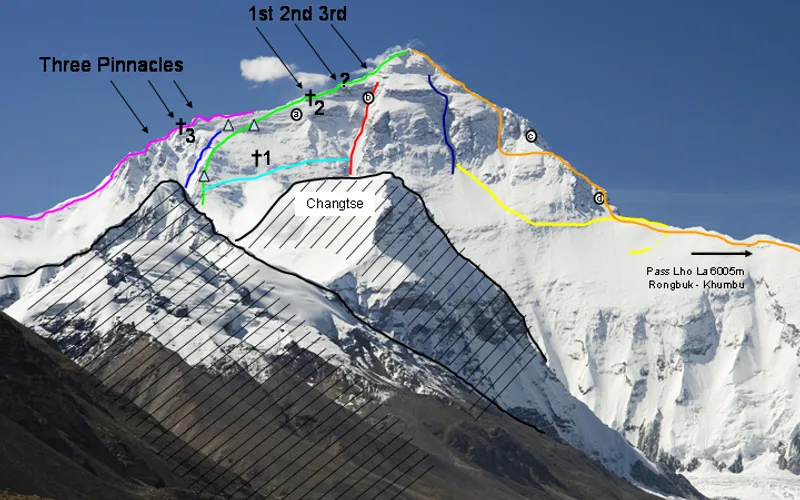
His name was Lieutenant Colonel Edward Felix Norton. On June 4, 1924, climbing without supplemental oxygen, wearing tweed jackets, gabardine woolens, and nailed leather boots, Norton pushed solo across the dizzying limestone slabs of the North Face into the Great Couloir, reaching an altitude of 8,570 meters (28,126 feet).
Norton’s calculated altitude stood as the absolute world record for human survival and movement without supplemental bottled oxygen for fifty-four years—until Reinhold Messner and Peter Habeler finally stepped onto the summit of Everest in May 1978.
The General Who Stepped Up
Edward Felix Norton, born in 1884, was a career artillery officer in the British Army who had honed his mountaineering craft on the granite peaks of the Alps. Soft-spoken, immensely cultured, and an accomplished landscape artist, Norton was widely respected by his men for his calm judgment, empathy for Sherpa porters, and indefatigable physical stamina.
During the 1922 expedition, Norton had reached 8,225 meters on Everest without bottled oxygen alongside Mallory and Somervell. When the 1924 expedition set out across the arid Tibetan plateau, Norton was second-in-command to Brigadier General Charles Bruce. But when Bruce was struck down by a crippling bout of malaria in Sikkim, the burden of expedition leadership fell squarely upon Norton’s shoulders.
Norton managed the crisis with military precision. Traversing the East Rongbuk Glacier, he oversaw the establishment of Advanced Base Camp beneath the North Col (7,020m) and personally led the rescue of four porters trapped on the col during an unexpected blizzard.
The Oxygenless Push: June 4, 1924
While Mallory was convinced that the summit could only be achieved with the mechanical assistance of heavy, finicky oxygen apparatus, Norton and his climbing companion, surgeon-artist Dr. Howard Somervell, chose to climb without bottled gas, relying purely on natural respiration.
On June 3, Norton, Somervell, and three Sherpa porters fought their way up the steep yellow slabs of the North Face to establish Camp VI at an altitude of 8,140 meters—a single tiny tent pitched on an inhospitable, sloping rock ledge.
At 6:40 AM on June 4, Norton and Somervell emerged into the thin, freezing Tibetan air. The physical toll was agonizing. Somervell suffered from severe altitude-induced pharyngitis; his throat was raw and constricted, forcing him to stop every few steps to cough up bloody mucus.
By noon, the pair had reached an elevation of 8,534 meters (28,000 ft) beneath the yellow limestone band. Here, Somervell’s larynx collapsed in a violent spasm of coughing, leaving him unable to proceed. Urging Norton to continue alone, Somervell sat down on a ledge to wait.
The Great Couloir: 8,570 Meters
Norton pressed onward alone into the high unknown. Rather than climbing directly up the shattered, vertical crest of the Northeast Ridge, Norton traversed diagonally across the sloping limestone slabs of the North Face toward the deep, shadowed cleft known as the Great Couloir (later christened the Norton Couloir in his honor).
The terrain was treacherous. The yellow limestone beds were tilted downward like roof tiles, covered in a treacherous dusting of fine, powdery snow that provided no purchase for the nails in his boots. Norton had to remove his tinted goggles to see the delicate footholds through the murky light, exposing his retinas to blinding ultraviolet radiation.
Inside the couloir, Norton found himself wading through waist-deep, unconsolidated powder snow. Every breath was a rasping battle for life. He later recorded that it required twenty or thirty gasping breaths for every single upward step.
At 1:00 PM, at an altitude verified by theodolite survey at 8,570 meters (28,126 ft)—less than 280 vertical meters below the summit of Everest—Norton stopped. He was suffering from acute photophthalmia (snow-blindness) and knew that if he continued any further, he would lack the physical coordination to negotiate the treacherous down-sloping slabs on descent.
With absolute clarity of mind, Norton turned around. Rejoining Somervell, the pair began an agonizing descent to Camp IV on the North Col. By the time they reached safety, Norton was completely blind, a condition that lasted for three days.
A Half-Century Landmark
Four days later, Mallory and Irvine disappeared on their fateful summit bid, overshadowing Norton’s staggering feat in the newspapers of the era.
Yet among mountaineering historians, Edward Norton’s solo traverse into the Great Couloir remains one of the crowning achievements in the history of human exploration. Without modern weather forecasting, without down suits, without fixed ropes, and without supplemental oxygen, Norton pushed human physiology into a realm where science insisted man could not survive.
His 8,570-meter mark stood unbroken across five decades, serving as the ultimate testament to human willpower on the greatest mountain on Earth.
Key Statistics & Topographic Figures
- Category
- Pre-WWII Himalayan Pioneers
Archival Subject
- Reading Time
- 12 min read
Narrative Length
- Key Mountain
- mount-everest
Objective
- Ascent Route
- everest-northeast-ridge
Topography
- Verification
- Editorially Verified
Archival Standard
Archival Primary Source Quotations
“In the mountains, truth is etched in ice and granite; every step requires unwavering respect for the heights.”
Defined Alpine Terminology & Concepts
- Summit Push
- The final continuous climbing effort from the highest established camp to the mountain apex and back.
- Death Zone Chronicle
- A verified, research-backed historical narrative documenting the human, technical, and environmental realities of an alpine expedition.
Frequently Asked Questions: Alone at 8,570 Meters: Edward Norton's 1924 Everest Record That Stood for 54 Years
What is the core chronicle and subject of "Alone at 8,570 Meters: Edward Norton's 1924 Everest Record That Stood for 54 Years"?
On June 4, 1924, British officer Edward Norton traversed solo into the Great Couloir of Everest to reach 8,570 meters without supplemental oxygen, setting a world record that stood unbroken until 1978.
Which mountain peaks and routes are featured in "Alone at 8,570 Meters: Edward Norton's 1924 Everest Record That Stood for 54 Years"?
This narrative documents climbs on mount-everest along the everest-northeast-ridge in China.
Which documented expedition is chronicled in this story?
This historical chronicle captures the events of the 1924-british-everest, verified through contemporary journals and archival records.
Who authored and researched this archival chronicle?
Authored and researched by Mountainity Historical Research Desk, drawing on primary eyewitness testimonies, alpine club registries, and verified summit logs.
What makes this high-altitude chronicle historically significant?
Categorized under "Pre-WWII Himalayan Pioneers", this chronicle preserves critical lessons in alpine leadership, survival, tactical speed, and human endurance in the death zone.
Related Mountains



Mount Everest
Mount Everest is the highest mountain above sea level on Earth, standing at an official elevation of 8,848.86 meters (29,031.7 ft). Straddling the international frontier between Nepal and China, it is known locally as Sagarmatha in Nepali ('Goddess of the Sky') and Chomolungma in Tibetan ('Mother Goddess of the World'). The peak rises into the extreme upper troposphere, where oxygen levels drop to barely one-third of sea-level pressure. Climbers face hurricane-force jet stream winds, severe frostbite conditions, shifting ice crevasses in the Khumbu Icefall, and the dangerous Death Zone above 8,000 meters.
Documented Sources & Archival Citations
- The Fight for Everest: 1924(Lt. Col. E.F. Norton / Edward Arnold & Co.)
Supporting claim: Primary expedition narrative documenting Norton's 8,570m climb in the Great Couloir
Accessed/Documented: 1925 - Geographical Journal: The 1924 Mount Everest Expedition(Royal Geographical Society)
Supporting claim: Official scientific measurement and verification of Norton's altitude record
Accessed/Documented: 1924