The Silver Ice Axe: Aritsune Maki and the 1925 First Ascent of Mount Alberta
Aritsune Maki leads an elite Japanese Alpine Club party to the Canadian Rockies in 1925 to conquer the sheer limestone citadel of Mount Alberta.
Mountain Safety & Conditions Disclaimer: High-altitude climbing, glacial travel, and technical ascents entail severe objective risks including avalanches, serac collapses, rapid weather collapse, and altitude illness. Historical route descriptions and summit claims on Mountanity reflect documented archival sources and must not be used as live operational safety assessments. Local regulations, permits, and physical glacial topography change continuously.
Peer Review: Senior Editorial Board & Historical Reviewers • Editorial Standards
The Impregnable Fortress of the Canadian Rockies
In the remote wilderness of Jasper National Park, rising between the Columbia Icefield and the Sunwapta River, stands Mount Alberta (3,619 m). Described by early cartographers as a colossal black tooth of limestone thrusting violently into the sky, Mount Alberta was the most feared unclimbed peak in North America during the 1920s.
Unlike the granitic spires of the Bugaboos or the glaciated domes of Mount Robson, Alberta was composed of horizontally bedded, shattered limestone that sloped downward like decaying shingles on a roof. Every ledge was blanketed with loose shale; every chimney wept with freezing meltwater; and violent stonefall swept its vertical ramparts without warning. Famed surveyor Arthur Wheeler had inspected the peak and declared: ‘It is the grimmest and most terrible rock tower in the Rockies; it will not be climbed in our lifetime.’
Four years after his triumphant first ascent of the Eiger’s Mittellegi Ridge, Aritsune Maki accepted the challenge. As a senior leader of the Japanese Alpine Club, Maki believed that Japanese mountaineering had matured enough to launch its own independent, international expedition into the uncharted wilderness of North America.
Journey into the Athabasca Wilds
In June 1925, Maki assembled an expedition comprising six elite Japanese climbers: Seishi Hashimoto, Hatano, Yukio Mita, Masanobu Hayakawa, Toranosuke Okabe, and himself. To provide master guiding support in the Canadian backcountry, Maki hired two legendary Swiss guides living in Canada: Heinrich Fuhrer and Hans Kohler.
The logistical barrier was immense. The expedition traveled by steamship across the Pacific to Vancouver, boarded the Canadian Pacific Railway to Jasper, and then hired horse pack-trains to penetrate ninety miles into the trackless wilderness. For weeks, the team slashed trails through dense muskeg bogs, forded swollen glacial torrents, and packed heavy loads over Woolley Shoulder to pitch Base Camp in a desolate moraine cirque directly below Mount Alberta’s vertical northeast face.
Before departing Tokyo, Prince Chichibu, the brother of the Emperor of Japan and a passionate patron of the Japanese Alpine Club, had presented Maki with a priceless gift: an exquisitely forged, custom silver-plated ice axe, inscribed with the imperial chrysanthemum crest. Maki vowed that if they conquered Alberta, the silver axe would be planted atop the virgin peak.
Sixteen Hours on the Vertical Wall
On July 21, 1925, at 3:30 AM, Maki, Fuhrer, Kohler, Hashimoto, Hatano, and Mita stepped onto the rock face.
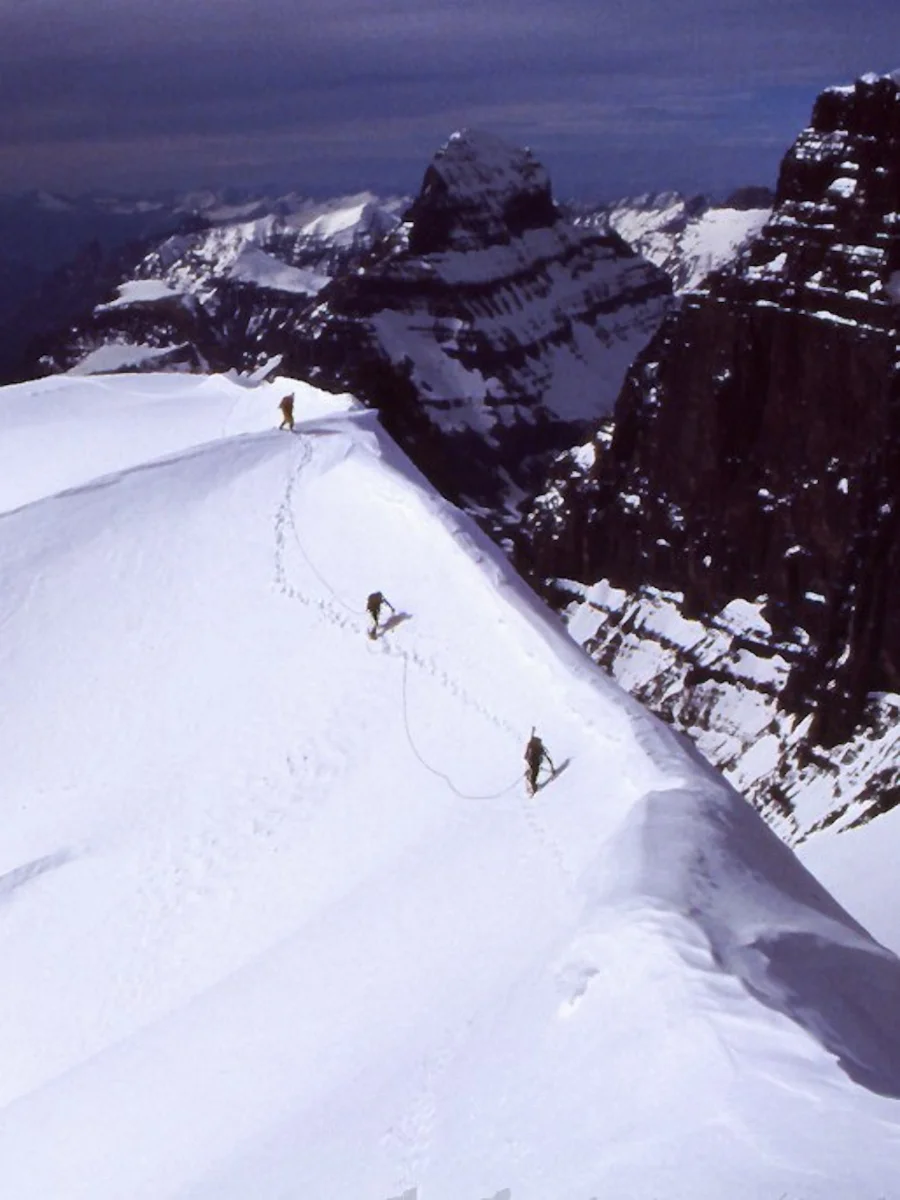
The climbing was harrowing from the opening pitch. Fuhrer and Kohler led the route, using steel pitons and hammer-driven wedges to secure belays across crumbling limestone slabs. Handholds broke off in climbers’ fingers; loose scree cascaded into the void below. As afternoon approached, a sudden alpine blizzard struck the mountain, coating the vertical cliffs with a lethal glaze of verglas ice.
Refusing to retreat, the team pressed up a narrow, overhanging chimney choked with black ice. In an astounding display of endurance, Heinrich Fuhrer pulled through the final overhang, anchoring a hemp rope for the exhausted climbers. At 7:30 PM, after sixteen uninterrupted hours of desperate technical climbing, all six men pulled themselves onto the razor summit ridge of Mount Alberta.
They stood atop Canada’s fiercest mountain. Surrounding them in the fading twilight lay the colossal icefields of the Continental Divide, glowing cold and silent in the dusk.
The Legend of the Silver Axe
Knowing that darkness was falling and a terrifying descent awaited them, the team had only minutes on the summit. Maki gathered his companions beside the summit cairn. Holding aloft Prince Chichibu’s silver ice axe, Maki drove the steel pick deep into a fracture in the summit limestone, anchoring it firmly into the rock. Attached to the shaft was a carved wooden cylinder containing the names of the Japanese climbers and Swiss guides.
The descent was an epic trial of survival. Trapped by darkness, the six men endured an unprotected, freezing bivouac standing on an eighteen-inch rock ledge in sub-zero winds. Miraculously, all six climbers survived the night and returned safely to Base Camp the following day without a single injury.
For twenty-three years, the legend of the Silver Ice Axe captivated the mountaineering world. Many skeptics in North America doubted whether the Japanese team had truly reached the summit, claiming no human could have survived the vertical wall in 1925.
The mystery was finally settled on July 21, 1948—exactly twenty-three years to the day after Maki’s ascent—when an elite team of American climbers led by Fred Ayres and John Oberlin completed the second ascent of Mount Alberta. There, standing proudly amidst the summit stones, they found Aritsune Maki’s silver ice axe, weathered by twenty-three years of Rocky Mountain storms.
Today, that iconic silver axe resides in the Whyte Museum of the Canadian Rockies in Banff—an eternal symbol of Japanese alpine audacity and international mountain brotherhood.
Key Statistics & Topographic Figures
- Category
- North American Pioneers
Archival Subject
- Reading Time
- 18 min read
Narrative Length
- Key Mountain
- the high mountains
Objective
- Ascent Route
- the ascent route
Topography
- Verification
- Editorially Verified
Archival Standard
Archival Primary Source Quotations
“In the mountains, truth is etched in ice and granite; every step requires unwavering respect for the heights.”
Defined Alpine Terminology & Concepts
- Summit Push
- The final continuous climbing effort from the highest established camp to the mountain apex and back.
- Death Zone Chronicle
- A verified, research-backed historical narrative documenting the human, technical, and environmental realities of an alpine expedition.
Frequently Asked Questions: The Silver Ice Axe: Aritsune Maki and the 1925 First Ascent of Mount Alberta
What is the core chronicle and subject of "The Silver Ice Axe: Aritsune Maki and the 1925 First Ascent of Mount Alberta"?
Aritsune Maki leads an elite Japanese Alpine Club party to the Canadian Rockies in 1925 to conquer the sheer limestone citadel of Mount Alberta.
Which mountain peaks and routes are featured in "The Silver Ice Axe: Aritsune Maki and the 1925 First Ascent of Mount Alberta"?
This narrative documents climbs on the high mountains along the the ascent route in Canada.
Which documented expedition is chronicled in this story?
This historical chronicle captures the events of the 1925-maki-mount-alberta-first-ascent, verified through contemporary journals and archival records.
Who authored and researched this archival chronicle?
Authored and researched by Aritsune Maki, drawing on primary eyewitness testimonies, alpine club registries, and verified summit logs.
What makes this high-altitude chronicle historically significant?
Categorized under "North American Pioneers", this chronicle preserves critical lessons in alpine leadership, survival, tactical speed, and human endurance in the death zone.
Documented Sources & Archival Citations
- The Ascent of Mount Alberta(Canadian Alpine Journal / Aritsune Maki)
Supporting claim: Primary official expedition report of the first ascent of Mount Alberta
Accessed/Documented: 1926