Guardian of the Altiplano: Hans Ertl and the 1950 Conquest of Illimani South Peak
In April 1950, German mountaineer and cinematographer Hans Ertl unlocked the towering, corniced South Peak of Nevado Illimani (6,438 m), establishing modern high-altitude alpinism in the Bolivian Andes.
Mountain Safety & Conditions Disclaimer: High-altitude climbing, glacial travel, and technical ascents entail severe objective risks including avalanches, serac collapses, rapid weather collapse, and altitude illness. Historical route descriptions and summit claims on Mountanity reflect documented archival sources and must not be used as live operational safety assessments. Local regulations, permits, and physical glacial topography change continuously.
Peer Review: Senior Editorial Board & Historical Reviewers • Editorial Standards
The White Sentinel of La Paz
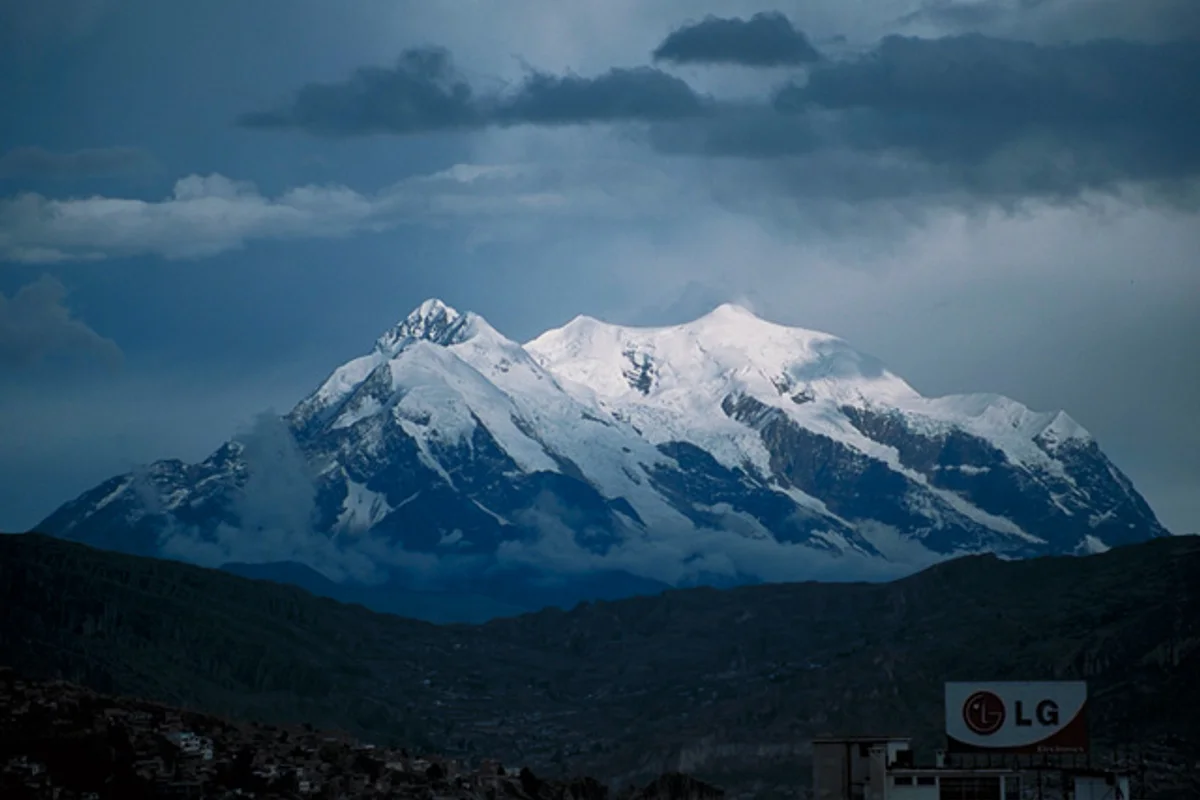
Towering majestically on the eastern horizon of the Bolivian Altiplano, Nevado Illimani (6,438 m) is the undisputed crown of the Cordillera Real. With its massive eight-kilometer-long summit ridge draped in hanging glaciers and corniced ice towers, the mountain commands the high-altitude landscape, visible from hundreds of miles across the altiplano and dominating the sky above the world’s highest capital city, La Paz. Revered by indigenous Aymara people as a sacred protector spirit (Apu), Illimani had long captivated European explorers.
While British mountaineer Sir William Martin Conway had reached the northern summit in 1898, the slightly higher, far steeper, and infinitely more treacherous South Peak—Picacho del Sur—remained unclimbed. Guarded by chaotic icefalls, fragile snow cornices, and ferocious winds sweeping upward from the Amazon basin, the South Peak was regarded as the ultimate prize in Bolivian mountaineering.
In 1948, Hans Ertl immigrated to Bolivia from war-torn Germany. A master mountaineer who had made the first solo ascent of the terrifying North Face of the Königspitze in 1930, and one of the world’s foremost mountain documentary cinematographers, Ertl found in the unmapped peaks of the Andes a pristine wilderness where an alpine pioneer could make history.
Into the Cordillera Real
In early April 1950, Ertl mounted an expedition to tackle the South Peak. Accompanied by fellow German climber Gert Schroeder and supported by local Aymara porters, Ertl approached Illimani from the village of Cohoni, trekking up the arid, terraced valleys that rise abruptly from the subtropical Yungas.
Establishing a base camp at 4,600 metres beside the moraine of the southwest glacier, Ertl spent several days studying the immense ice wall above. Unlike the dry, stable granitic peaks of the Western Cordillera, Illimani was subject to sudden thermal shifts: intense solar radiation by day rapidly weakened snow bridges, while sub-zero nights froze the ice into glass-hard armor.
Carrying heavy packs loaded with hemp climbing ropes, wooden ice axes, canvas bivouac sheets, and early camera gear, Ertl and Schroeder pushed high onto the glaciated southwest slopes, establishing a high camp at 5,600 metres on a narrow snow shelf beneath the summit headwall.
Navigating the Amazonian Cornices
On the morning of April 24, 1950, beneath a cloudless blue sky, Ertl and Schroeder began their final assault on the South Peak. The climbing was immediately technical. Bridging across a cavernous bergschrund on a delicate snow bridge, Ertl kicked steps up a sustained fifty-five-degree ice slope leading toward the southwest ridge.
As they gained the high crest, they were confronted by one of the most terrifying phenomena in Andean mountaineering: giant, overhanging rime cornices formed by moisture rising from the Amazon rainforest. These fragile, curving snow eaves extended dozens of feet out over the four-thousand-foot vertical abyss of the eastern face. A single misstep onto the overhanging snow would have sent a climber plummeting into the jungle below.
Moving with meticulous precision, Ertl stayed carefully below the fracture line of the cornices, chopping hundreds of bucket steps into the wind-scoured ice with his heavy ice axe. At nearly 6,400 metres, without supplemental oxygen, every blow of the axe required deliberate, rhythmic breathing.
Standing on the Apex
Around midday on April 24, 1950, Hans Ertl pulled himself onto the highest crest of the South Peak of Nevado Illimani. Moments later, Schroeder joined him.
From their 6,438-metre vantage point, the panorama was breathtaking: to the west lay the vast, ochre-tinted plains of the Altiplano and the glittering expanse of Lake Titicaca; to the east, the Andes dropped precipitously into the green, cloud-draped sea of the Amazon basin. Ertl captured the moment on film, recording the triumphant first ascent of Bolivia’s most iconic mountain apex.
Legacy in the High Andes
The first ascent of Illimani South Peak opened a golden era of exploration across the Bolivian Andes. Over the following decade, Ertl went on to explore and conquer virgin summits throughout the Cordillera Real and the Apolobamba, including Mount Campamento.
Three years later, Ertl’s alpine prowess and camera mastery would carry him to the Himalayas, where he served as chief cinematographer for Hermann Buhl’s historic solo first ascent of Nanga Parbat in 1953. Yet his pioneering climb on the glittering crest of Illimani remained his most beloved personal achievement—a masterclass in high-altitude exploratory alpinism on the roof of Bolivia.
Key Statistics & Topographic Figures
- Category
- Andean Alpine Legends
Archival Subject
- Reading Time
- 14 min read
Narrative Length
- Key Mountain
- the high mountains
Objective
- Ascent Route
- the ascent route
Topography
- Verification
- Editorially Verified
Archival Standard
Archival Primary Source Quotations
“In the mountains, truth is etched in ice and granite; every step requires unwavering respect for the heights.”
Defined Alpine Terminology & Concepts
- Summit Push
- The final continuous climbing effort from the highest established camp to the mountain apex and back.
- Death Zone Chronicle
- A verified, research-backed historical narrative documenting the human, technical, and environmental realities of an alpine expedition.
Frequently Asked Questions: Guardian of the Altiplano: Hans Ertl and the 1950 Conquest of Illimani South Peak
What is the core chronicle and subject of "Guardian of the Altiplano: Hans Ertl and the 1950 Conquest of Illimani South Peak"?
In April 1950, German mountaineer and cinematographer Hans Ertl unlocked the towering, corniced South Peak of Nevado Illimani (6,438 m), establishing modern high-altitude alpinism in the Bolivian Andes.
Which mountain peaks and routes are featured in "Guardian of the Altiplano: Hans Ertl and the 1950 Conquest of Illimani South Peak"?
This narrative documents climbs on the high mountains along the the ascent route in Bolivia.
Which documented expedition is chronicled in this story?
This historical chronicle captures the events of the 1950-ertl-illimani-south-peak, verified through contemporary journals and archival records.
Who authored and researched this archival chronicle?
Authored and researched by Mountainity Historical Research Desk, drawing on primary eyewitness testimonies, alpine club registries, and verified summit logs.
What makes this high-altitude chronicle historically significant?
Categorized under "Andean Alpine Legends", this chronicle preserves critical lessons in alpine leadership, survival, tactical speed, and human endurance in the death zone.
Documented Sources & Archival Citations
- American Alpine Journal: Andean Climbs by Hans Ertl (1951)(American Alpine Club)
Supporting claim: Documentation of first ascents on Illimani and Cordillera Real peaks
Accessed/Documented: 2026 - Bergvagabunden(Hans Ertl / Nymphenburger Verlagshandlung)
Supporting claim: Primary autobiographical account of early Andean mountaineering and exploration
Accessed/Documented: 2026