The 1953 Ascent of Everest: Hillary, Tenzing, and the Summit of the World
On May 29, 1953, Edmund Hillary and Tenzing Norgay stood atop the highest point on Earth, turning decades of Himalayan failure into mountaineering triumph.
Mountain Safety & Conditions Disclaimer: High-altitude climbing, glacial travel, and technical ascents entail severe objective risks including avalanches, serac collapses, rapid weather collapse, and altitude illness. Historical route descriptions and summit claims on Mountanity reflect documented archival sources and must not be used as live operational safety assessments. Local regulations, permits, and physical glacial topography change continuously.
Peer Review: Senior Editorial Board & Historical Reviewers • Editorial Standards
Decades of Himalayan Shadows
For three decades, Mount Everest stood as the unconquered prize of global exploration. Beginning in 1921, eight British expeditions marched through the high plateau of Tibet to probe the mountain’s northern flank. Men like George Mallory and Andrew Irvine vanished into the clouds near the Second Step in 1924, leaving behind myth, heartbreak, and an aura of invincibility surrounding the peak.
When the political borders of Tibet closed in 1950, mountaineers turned toward the southern approaches of Nepal, which had freshly opened its borders to foreign travelers. In 1951, a reconnaissance party led by Eric Shipton discovered that a viable route existed through the chaotic seracs of the Khumbu Icefall into the elevated hanging valley known as the Western Cwm. A year later, a determined Swiss expedition pushed past the South Col to 8,600 meters, with Sherpa sardar Tenzing Norgay and Raymond Lambert turning back only when their rudimentary open-circuit oxygen units failed.
The stage was set for the spring of 1953.
The Scientific Precision of John Hunt
The 1953 British Mount Everest Expedition was led by Colonel John Hunt, an army officer with extensive Himalayan experience. Hunt approached the mountain with meticulous organization. Rather than relying on romantic notions of high adventure, he collaborated closely with physiologist Griffith Pugh to understand dehydration, oxygen flow rates, acclimatization schedules, and nutrition at high altitudes.
The expedition arrived at the base of the Khumbu Glacier in March 1953 with more than 350 porters, tons of canned rations, and two distinct oxygen systems:
- Closed-circuit units, which recycled exhaled air and theoretically offered pure oxygen, pioneered by Tom Bourdillon.
- Open-circuit units, which blended atmospheric air with a steady flow of bottled oxygen, favored by the New Zealanders for reliability.
Working through April, the team established a ladder of camps through the crumbling ice towers of the Khumbu Icefall and across the blistering snowfields of the Western Cwm. On the steep blue ice of the Lhotse Face, high-altitude Sherpas ferried loads to the wind-blasted plateau of the South Col at 7,925 meters, placing food and sleeping bags on the threshold of the Death Zone.
The First Assault: Bourdillon and Evans
Hunt had planned a two-pronged assault strategy. On May 26, 1953, the first summit team—Charles Evans and Tom Bourdillon—set out from the South Col equipped with the experimental closed-circuit oxygen rigs.
Moving with impressive speed on the Southeast Ridge, Evans and Bourdillon climbed past the snow plateau of the Balcony and reached the South Summit at 8,750 meters by 1:00 PM. They stood higher than any human beings before them. However, Evans’s oxygen apparatus was malfunctioning, freezing valves were threatening suffocation, and clouds were boiling up from the valleys below. Recognizing that continuing along the razor-thin final ridge would result in death, they made the disciplined, agonizing choice to turn back, descending safely to the South Col.
The Solitary Camp at 8,500 Meters
The second assault pair was New Zealand beekeeper Edmund Hillary and Nepali-Tibetan sardar Tenzing Norgay. Both men were at the absolute peak of their physical strength and mental endurance.
On May 28, supported by John Hunt, George Lowe, and Alfred Gregory, Hillary and Tenzing climbed past the South Col and established Camp IX on a tiny, sloping ledge chiseled into rock and snow at 8,500 meters. As their companions descended, Hillary and Tenzing spent a restless night pinned beneath flapping canvas while gale-force winds battered the ridge. Outside, temperatures plunged to minus thirty degrees Celsius.
By dawn on May 29, the storm had quieted. Hillary spent two hours thawing his frozen leather climbing boots over the Primus stove, while Tenzing prepared sweet tea and biscuits. At 6:30 AM, strapping on their reliable open-circuit oxygen masks and tying into a thirty-foot nylon rope, the pair stepped out onto the crusted snow of the ridge.
The Hillary Step: The Final Crucible
Climbing steadily across hard snow, Hillary and Tenzing reached the South Summit by 9:00 AM. Before them stretched the final, unclimbed section of Everest: a knife-edge ridge of corniced snow falling away thousands of feet down the Kangshung Face into Tibet on the right and down the Southwest Face into Nepal on the left.
Carefully chipping steps into the icy crest, Hillary came face to face with the most formidable obstacle on the route: a sheer, 12-meter vertical rock buttress barring the ridge. The rock was smooth and held few natural handholds. However, on its eastern side, Hillary spotted a narrow vertical fissure between the dark rock wall and a massive overhang of wind-packed snow.
Jamming his back against the ice and working his crampons against the rock cracks, Hillary chimneyed his way up the narrow gap inch by inch. After minutes of strenuous effort, he hauled himself over the crest. Tenzing followed up the fixed rope, wriggling through the chimney until both men stood exhausted above the crux. This historic obstacle would forever be named the Hillary Step.
11:30 AM: Standing on Top of the World
Above the step, the ridge curved gently onward, with rounded snow dunes hiding the final horizon. Hillary and Tenzing kept chipping footsteps, expecting another rock wall behind each rise. Suddenly, the snow leveled out.
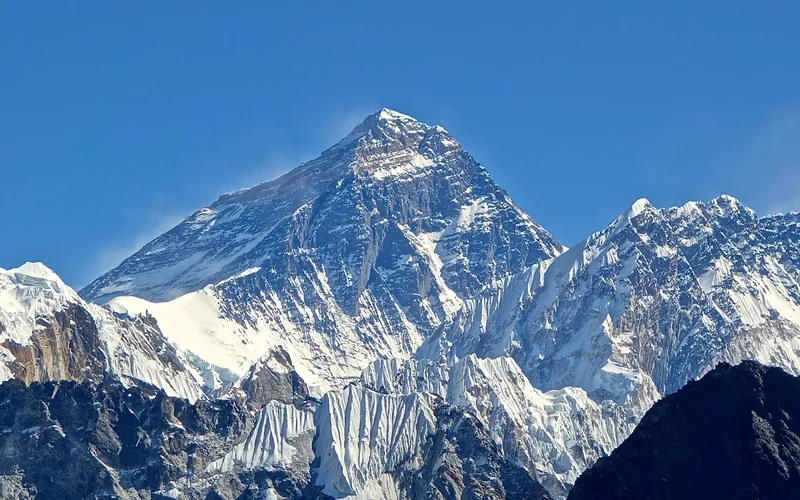
At 11:30 AM on May 29, 1953, Edmund Hillary and Tenzing Norgay took their final steps together onto a small, symmetrical snow dome: the summit of Mount Everest (8,848.86 m).
There were no more slopes to climb. In every direction, the jagged peaks of the Himalayas—Lhotse, Makalu, and Cho Oyu—stretched out beneath their feet like white islands in an ocean of blue sky.
Hillary reached out his hand, but Tenzing threw his arms around him in a warm, tearful embrace. Hillary took out his camera and captured the iconic photograph of Tenzing standing atop the world, raising his ice axe adorned with the flags of the United Nations, Great Britain, Nepal, and India. Tenzing, a devout Buddhist, made a small hollow in the snow and buried an offering of biscuits, chocolate, and a red-and-blue pencil given to him by his daughter. Hillary buried a small crucifix entrusted to him by John Hunt.
After fifteen minutes of breathtaking wonder, they turned to begin the long descent back down the ridge.
A Legacy of Mutual Respect
When the news reached London on the morning of Queen Elizabeth II’s coronation on June 2, 1953, it sparked global celebration. For decades afterward, reporters and politicians pressed the two climbers with the same petty question: Who stepped on the summit first?
Both Hillary and Tenzing steadfastly refused to feed nationalistic rivalries. They maintained that they reached the summit as a united rope team—two partners whose trust, shared sweat, and mutual respect had conquered the highest mountain on Earth. Their climb was not merely a victory of human endurance, but an enduring monument to brotherhood in the high mountains.
Key Statistics & Topographic Figures
- Category
- Expedition History
Archival Subject
- Reading Time
- 7 min read
Narrative Length
- Key Mountain
- mount-everest
Objective
- Ascent Route
- south-col-route
Topography
- Verification
- Editorially Verified
Archival Standard
Archival Primary Source Quotations
“In the mountains, truth is etched in ice and granite; every step requires unwavering respect for the heights.”
Defined Alpine Terminology & Concepts
- Summit Push
- The final continuous climbing effort from the highest established camp to the mountain apex and back.
- Death Zone Chronicle
- A verified, research-backed historical narrative documenting the human, technical, and environmental realities of an alpine expedition.
Frequently Asked Questions: The 1953 Ascent of Everest: Hillary, Tenzing, and the Summit of the World
What is the core chronicle and subject of "The 1953 Ascent of Everest: Hillary, Tenzing, and the Summit of the World"?
On May 29, 1953, Edmund Hillary and Tenzing Norgay stood atop the highest point on Earth, turning decades of Himalayan failure into mountaineering triumph.
Which mountain peaks and routes are featured in "The 1953 Ascent of Everest: Hillary, Tenzing, and the Summit of the World"?
This narrative documents climbs on mount-everest along the south-col-route in Nepal.
Which documented expedition is chronicled in this story?
This historical chronicle captures the events of the 1953-everest-expedition, verified through contemporary journals and archival records.
Who authored and researched this archival chronicle?
Authored and researched by Mountanity Editorial Desk, drawing on primary eyewitness testimonies, alpine club registries, and verified summit logs.
What makes this high-altitude chronicle historically significant?
Categorized under "Expedition History", this chronicle preserves critical lessons in alpine leadership, survival, tactical speed, and human endurance in the death zone.
Related Mountains


Mount Everest
Mount Everest is the highest mountain above sea level on Earth, standing at an official elevation of 8,848.86 meters (29,031.7 ft). Straddling the international frontier between Nepal and China, it is known locally as Sagarmatha in Nepali ('Goddess of the Sky') and Chomolungma in Tibetan ('Mother Goddess of the World'). The peak rises into the extreme upper troposphere, where oxygen levels drop to barely one-third of sea-level pressure. Climbers face hurricane-force jet stream winds, severe frostbite conditions, shifting ice crevasses in the Khumbu Icefall, and the dangerous Death Zone above 8,000 meters.