Everest 1975: The Southwest Face Rock Band and the 8,760m Survival Bivouac
On September 24, 1975, Doug Scott and Dougal Haston unlocked the vertical 300-meter Rock Band on Mount Everest's Southwest Face, standing atop the world and surviving a historic 8,760m open-air bivouac.
Mountain Safety & Conditions Disclaimer: High-altitude climbing, glacial travel, and technical ascents entail severe objective risks including avalanches, serac collapses, rapid weather collapse, and altitude illness. Historical route descriptions and summit claims on Mountanity reflect documented archival sources and must not be used as live operational safety assessments. Local regulations, permits, and physical glacial topography change continuously.
Peer Review: Senior Editorial Board & Historical Reviewers • Editorial Standards
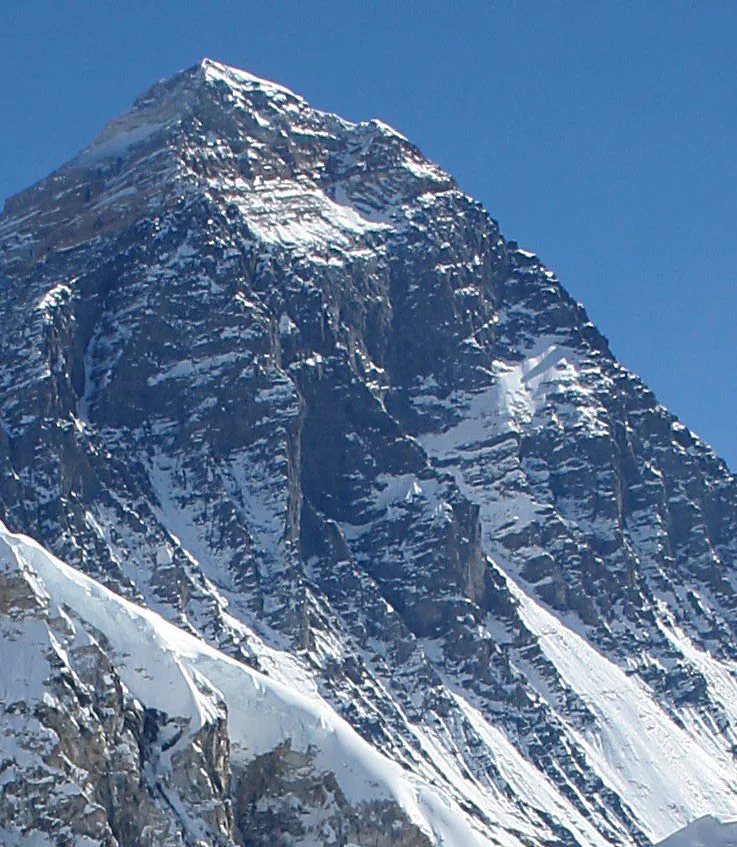
By 1975, Mount Everest had been climbed via the South Col and the North Ridge, but its colossal precipices remained undefeated. Rising 2,300 vertical meters (7,500 feet) from the floor of the Western Cwm to the summit pyramid, the Southwest Face of Everest was revered as the ultimate prize in mountaineering—and the most formidable big wall on Earth.
Between 1969 and 1974, six major international expeditions—including teams led by the Japanese, the Swiss, and an earlier British attempt in 1972—had been repelled by the face. The barrier was the notorious Rock Band: a 300-meter vertical cliff of shattered yellow limestone barring all access to the upper snowfields between 8,200 and 8,500 meters, perched in the heart of the Death Zone.
In autumn 1975, legendary British expedition leader Chris Bonington returned to Everest with an all-star team of British climbers, including Doug Scott, Dougal Haston, Peter Boardman, Nick Estcourt, and Paul Braithwaite, determined to solve the problem through military-style logistics and cutting-edge big-wall engineering.
Unlocking the Rock Band
Operating in post-monsoon conditions, the expedition established Camp II (Advanced Base Camp) in the Western Cwm and methodically fixed ropes up the lower 50-degree ice gullies. At 7,800 meters, they carved out Camp V beneath the looming shadow of the yellow limestone barrier.
On September 20, 1975, Nick Estcourt and Paul Braithwaite launched an audacious attempt to breach the Rock Band. Hauling heavy loads of fixed rope and oxygen cylinders, Estcourt found a narrow, diagonal snow ramp cutting through the vertical rock. In a masterclass of high-altitude rock climbing, Estcourt traversed across rotten limestone slabs and wriggled up an overhanging corner at 8,300 meters, hauling the fixed lines to the top of the band. The fortress had been breached.
Two days later, Camp VI was established above the Rock Band at 8,320 meters—the highest camp ever pitched by human hands at the time.
The Summit Assault: September 24, 1975
The lead summit pair was Doug Scott, a powerful 34-year-old schoolteacher from Nottingham, and Dougal Haston, a brilliant 35-year-old Scottish mountaineer and director of the International School of Mountaineering in Leysin.
Setting out from Camp VI into a bitter wind at 3:30 AM on September 24, Scott and Haston ascended the deep powder slopes of the upper face. Taking turns plowing waist-deep snow, they arrived at the South Summit (8,750m) at 3:00 PM. Before them lay the razor-sharp snow arête of the summit ridge and the sheer obstacle of the Hillary Step.
With afternoon light already waning, most climbers would have turned back to save their lives. But Scott and Haston were men of extraordinary resolve. Scott tackled the vertical rock of the Hillary Step, bridging between the rock wall and the snow cornice. Pushing through the deep summit drifts, Doug Scott and Dougal Haston stepped onto the summit of Mount Everest at 6:00 PM.
They had made the first ascent of Everest’s Southwest Face—and the first British ascent of Mount Everest in history.
Standing in the crimson glow of the setting sun with the shadow of Everest stretching a hundred miles across the Tibetan plateau, they spent an unforgettable twenty minutes photographing each other and the survey tripod before turning to descend.
The Historic 8,760-Meter Survival Bivouac
Night fell with terrifying speed. By the time they reached the South Summit at 8,760 meters, complete blackness enveloped the mountain. Their oxygen bottles were nearly empty, and their headlamps were failing. Attempting to navigate the treacherous knife-edge ridge down to the South Col or back to Camp VI in the dark meant certain death.
Realizing they were trapped, Scott and Haston decided to bivouac. No human had ever survived an open-air bivouac at 8,760 meters. Medical dogma stated that anyone caught above 8,500 meters without shelter and supplemental oxygen would succumb to hypothermia and fatal cerebral edema within hours.
Using their ice axes, Scott and Haston dug a shallow cave into a snow drift beneath the South Summit. The cave was too small to lie down in, so they sat side by side on their foam pads with their knees pulled to their chests. They had no sleeping bags, no tent, and no stove to melt water.
Throughout the long, sub-zero night, as temperatures plunged below -35°C, they engaged in a relentless struggle for survival. They massaged each other’s toes and fingers, spoke continuously to prevent falling into the fatal sleep of hypothermia, and performed isometric muscle tensing. Scott later described experiencing profound spiritual detachment, sensing a warm, comforting presence sitting in the cave that gave them the strength to endure.
Triumph and Tragedy
At dawn on September 25, stiff with frost but miraculously alive and without severe frostbite, Scott and Haston crawled out of their snow hole. Moving with frozen boots, they descended carefully down to Camp VI, where ecstatic teammates greeted them with hot soup.
Two days later, on September 26, teammates Peter Boardman and Pertemba Sherpa reached the summit via the same route. Tragically, second-pair climber Mick Burke, who pushed toward the summit alone in deteriorating weather, disappeared in a blizzard and never returned.
The 1975 conquest of Everest’s Southwest Face remains one of the crowning achievements in British exploration. Doug Scott and Dougal Haston’s triumph proved that the greatest big walls on Earth could be surmounted, and that the human body could endure the absolute extremes of the Death Zone through sheer psychological fortitude.
Key Statistics & Topographic Figures
- Category
- Historic Expeditions
Archival Subject
- Reading Time
- 15 min read
Narrative Length
- Key Mountain
- mount-everest
Objective
- Ascent Route
- everest-southwest-face
Topography
- Verification
- Editorially Verified
Archival Standard
Archival Primary Source Quotations
“In the mountains, truth is etched in ice and granite; every step requires unwavering respect for the heights.”
Defined Alpine Terminology & Concepts
- Summit Push
- The final continuous climbing effort from the highest established camp to the mountain apex and back.
- Death Zone Chronicle
- A verified, research-backed historical narrative documenting the human, technical, and environmental realities of an alpine expedition.
Frequently Asked Questions: Everest 1975: The Southwest Face Rock Band and the 8,760m Survival Bivouac
What is the core chronicle and subject of "Everest 1975: The Southwest Face Rock Band and the 8,760m Survival Bivouac"?
On September 24, 1975, Doug Scott and Dougal Haston unlocked the vertical 300-meter Rock Band on Mount Everest's Southwest Face, standing atop the world and surviving a historic 8,760m open-air bivouac.
Which mountain peaks and routes are featured in "Everest 1975: The Southwest Face Rock Band and the 8,760m Survival Bivouac"?
This narrative documents climbs on mount-everest along the everest-southwest-face in Nepal.
Which documented expedition is chronicled in this story?
This historical chronicle captures the events of the 1975-british-everest-southwest-face, verified through contemporary journals and archival records.
Who authored and researched this archival chronicle?
Authored and researched by Mountainity Historical Research Desk, drawing on primary eyewitness testimonies, alpine club registries, and verified summit logs.
What makes this high-altitude chronicle historically significant?
Categorized under "Historic Expeditions", this chronicle preserves critical lessons in alpine leadership, survival, tactical speed, and human endurance in the death zone.
Related Mountains



Mount Everest
Mount Everest is the highest mountain above sea level on Earth, standing at an official elevation of 8,848.86 meters (29,031.7 ft). Straddling the international frontier between Nepal and China, it is known locally as Sagarmatha in Nepali ('Goddess of the Sky') and Chomolungma in Tibetan ('Mother Goddess of the World'). The peak rises into the extreme upper troposphere, where oxygen levels drop to barely one-third of sea-level pressure. Climbers face hurricane-force jet stream winds, severe frostbite conditions, shifting ice crevasses in the Khumbu Icefall, and the dangerous Death Zone above 8,000 meters.
Documented Sources & Archival Citations
- Everest the Hard Way(Chris Bonington / Hodder & Stoughton)
Supporting claim: Authoritative expedition record detailing the siege, logistics, and summit bivouac
Accessed/Documented: 1976 - Up and About: The Hard Road to Everest(Doug Scott / Vertebrate Publishing)
Supporting claim: Firsthand autobiographical account of the Rock Band climb and 8,760m survival
Accessed/Documented: 2015