The Great Couloir: Lou Whittaker's 1984 American North Face Everest Victory
In October 1984, legendary Rainier guide Lou Whittaker led the historic China-Everest Expedition to the first American ascent of Mount Everest from Tibet. Operating through the Great Couloir and North Col, the team placed Phil Ershler on the summit amidst hurricane-force gales.
Mountain Safety & Conditions Disclaimer: High-altitude climbing, glacial travel, and technical ascents entail severe objective risks including avalanches, serac collapses, rapid weather collapse, and altitude illness. Historical route descriptions and summit claims on Mountanity reflect documented archival sources and must not be used as live operational safety assessments. Local regulations, permits, and physical glacial topography change continuously.
Peer Review: Senior Editorial Board & Historical Reviewers • Editorial Standards
The Cold Walls of the Tibetan Plateau
For decades after the Second World War, the Tibetan approach to Mount Everest remained locked behind closed borders. Western expeditions were confined strictly to the southern routes through Nepal. It was not until the early 1980s, when China began reopening the autonomous region of Tibet to foreign climbing permits, that American mountaineers were finally granted permission to attempt the legendary North Face.
To lead this monumental assault, the American climbing community turned to Lou Whittaker, the venerable patriarch of Rainier Mountaineering Incorporated. While his twin brother Jim had stood atop Everest from the south in 1963, Lou had built RMI into a powerhouse training academy on Mount Rainier, guiding thousands of climbers and mastering the art of high-altitude logistics, safety protocols, and team psychology.
In the autumn of 1984, Whittaker assembled an elite squad of Pacific Northwest guides, including Phil Ershler, Peter Whittaker, Jim Wickwire, and John Roskelley, launching the historic China-Everest Expedition.
The Funnel of the Great Couloir
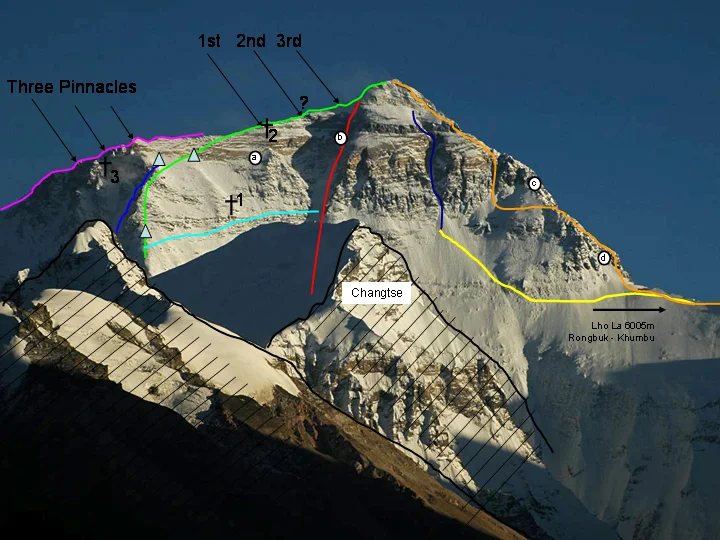
Arriving at the Rongbuk Glacier in August 1984, the team faced an imposing, desolate landscape of shattered moraines and biting winds. Their objective was the formidable North Face, climbing through the North Col (7,020 m) and pioneering a new variation up the Great Couloir, a massive 3,000-foot avalanche funnel slashing directly through the upper yellow limestone cliffs toward the summit.
Under Whittaker’s methodical command, the team established a string of high camps despite relentless autumn gales that threatened to rip canvas shelters from the ice. Jet-stream winds roared constantly across the north face, driving temperatures down to minus forty degrees Fahrenheit and turning routine load-hauling into desperate battles against frostbite.
Whittaker’s deep guiding philosophy centered on preserving human life: no summit was worth the loss of fingers, toes, or a companion. When severe storms pinned the lead climbers down at Camp IV, Whittaker coordinated radio communications, weather forecasts, and oxygen logistics from Advanced Base Camp with calm, unwavering authority.
Ershler’s Lone Push
By mid-October, the autumn weather window was slamming shut. Hurricane-force winds were battering the upper mountain, stripping snow from the rocks and leaving a treacherous glaze of verglas.
On October 20, 1984, thirty-three-year-old guide Phil Ershler, battling severe intestinal illness and freezing gale-force gusts exceeding sixty miles per hour, departed Camp V at 27,000 feet (8,230 m) on a solo summit push. Climbing with single-minded intensity up the shattered limestone bands of the upper north face, Ershler breached the summit ridge.
At 4:40 PM on October 20, 1984, Phil Ershler stood upon the summit of Mount Everest, completing the first American ascent of Everest from the north via Tibet. Through tears and freezing winds, Ershler radioed Base Camp: Lou, I’m on top.
Listening at the radio transceiver thousands of feet below on the Rongbuk Glacier, Lou Whittaker felt the culmination of a lifetime dedicated to the high mountains. His leadership had proven that professional American mountain guides could organize, execute, and triumph on the most demanding, unforgiving big walls in the Himalayas without a single serious injury.
Key Statistics & Topographic Figures
- Category
- Himalayan North Face Epics
Archival Subject
- Reading Time
- 15 min read
Narrative Length
- Key Mountain
- mount-everest
Objective
- Ascent Route
- south-col-route
Topography
- Verification
- Editorially Verified
Archival Standard
Archival Primary Source Quotations
“In the mountains, truth is etched in ice and granite; every step requires unwavering respect for the heights.”
Defined Alpine Terminology & Concepts
- Summit Push
- The final continuous climbing effort from the highest established camp to the mountain apex and back.
- Death Zone Chronicle
- A verified, research-backed historical narrative documenting the human, technical, and environmental realities of an alpine expedition.
Frequently Asked Questions: The Great Couloir: Lou Whittaker's 1984 American North Face Everest Victory
What is the core chronicle and subject of "The Great Couloir: Lou Whittaker's 1984 American North Face Everest Victory"?
In October 1984, legendary Rainier guide Lou Whittaker led the historic China-Everest Expedition to the first American ascent of Mount Everest from Tibet. Operating through the Great Couloir and North Col, the team placed Phil Ershler on the summit amidst hurricane-force gales.
Which mountain peaks and routes are featured in "The Great Couloir: Lou Whittaker's 1984 American North Face Everest Victory"?
This narrative documents climbs on mount-everest along the south-col-route in China.
Which documented expedition is chronicled in this story?
This historical chronicle captures the events of the 1984-whittaker-everest-north-col, verified through contemporary journals and archival records.
Who authored and researched this archival chronicle?
Authored and researched by Mountainity Historical Research Desk, drawing on primary eyewitness testimonies, alpine club registries, and verified summit logs.
What makes this high-altitude chronicle historically significant?
Categorized under "Himalayan North Face Epics", this chronicle preserves critical lessons in alpine leadership, survival, tactical speed, and human endurance in the death zone.
Related Mountains



Mount Everest
Mount Everest is the highest mountain above sea level on Earth, standing at an official elevation of 8,848.86 meters (29,031.7 ft). Straddling the international frontier between Nepal and China, it is known locally as Sagarmatha in Nepali ('Goddess of the Sky') and Chomolungma in Tibetan ('Mother Goddess of the World'). The peak rises into the extreme upper troposphere, where oxygen levels drop to barely one-third of sea-level pressure. Climbers face hurricane-force jet stream winds, severe frostbite conditions, shifting ice crevasses in the Khumbu Icefall, and the dangerous Death Zone above 8,000 meters.
Documented Sources & Archival Citations
- Memoirs of a Mountain Guide(Lou Whittaker with Andrea Gabbard / The Mountaineers Books)
Supporting claim: Detailed narrative of Lou Whittaker's leadership of the 1984 North Face of Everest climb
Accessed/Documented: 2026 - American Alpine Journal: Everest North Face 1984(American Alpine Club)
Supporting claim: Official expedition journal documentation of the first American ascent from Tibet
Accessed/Documented: 2026