Everest 1986: Erhard Loretan and Jean Troillet's 43-Hour Alpine Blitz
In August 1986, Swiss speed alpinists Erhard Loretan and Jean Troillet climbed Mount Everest's North Face in a 31-hour night push without oxygen or tents, glissading down in 3.5 hours for a 43-hour round trip.
Mountain Safety & Conditions Disclaimer: High-altitude climbing, glacial travel, and technical ascents entail severe objective risks including avalanches, serac collapses, rapid weather collapse, and altitude illness. Historical route descriptions and summit claims on Mountanity reflect documented archival sources and must not be used as live operational safety assessments. Local regulations, permits, and physical glacial topography change continuously.
Peer Review: Senior Editorial Board & Historical Reviewers • Editorial Standards
In late August 1986, two young Swiss mountaineers pulled off what many high-altitude purists still consider the most audacious, radical, and athletic ascent in the history of Mount Everest: a non-stop, lightweight speed sprint up the 3,000-meter North Face, completed from Base Camp to summit and back in just 43 hours.
The climbers were twenty-seven-year-old Erhard Loretan, a carpenter and UIAGM mountain guide from the Swiss Pre-Alps, and thirty-eight-year-old Jean Troillet, a rugged mountain guide from the Valais. Both men were physical phenomena, possessing cardiovascular systems conditioned to continuous rapid movement in high alpine terrain.
The Philosophy of the “Naked” Mountain
Traditional Everest expeditions in the 1980s were massive sieges involving tons of equipment, miles of fixed nylon ropes, dozens of high-altitude Sherpas, and hundreds of bottled oxygen canisters.
Loretan and Troillet rejected all of it. They believed that heavy gear was not a safety measure, but an anchor that slowed climbers down, keeping them trapped for weeks in the dangerous objective hazard zone of falling ice and rock. Their philosophy was the complete antithesis: travel ultralight, climb at night, and move with superhuman speed.
They carried no supplemental oxygen, no ropes, no tents, no sleeping bags, and no cooking stoves. In their small twenty-liter daypacks, each man carried only a lightweight headlamp, spare batteries, a thermos filled with warm tea, warm gloves, crampons, an ice axe, and a pocketful of chocolate and dried fruit.
Their chosen route was the most direct line on the mountain: the Japanese Couloir transitioning straight into the Hornbein Couloir—a narrow, vertical cleft of 60-degree snow and ice slicing 3,000 vertical meters through the limestone cliffs of the North Face.
The Night Sprint
Because the Hornbein Couloir acts as a natural funnel for falling rocks and daytime powder avalanches once the sun warms the upper face, climbing during the day was suicidal. Loretan and Troillet made the calculated decision to climb almost exclusively in the dark.
At 10:00 PM on August 28, 1986, Loretan and Troillet crossed the bergschrund at 5,850 meters on the Central Rongbuk Glacier and stepped onto the face. The night was bitter, with temperatures dropping below -25°C, but the cold kept the snow hard and frozen. Front-pointing in continuous rhythm without roping up, their headlamps illuminated narrow cones of white ice as they surged upward at an astonishing pace.
By dawn on August 29, having climbed continuously for ten hours through the freezing night, they were already at 7,800 meters. The steepness increased to 60 degrees as the couloir narrowed between the yellow rock walls. To rest, they did not pitch a tent—they simply sat down on the snow for twenty minutes, leaned their heads against their knees, drank a mouthful of lukewarm tea, and kept moving.
At 8,400 meters, near the base of the Yellow Band, severe fatigue and thin air began to bite. They stopped for a 90-minute sit-bivy in a shallow snow scoop to wait for daylight. At 8,500 meters, navigating vertical constrictions of mixed ice and brittle rock, their lungs burned with every breath. But their acclimatization was flawless.
Summit at 1:30 PM: August 30, 1986
At 1:30 PM on Saturday, August 30, 1986, Erhard Loretan and Jean Troillet stepped onto the summit of Mount Everest (8,848m).
They had climbed the entire 3,000-meter North Face in a continuous push of 31 hours. They stood on the roof of the world without oxygen masks, their faces framed by frost-caked balaclavas, looking out across the vast brown plains of Tibet and the green valleys of Nepal.
They remained on top for only thirty minutes. In the thin air at 8,848 meters, with no bivy gear, spending the night on the summit would have meant certain death. They had to get down—and their method of descent would become the stuff of mountaineering folklore.
The 3.5-Hour Glissade Down the North Face
Most climbers spend two to three agonizing days descending from the summit of Everest. Loretan and Troillet descended the entire mountain in three and a half hours.
Reversing their tracks down to the top of the Hornbein Couloir, they sat down on the 60-degree snow slope. Wearing windproof nylon anoraks and smooth shell pants, they tucked their boots forward, gripped their ice axes under their arms to act as steering rudders and friction brakes, and glissaded directly down the face.
Sliding at speeds reaching 30 to 40 miles per hour, they rocketed down the steep couloirs. When their speed became too terrifying or when they approached rock outcrops, they dug the steel picks of their axes into the hard snow, throwing up rooster-tails of white powder to slow their momentum.
By 6:00 PM on August 30, 1986—just four and a half hours after standing on the highest point on Earth—Loretan and Troillet slid across the bergschrund and stepped off the face onto the Rongbuk Glacier.
Their total round-trip time from Advanced Base Camp to the summit of Everest and back was an unbelievable 43 hours.
Legacy of an Unmatched Feat
The Loretan-Troillet speed blitz of Everest’s North Face remains an unmatched pinnacle of athletic audacity. It proved that in the hands of elite, perfectly acclimatized alpinists, speed and minimalism were the ultimate weapons against high-altitude objective danger. Erhard Loretan’s 43-hour masterpiece proved that Everest could be climbed not as a military siege, but as a pure, joyous sprint of human vitality.
Key Statistics & Topographic Figures
- Category
- Speed Climbing
Archival Subject
- Reading Time
- 14 min read
Narrative Length
- Key Mountain
- mount-everest
Objective
- Ascent Route
- everest-hornbein-couloir-supercouloir
Topography
- Verification
- Editorially Verified
Archival Standard
Archival Primary Source Quotations
“In the mountains, truth is etched in ice and granite; every step requires unwavering respect for the heights.”
Defined Alpine Terminology & Concepts
- Summit Push
- The final continuous climbing effort from the highest established camp to the mountain apex and back.
- Death Zone Chronicle
- A verified, research-backed historical narrative documenting the human, technical, and environmental realities of an alpine expedition.
Frequently Asked Questions: Everest 1986: Erhard Loretan and Jean Troillet's 43-Hour Alpine Blitz
What is the core chronicle and subject of "Everest 1986: Erhard Loretan and Jean Troillet's 43-Hour Alpine Blitz"?
In August 1986, Swiss speed alpinists Erhard Loretan and Jean Troillet climbed Mount Everest's North Face in a 31-hour night push without oxygen or tents, glissading down in 3.5 hours for a 43-hour round trip.
Which mountain peaks and routes are featured in "Everest 1986: Erhard Loretan and Jean Troillet's 43-Hour Alpine Blitz"?
This narrative documents climbs on mount-everest along the everest-hornbein-couloir-supercouloir in China.
Which documented expedition is chronicled in this story?
This historical chronicle captures the events of the 1986-everest-hornbein-couloir-loretan, verified through contemporary journals and archival records.
Who authored and researched this archival chronicle?
Authored and researched by Mountainity Historical Research Desk, drawing on primary eyewitness testimonies, alpine club registries, and verified summit logs.
What makes this high-altitude chronicle historically significant?
Categorized under "Speed Climbing", this chronicle preserves critical lessons in alpine leadership, survival, tactical speed, and human endurance in the death zone.
Related Mountains
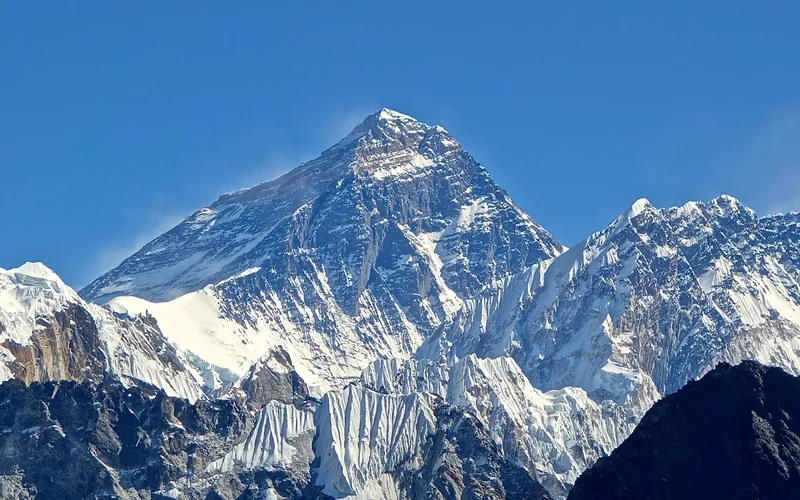


Mount Everest
Mount Everest is the highest mountain above sea level on Earth, standing at an official elevation of 8,848.86 meters (29,031.7 ft). Straddling the international frontier between Nepal and China, it is known locally as Sagarmatha in Nepali ('Goddess of the Sky') and Chomolungma in Tibetan ('Mother Goddess of the World'). The peak rises into the extreme upper troposphere, where oxygen levels drop to barely one-third of sea-level pressure. Climbers face hurricane-force jet stream winds, severe frostbite conditions, shifting ice crevasses in the Khumbu Icefall, and the dangerous Death Zone above 8,000 meters.
Documented Sources & Archival Citations
- Les 8000 rugissants (The Roaring 8000s)(Erhard Loretan & Jean Ammann / Éditions de la Sarine)
Supporting claim: Autobiographical memoirs detailing the 43-hour speed ascent and glissade descent
Accessed/Documented: 1996 - American Alpine Journal: Mount Everest North Face Hornbein Couloir in Alpine Style(American Alpine Club)
Supporting claim: Official expedition chronicle and technical analysis of the speed blitz
Accessed/Documented: 1987