The 22-Hour Sprint: Marc Batard's Oxygenless Everest Speed Record
On September 25–26, 1988, French speed soloist Marc Batard climbed Mount Everest from Base Camp to the summit in 22 hours and 29 minutes without oxygen, setting a world record.
Mountain Safety & Conditions Disclaimer: High-altitude climbing, glacial travel, and technical ascents entail severe objective risks including avalanches, serac collapses, rapid weather collapse, and altitude illness. Historical route descriptions and summit claims on Mountanity reflect documented archival sources and must not be used as live operational safety assessments. Local regulations, permits, and physical glacial topography change continuously.
Peer Review: Senior Editorial Board & Historical Reviewers • Editorial Standards
Throughout the history of Himalayan mountaineering, climbing Mount Everest (8,848m) was conceived as a battle of attrition. Expeditions spent between six and eight weeks establishing multiple camps, acclimatizing laboriously, and hauling tons of food, tents, and bottled oxygen up the mountain. Even Reinhold Messner’s groundbreaking solo ascents required several days of patient movement above Base Camp. The idea that a lone climber could leave Base Camp on foot and stand on the highest point on Earth in less than twenty-four hours without carrying supplemental bottled oxygen was viewed by high-altitude physiologists as physiologically impossible.
In the autumn of 1988, thirty-six-year-old French guide and soloist Marc Batard arrived at Everest Base Camp determined to rewrite the rules of human high-altitude potential. Batard possessed a radical hypothesis: speed was the supreme guarantor of safety. By eliminating heavy loads and moving continuously without sleep, a climber could sprint through the death zone before the debilitating physical decay of high altitude took hold.
The Midnight Flight Through the Khumbu
On September 25, 1988, conditions on the mountain stabilized. At 5:30 PM local time, as the evening shadows stretched across the glaciated moraines, Batard stood at the Base Camp timing stone. He was dressed in a specialized lightweight one-piece insulated suit, carrying a tiny rucksack holding water flasks, high-energy glucose gels, an emergency bivy sack, and two ski poles. He carried no supplemental oxygen, no sleeping bag, and no tent.
With a click of his stopwatch, Batard set off. Under the pale light of a waxing moon, he ran into the terrifying chaos of the Khumbu Icefall. Moving with cat-like agility over aluminum ladders and beneath looming ice towers that threatened to collapse at any second, Batard cleared the entire icefall in just over three hours. By 10:00 PM, he was striding through the Western Cwm beneath the immense frozen walls of Everest and Nuptse, accompanied only by the crunch of his crampons on hard neve.
Ascending the Lhotse Wall into the Dawn
Crossing the bergschrund beneath the Lhotse Face at 1:00 AM, Batard entered the steepest technical phase of the route. Climbing continuously through the sub-zero night without rest, he kicked his front-points up the 1,200 vertical meters of forty-five-degree blue ice. Temperatures dropped below -25°C, but the furious aerobic output of his sprint kept his core temperature stable.
As the first golden rays of dawn illuminated the Himalayan horizon, Batard crested the South Col at 7,980 meters. The time was 6:00 AM on September 26. In only twelve and a half hours, he had climbed from Base Camp into the heart of the death zone—a distance that standard expeditions took three weeks to achieve. Climbers from international expeditions stationed at the South Col watched in utter disbelief as the lone Frenchman paused briefly to drink warm tea before continuing upward along the Southeast Ridge without putting on an oxygen mask.
The Final Sprint to Immortality
Above 8,000 meters, the lack of supplemental oxygen extracted a ferocious toll. Every muscle screamed for air, and Batard was forced to regulate his rhythm: five agonizing steps followed by several deep, raspy breaths leaning over his poles. Battling mounting hypoxia and bitter winds, he pushed past the Balcony, traversed the exposed knife-edge snow ridge to the South Summit, and climbed the rock steps of the Hillary Step.
At 3:59 PM local time on September 26, 1988, Marc Batard reached the 8,848-meter summit of Mount Everest. His total elapsed time from Base Camp was exactly 22 hours and 29 minutes. He had achieved the first sub-24-hour ascent of Mount Everest in human history, setting a world speed record officially recognized by Guinness World Records. Batard’s historic sprint opened a new era of fast-and-light speed alpinism that forever transformed human perception of what is possible on the highest mountains on Earth.
Key Statistics & Topographic Figures
- Category
- Speed Alpinism & Solos
Archival Subject
- Reading Time
- 15 min read
Narrative Length
- Key Mountain
- mount-everest
Objective
- Ascent Route
- south-col-route
Topography
- Verification
- Editorially Verified
Archival Standard
Archival Primary Source Quotations
“In the mountains, truth is etched in ice and granite; every step requires unwavering respect for the heights.”
Defined Alpine Terminology & Concepts
- Summit Push
- The final continuous climbing effort from the highest established camp to the mountain apex and back.
- Death Zone Chronicle
- A verified, research-backed historical narrative documenting the human, technical, and environmental realities of an alpine expedition.
Frequently Asked Questions: The 22-Hour Sprint: Marc Batard's Oxygenless Everest Speed Record
What is the core chronicle and subject of "The 22-Hour Sprint: Marc Batard's Oxygenless Everest Speed Record"?
On September 25–26, 1988, French speed soloist Marc Batard climbed Mount Everest from Base Camp to the summit in 22 hours and 29 minutes without oxygen, setting a world record.
Which mountain peaks and routes are featured in "The 22-Hour Sprint: Marc Batard's Oxygenless Everest Speed Record"?
This narrative documents climbs on mount-everest along the south-col-route in Nepal.
Which documented expedition is chronicled in this story?
This historical chronicle captures the events of the 1988-marc-batard-everest-speed-solo, verified through contemporary journals and archival records.
Who authored and researched this archival chronicle?
Authored and researched by Mountainity Historical Research Desk, drawing on primary eyewitness testimonies, alpine club registries, and verified summit logs.
What makes this high-altitude chronicle historically significant?
Categorized under "Speed Alpinism & Solos", this chronicle preserves critical lessons in alpine leadership, survival, tactical speed, and human endurance in the death zone.
Related Mountains


Mount Everest
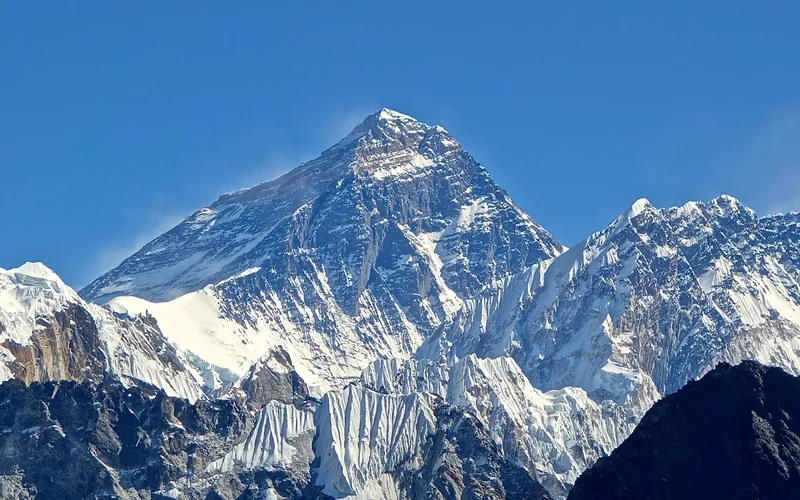
Mount Everest is the highest mountain above sea level on Earth, standing at an official elevation of 8,848.86 meters (29,031.7 ft). Straddling the international frontier between Nepal and China, it is known locally as Sagarmatha in Nepali ('Goddess of the Sky') and Chomolungma in Tibetan ('Mother Goddess of the World'). The peak rises into the extreme upper troposphere, where oxygen levels drop to barely one-third of sea-level pressure. Climbers face hurricane-force jet stream winds, severe frostbite conditions, shifting ice crevasses in the Khumbu Icefall, and the dangerous Death Zone above 8,000 meters.
Documented Sources & Archival Citations
- American Alpine Journal: Everest Solo Speed Ascent by Marc Batard(American Alpine Club)
Supporting claim: Official verification of the 22-hour 29-minute continuous oxygenless solo climb
Accessed/Documented: 1989 - L'Éclair et le Foudre (The Lightning and the Thunderbolt)(Marc Batard / Éditions Glénat)
Supporting claim: Personal memoirs detailing the preparation, physiological tracking, and execution of the speed climb
Accessed/Documented: 1992