Twenty-One Hours on the Crown of the Earth: Babu Chiri Sherpa's Unimaginable Everest Summit Bivouac
On May 6, 1999, legendary Nepali Sherpa Babu Chiri pitched a tent on the 8,848-meter summit of Mount Everest and spent 21 hours and 30 minutes in the Death Zone without supplemental oxygen.
Mountain Safety & Conditions Disclaimer: High-altitude climbing, glacial travel, and technical ascents entail severe objective risks including avalanches, serac collapses, rapid weather collapse, and altitude illness. Historical route descriptions and summit claims on Mountanity reflect documented archival sources and must not be used as live operational safety assessments. Local regulations, permits, and physical glacial topography change continuously.
Peer Review: Senior Editorial Board & Historical Reviewers • Editorial Standards
At 8,848 meters above sea level, the human body cannot heal, digest food normally, or sustain cellular life. In this rarefied realm known as the Death Zone, atmospheric pressure plummets to barely one-third of sea-level density. Standard physiological guidelines dictate that climbers must spend no more than 15 to 30 minutes atop Mount Everest before beating a hasty retreat, lest cerebral edema, hypoxia, or severe hypothermia turn a victory into a catastrophe.
On the morning of May 6, 1999, a 33-year-old Sherpa from the village of Taksindu in Solukhumbu challenged everything science believed about the physiological boundaries of human survival.
His name was Babu Chiri Sherpa.
The Audacious Vision
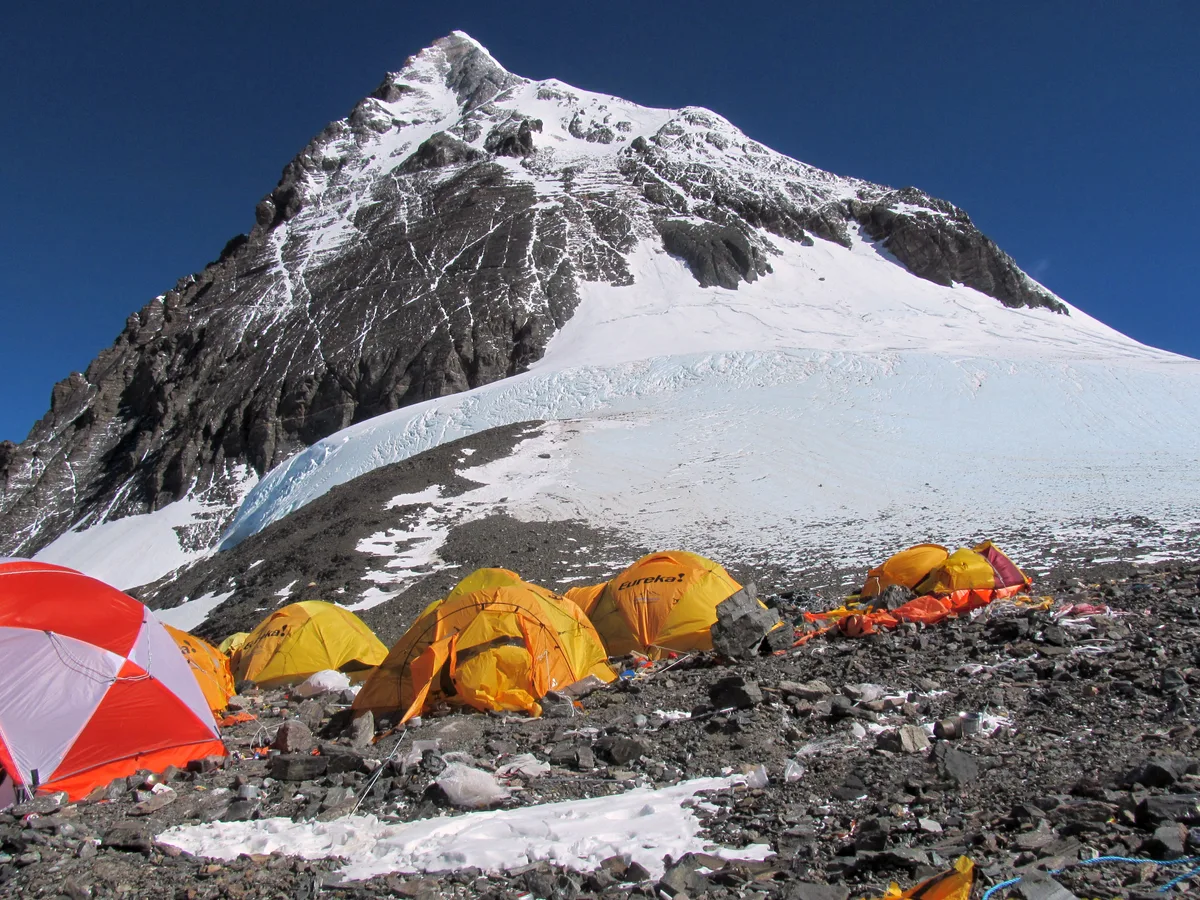
Babu Chiri was no reckless daredevil. He was one of the most respected and physically gifted climbing sardars in Nepal, possessing an extraordinary calm under pressure and natural physiological adaptations to hypoxia. Having already summited Everest multiple times without supplemental oxygen, Babu Chiri conceived a challenge that many Western doctors regarded as suicide: he would climb to the highest point on Earth without supplemental oxygen, pitch a lightweight two-man tent, and remain overnight on the summit.
Carrying his own tent, sleeping bag, meteorological instruments, and radio, Babu Chiri climbed swiftly up the classic Southeast Ridge from the South Col on May 6, 1999.
At approximately 10:00 AM, he stepped onto the knife-edge crest of the world’s highest peak. The summit was deserted. Beneath him, the brown plains of the Tibetan plateau sprawled to the north, while the rugged green valleys of Nepal unfurled to the south.
Instead of turning back, Babu Chiri unpacked his gear.
A Tent on the Edge of Space
Anchoring his lightweight tent with snow pickets and rocks along the narrow summit crown, Babu Chiri crawled inside. Over the next twenty-one hours, the world outside was buffeted by sub-zero winds dropping beneath minus thirty degrees Celsius.
Without supplemental oxygen, breathing in the thin air requires intense, conscious hyperventilation. Most individuals lapse into cognitive confusion or severe lethargy within hours under such conditions. Babu Chiri, however, remained lucid and active. He took barometric and temperature readings, brewed melted snow for tea, and maintained regular radio contact with his brother and team down at Base Camp.
At one point during the twilight hours, as base camp operators held their breath listening to the scratchy radio transmission from the apex of the globe, Babu Chiri began singing the Nepali national anthem across the VHF radio frequency—his clear voice echoing down the Western Cwm into the tents of dumbfounded international expeditions.
The Return of a Giant
Through the bitterly cold Himalayan night, Babu Chiri stayed awake, monitoring his circulation and preventing frostbite through rhythmic movement. When dawn broke on May 7, the sun illuminated the rounded curvature of the Earth in shades of purple and gold.
At 7:30 AM on May 7, 1999—after spending an astounding 21 hours and 30 minutes on the summit of Mount Everest entirely without bottled oxygen—Babu Chiri packed his tent, stepped into his crampons, and began his descent.
He arrived safely back at Camp II without frostbite, cognitive impairment, or medical assistance. The feat was ratified by Guinness World Records as the longest continuous duration spent on the summit of Mount Everest, an all-time record that has never been equaled.
Just one year later, in May 2000, Babu Chiri astounded the world once more by sprinting from Everest Base Camp to the summit in just 16 hours and 56 minutes, setting another world speed record. When asked why he undertook such unimaginable trials, Babu Chiri’s answer was always simple: to bring honor to Nepal, to prove the unmatched capabilities of his Sherpa people, and to raise funds to build a school for the children of his native village.
Key Statistics & Topographic Figures
- Category
- Himalayan High-Altitude Legends
Archival Subject
- Reading Time
- 11 min read
Narrative Length
- Key Mountain
- mount-everest
Objective
- Ascent Route
- south-col-route
Topography
- Verification
- Editorially Verified
Archival Standard
Archival Primary Source Quotations
“In the mountains, truth is etched in ice and granite; every step requires unwavering respect for the heights.”
Defined Alpine Terminology & Concepts
- Summit Push
- The final continuous climbing effort from the highest established camp to the mountain apex and back.
- Death Zone Chronicle
- A verified, research-backed historical narrative documenting the human, technical, and environmental realities of an alpine expedition.
Frequently Asked Questions: Twenty-One Hours on the Crown of the Earth: Babu Chiri Sherpa's Unimaginable Everest Summit Bivouac
What is the core chronicle and subject of "Twenty-One Hours on the Crown of the Earth: Babu Chiri Sherpa's Unimaginable Everest Summit Bivouac"?
On May 6, 1999, legendary Nepali Sherpa Babu Chiri pitched a tent on the 8,848-meter summit of Mount Everest and spent 21 hours and 30 minutes in the Death Zone without supplemental oxygen.
Which mountain peaks and routes are featured in "Twenty-One Hours on the Crown of the Earth: Babu Chiri Sherpa's Unimaginable Everest Summit Bivouac"?
This narrative documents climbs on mount-everest along the south-col-route in Nepal.
Which documented expedition is chronicled in this story?
This historical chronicle captures the events of the 1999-babu-chiri-everest-summit-bivouac, verified through contemporary journals and archival records.
Who authored and researched this archival chronicle?
Authored and researched by Mountainity Historical Research Desk, drawing on primary eyewitness testimonies, alpine club registries, and verified summit logs.
What makes this high-altitude chronicle historically significant?
Categorized under "Himalayan High-Altitude Legends", this chronicle preserves critical lessons in alpine leadership, survival, tactical speed, and human endurance in the death zone.
Related Mountains



Mount Everest
Mount Everest is the highest mountain above sea level on Earth, standing at an official elevation of 8,848.86 meters (29,031.7 ft). Straddling the international frontier between Nepal and China, it is known locally as Sagarmatha in Nepali ('Goddess of the Sky') and Chomolungma in Tibetan ('Mother Goddess of the World'). The peak rises into the extreme upper troposphere, where oxygen levels drop to barely one-third of sea-level pressure. Climbers face hurricane-force jet stream winds, severe frostbite conditions, shifting ice crevasses in the Khumbu Icefall, and the dangerous Death Zone above 8,000 meters.
Documented Sources & Archival Citations
- The Himalayan Database: Spring 1999 Everest Expeditions(Elizabeth Hawley / The Himalayan Database)
Supporting claim: Official verification of the 21-hour 30-minute summit stay without supplemental oxygen on May 6-7, 1999
Accessed/Documented: 1999 - American Alpine Journal: Babu Chiri's 21 Hours on the Summit of Everest(American Alpine Club)
Supporting claim: Detailed analysis of medical conditions, atmospheric pressure, and bivouac equipment
Accessed/Documented: 2000 - Guinness World Records: Longest Stay on the Summit of Mount Everest(Guinness World Records)
Supporting claim: World record verification for 21.5 hours without supplemental oxygen
Accessed/Documented: 2000