Annapurna I: The Crucible of Project Possible & Rescue
The dramatic story of Nirmal Purja's Annapurna I ascent, opening Project Possible and executing a miraculous high-altitude helicopter rescue.
Mountain Safety & Conditions Disclaimer: High-altitude climbing, glacial travel, and technical ascents entail severe objective risks including avalanches, serac collapses, rapid weather collapse, and altitude illness. Historical route descriptions and summit claims on Mountanity reflect documented archival sources and must not be used as live operational safety assessments. Local regulations, permits, and physical glacial topography change continuously.
Peer Review: Senior Editorial Board & Historical Reviewers • Editorial Standards
The Opening Gambit of Project Possible
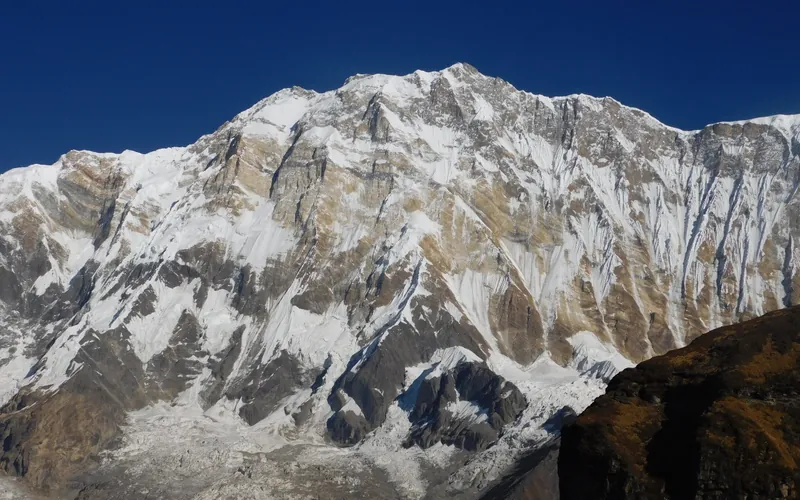
When Nirmal “Nimsdai” Purja announced his ambition to summit all fourteen 8,000-meter peaks in seven months, seasoned Himalayan veterans called it suicidal madness. To prove his operational model, Purja chose Annapurna I (8,091m)—statistically the deadliest of all eight-thousanders, infamous for its sweeping avalanches and treacherous ice cliffs along the classic 1950 French North Face route.
Accompanied by Mingma David Sherpa, Gesman Tamang, and Gyalu Sherpa, Purja established Base Camp in mid-April 2019. While commercial teams waited anxiously for a stable weather window, Purja relied on SBS-honed aggressive tempo and precision logistics. Breaking trail through heavy spring snowdrifts and fixing thousands of meters of rope across the Sickle and Dutch Rib, the team reached the summit on April 23, 2019. Project Possible was officially alive.
The Cry from the Death Zone
Descending back to Camp 4 in exhaustion, the team received desperate radio transmissions. A Malaysian climber, Dr. Chin Kin Wah, had fallen behind his guide on descent and had spent two freezing nights exposed near 7,500 meters without supplemental oxygen, food, or water. Standard expedition protocol deemed rescue at that altitude virtually impossible—most assumed the climber was already dead.
Refusing to abandon a fellow mountaineer, Purja made an immediate executive decision. Paired with veteran high-altitude helicopter pilot Captain Maurizio Folini, Purja organized an unprecedented long-line extraction mission. Dropping back onto the avalanche-swept face with emergency oxygen and medical supplies, Purja and his Sherpa squad reached Dr. Chin, administered dexamethasone and oxygen, and guided the long-line sling rescue that miraculously lifted the survivor to safety.
Redefining Alpine Leadership
The Annapurna mission demonstrated that Project Possible was not merely an ego-driven speed trial; it was anchored in elite operational discipline and unwavering mountain solidarity. By pulling off one of the highest successful long-line helicopter rescues in history on his very first peak, Nirmal Purja established the core philosophy that would guide his entire 189-day global campaign.
Key Statistics & Topographic Figures
- Category
- Rescue Chronicles
Archival Subject
- Reading Time
- 8 min read
Narrative Length
- Key Mountain
- annapurna-1
Objective
- Ascent Route
- annapurna-north-face
Topography
- Verification
- Editorially Verified
Archival Standard
Archival Primary Source Quotations
“In the mountains, truth is etched in ice and granite; every step requires unwavering respect for the heights.”
Defined Alpine Terminology & Concepts
- Summit Push
- The final continuous climbing effort from the highest established camp to the mountain apex and back.
- Death Zone Chronicle
- A verified, research-backed historical narrative documenting the human, technical, and environmental realities of an alpine expedition.
Frequently Asked Questions: Annapurna I: The Crucible of Project Possible & Rescue
What is the core chronicle and subject of "Annapurna I: The Crucible of Project Possible & Rescue"?
The dramatic story of Nirmal Purja's Annapurna I ascent, opening Project Possible and executing a miraculous high-altitude helicopter rescue.
Which mountain peaks and routes are featured in "Annapurna I: The Crucible of Project Possible & Rescue"?
This narrative documents climbs on annapurna-1 along the annapurna-north-face in Nepal.
Which documented expedition is chronicled in this story?
This historical chronicle captures the events of the 2019-purja-annapurna-1, verified through contemporary journals and archival records.
Who authored and researched this archival chronicle?
Authored and researched by Mountanity Research Desk, drawing on primary eyewitness testimonies, alpine club registries, and verified summit logs.
What makes this high-altitude chronicle historically significant?
Categorized under "Rescue Chronicles", this chronicle preserves critical lessons in alpine leadership, survival, tactical speed, and human endurance in the death zone.
Related Mountains

Annapurna I
Annapurna I, at 8,091 meters (26,545 ft), is the tenth-highest mountain in the world and historically the first 8,000-meter peak ever summited (June 3, 1950 by Maurice Herzog and Louis Lachenal). Rising above the Annapurna Sanctuary, its north and south walls present extreme avalanche and serac fall hazards.