1952 Franco-Dutch Nevado Huantsán Expedition
The 1952 Franco-Dutch expedition led by Lionel Terray and Cees Egeler that achieved the maiden first ascent of Nevado Huantsán (6,369m) via the North Ridge.
Mountain Safety & Conditions Disclaimer: High-altitude climbing, glacial travel, and technical ascents entail severe objective risks including avalanches, serac collapses, rapid weather collapse, and altitude illness. Historical route descriptions and summit claims on Mountainity reflect documented archival sources and must not be used as live operational safety assessments. Local regulations, permits, and physical glacial topography change continuously.
Peer Review: Senior Editorial Board & Historical Reviewers • Editorial Standards
Official Expedition Narrative & Archival Record
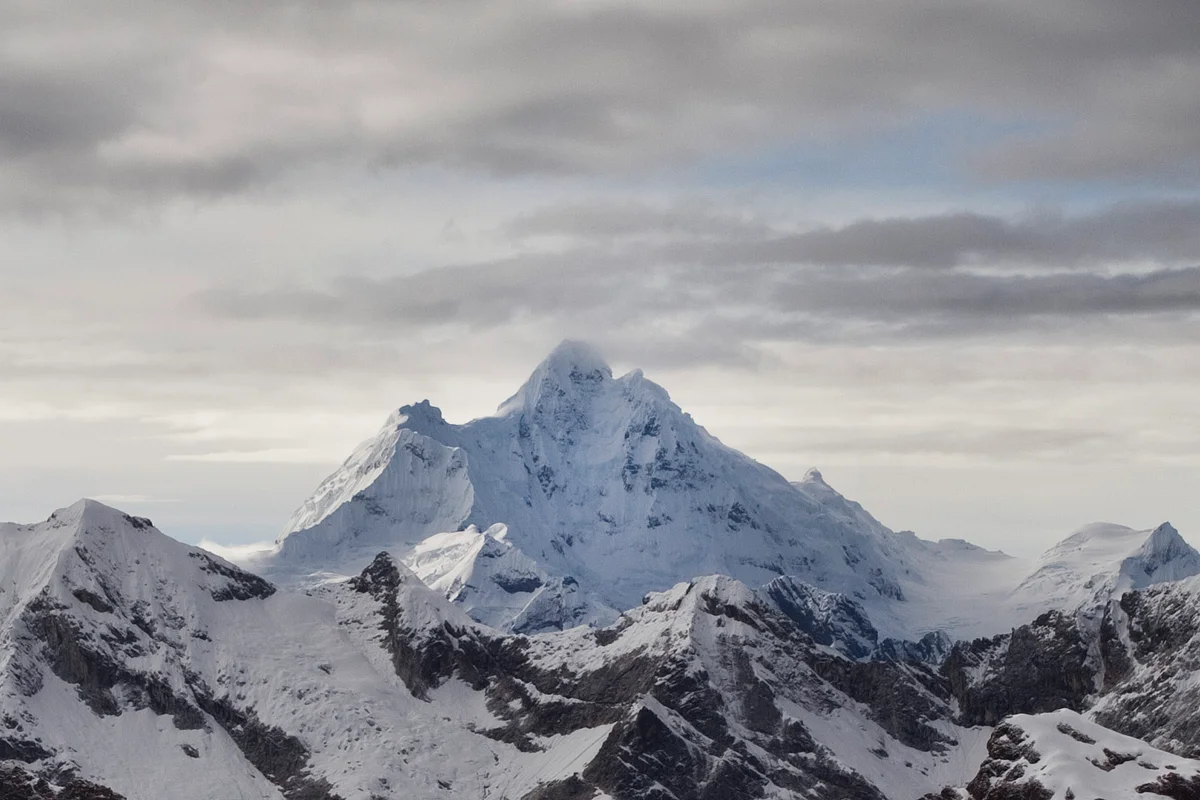
Nevado Huantsán (6,369m / 20,896 ft) stands as the supreme southern bastion of Peru's Cordillera Blanca, rising with forbidding verticality above the Rajucolta valley. Guarded on all sides by treacherous ice walls, towering serac barriers, and delicate snow mushroom cornices, Huantsán had repelled numerous international parties and was widely regarded as the most difficult unclimbed mountain in South America. In June 1952, Dutch geologists Cees G. Egeler and Tom de Booy organized an expedition to the high Blanca, enlisting premier French Chamonix guide Lionel Terray as their climbing leader. Establishing base camp beside Laguna Rajucolta, Terray led the technical assault up a steep glacial breach onto the high northern col. Over days of sustained extreme climbing on sheer ice flutes and unstable knife-edge ridges, Terray, Egeler, and de Booy forged an audacious line up the North Ridge. On July 7, 1952, all three men conquered the perilous final summit crest, securing the historic maiden first ascent of Huantsán and establishing a watershed benchmark in technical Andean alpinism.
Documented Team Composition
- Lionel Terray (Expedition Climbing Leader & Summiter)
- Dr. Cees G. Egeler (Dutch Scientific Leader & Summiter)
- Tom de Booy (Summiter & Geologist)
- Dr. J. de Jong (Expedition Doctor)
Key Statistics & Topographic Figures
- Official Outcome
- Historic Maiden First Ascent
Expedition Status
- Summit Date
- 1952-07-07
Ascent Timestamp
- Target Objective
- huantsan
Mountain Peak
- Ascent Route
- the documented ascent route
Climbing Path
- Team Size
- 4 Climbers
High-Altitude Team
- Region / Country
- Peru (Ancash Region, Huaraz Province, Cordillera Blanca, Andes)
Geography
Defined Alpine Terminology & Concepts
- Alpine Expedition
- A planned, self-contained high-altitude mountaineering undertaking operating in remote mountain terrain subject to extreme objective hazards.
- Death Zone
- The high-altitude region above 8,000 meters where atmospheric oxygen pressure is inadequate for sustained human survival.
Frequently Asked Questions: 1952 Franco-Dutch Nevado Huantsán Expedition
What was the primary outcome and achievement of the 1952 Franco-Dutch Nevado Huantsán Expedition?
Historic Maiden First Ascent. The 1952 Franco-Dutch expedition led by Lionel Terray and Cees Egeler that achieved the maiden first ascent of Nevado Huantsán (6,369m) via the North Ridge.
When did the 1952 Franco-Dutch Nevado Huantsán Expedition reach the summit?
The expedition officially reached the summit on 1952-07-07, operating between 1952-06-01 and 1952-07-25.
Who were the documented climbing team members on the 1952 Franco-Dutch Nevado Huantsán Expedition?
The documented climbing roster included: Lionel Terray (Expedition Climbing Leader & Summiter), Dr. Cees G. Egeler (Dutch Scientific Leader & Summiter), Tom de Booy (Summiter & Geologist), Dr. J. de Jong (Expedition Doctor).
What climbing route and mountain objective were tackled during the 1952 Franco-Dutch Nevado Huantsán Expedition?
The expedition tackled huantsan via the the documented ascent route in Peru (Ancash Region, Huaraz Province, Cordillera Blanca, Andes).
How are the records and summit claims of the 1952 Franco-Dutch Nevado Huantsán Expedition verified?
Summit claims, route topography, and timeline logs for the 1952 Franco-Dutch Nevado Huantsán Expedition are cross-referenced with official alpine registries, national mountaineering federations, and primary expedition journals.
Target Objective Peak

Nevado Huantsán
Nevado Huantsán, towering at 6,369 meters, is the southernmost 6,000-meter giant of Peru's Cordillera Blanca and widely considered its most formidable technical objective. Flanked by fearsome ice walls and knife-edge corniced ridges, Huantsán repelled numerous elite teams before yielding to Lionel Terray in 1952.
Featured Expedition Climber
Lionel Terray
Lionel Terray was born on July 25, 1921, in Grenoble, France. Raised in the shadow of the French Alps, Terray developed an all-consuming passion for extreme skiing and high-angle alpinism from early childhood. During...
Documented Sources & Archival Citations
- Reference OverviewUnto a High Mountain: The Story of the Franco-Dutch Expedition to the Andes ↗— by Cees G. Egeler and Tom de Booyin Geoffrey Bles Historical Editions (1954)(Geoffrey Bles)
Supporting claim: Official expedition volume by Egeler and de Booy chronicling the geological exploration and July 7, 1952 first ascent of Nevado Huantsán.
- Primary Alpine JournalThe French-Dutch Expedition to the Cordillera Blanca, 1952 ↗— by Lionel Terrayin The Alpine Journal, Vol. 59, pp. 158–168 (1953)(The Alpine Club)
Supporting claim: Firsthand technical account by Lionel Terray detailing the pitches, camps, and summit knife-edge on Huantsán.
Share Exploration
Global Mountain Intelligence
✓ Link copied to clipboard!