1955 Walter Bonatti Petit Dru Solo Expedition
Walter Bonatti completed one of the greatest solo rock climbing feats in alpine history between August 17 and 23, 1955, conquering the virgin Southwest Pillar of the Aiguille du Petit Dru alone over six grueling days.
Mountain Safety & Conditions Disclaimer: High-altitude climbing, glacial travel, and technical ascents entail severe objective risks including avalanches, serac collapses, rapid weather collapse, and altitude illness. Historical route descriptions and summit claims on Mountanity reflect documented archival sources and must not be used as live operational safety assessments. Local regulations, permits, and physical glacial topography change continuously.
Peer Review: Senior Editorial Board & Historical Reviewers • Editorial Standards
Official Expedition Narrative & Archival Record
Following the painful controversy of the 1954 K2 expedition, Walter Bonatti sought solace and personal vindication on the blank granite walls of the Mont Blanc massif. Targeting the unclimbed 600-meter Southwest Pillar of the Petit Dru, Bonatti climbed entirely solo with heavy sack hauling and primitive pitons. Faced with a completely smooth, impassable 40-meter granite overhang on day five, Bonatti lassoed a distant rock flake and executed a breathtaking pendulum traverse across open space, reaching the summit on August 23, 1955. The route became forever known as the Bonatti Pillar.
Documented Team Composition
- Walter Bonatti (Solo Alpinist)
Key Statistics & Topographic Figures
- Climb Duration
- 6 Days (August 17–23, 1955)
Solo Ascent
- Climber
- Walter Bonatti
Completely Solo & Self-Belayed
- Technical Difficulty
- UIAA Grade VI / A2
Granite Big Wall
- Mountain Massif
- Aiguille du Petit Dru (3,733m)
Mont Blanc Massif, France
Archival Primary Source Quotations
“On the Dru pillar, I found my inner peace and redeemed my dignity after the bitterness of K2. I was alone with the rock, and the rock did not lie.”
Defined Alpine Terminology & Concepts
- Pendulum Traverse
- A climbing technique where a climber hangs from a high anchor rope and swings horizontally across a blank, holdless rock wall to reach another crack system.
- Hanging Bivouac
- An overnight stay on a vertical cliff where a climber sleeps suspended in a harness or tiny canvas ledge anchored to pitons driven into the rock.
Frequently Asked Questions: 1955 Walter Bonatti Petit Dru Solo Expedition
Why is Walter Bonatti’s solo climb of the Petit Dru considered legendary?
In August 1955, Walter Bonatti spent six solitary days making the first ascent of the vertical Southwest Pillar of the Aiguille du Petit Dru. Climbing completely alone with minimal equipment, he pioneered audacious pendulum rope maneuvers and mastered grade VI rock climbing in an era when solo big-wall climbing was deemed suicidal.
Does the Bonatti Pillar on Petit Dru still exist today?
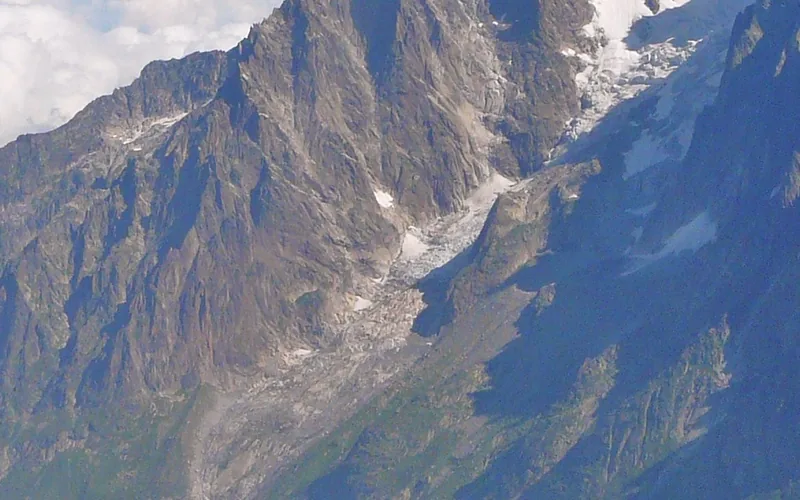
No. Massive rockfalls in 1997, 2003, 2005, and 2011 completely destroyed the Southwest Pillar of the Petit Dru, erasing Bonatti’s classic route from the mountain face forever.
How many days did Walter Bonatti spend on the Petit Dru pillar?
Bonatti spent six grueling days on the rock wall from August 17 to August 23, 1955, carrying heavy sacks, setting his own belays, and enduring multiple exposed hanging bivouacs.
Ascent Route & Topography
Goûter Route (Voie Royale / Normal Route)
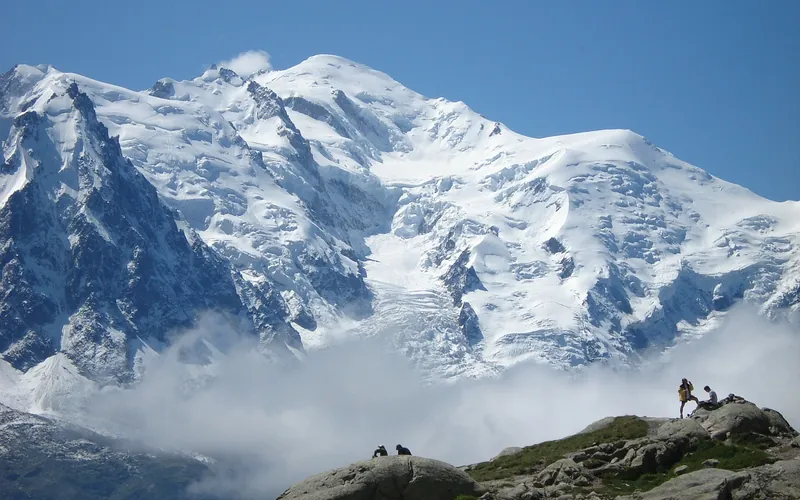
The Goûter Route, often called the Voie Royale, is the most frequented and classic line to the summit of Mont Blanc (4,808 m). Starting from the Tramway du Mont-Blanc terminus at Nid d'Aigle (2,372 m), climbers ascend past the Tête Rousse Glacier, traverse the notorious Grand Couloir, scramble up the steep Aiguille du Goûter to the Goûter Refuge (3,835 m), and complete the dawn push across the Dôme du Goûter and the exposed knife-edge Arête des Bosses to the summit dome.
Target Objective Peak


Mont Blanc
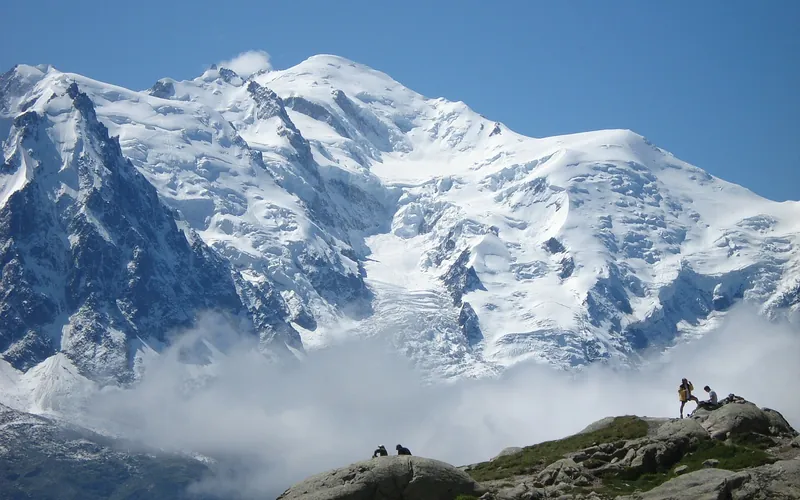
Mont Blanc (Monte Bianco), at 4,808 meters (15,774 ft), is the highest mountain in the Alps and Western Europe. Rising on the Franco-Italian watershed, this iconic glacier-draped granite massif is revered as the historic cradle of modern mountaineering following its celebrated first ascent in 1786. Featuring towering seracs, complex crevasse systems, and classic ridges like the Goûter and Bosses, it attracts climbers from around the globe.
Featured Expedition Climber
Walter Bonatti
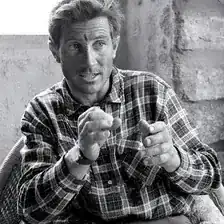
Walter Bonatti was born on June 22, 1930, in Bergamo, Lombardy, Italy. Raised in Monza and the Po Valley, he found his spiritual sanctuary in the rugged limestone spires of the Grigna mountains above Lake Como. Displaying extraordinary physical power, balance, and innate climbing intuition, Bonatti made astonishing technical ascents as a teenager. In 1949, at just nineteen, he repeated the fearsome Walker Spur on the Grandes Jorasses and the north face of the Piz Badile. In July 1951, Bonatti and climbing partner Luciano Ghigo stunned European alpinism by making the first ascent of the vertical 400-meter East Face of the Grand Capucin on Mont Blanc over four grueling days, mastering sheer red granite that international authorities had declared impossible. In 1954, geologist Ardito Desio selected the 24-year-old Bonatti as the youngest member of the Italian National Expedition to K2 (8,611m). On July 30, tasked with carrying vital oxygen cylinders to Camp IX for the summit assault pair (Achille Compagnoni and Lino Lacedelli), Bonatti and Hunza high-altitude porter Amir Mehdi ascended through dangerous snow. Arriving at the agreed location in darkness, they discovered that Compagnoni had moved Camp IX higher and out of sight across a treacherous crevasse. Trapped at 8,100 meters in a ferocious gale without a tent, sleeping bags, or food, Bonatti carved a tiny snow ledge with his ice axe. He spent the sub-zero night keeping Mehdi conscious through sheer force of will, surviving the highest open bivouac in history. While both survived, Mehdi suffered severe frostbite leading to amputations. In the aftermath, expedition leaders fabricated false claims to protect national mythmaking, sparking a bitter 50-year campaign of defamation against Bonatti until the Italian Alpine Club (CAI) officially validated his account and recognized his decisive heroism in 2007. Deeply wounded by the political machinations on K2, Bonatti retreated from team expeditions and directed his energy toward solitary, self-reliant climbing. In August 1955, he achieved what many climbing historians regard as the greatest individual feat in alpine history: the solo first ascent of the vertical Southwest Pillar of the Aiguille du Petit Dru (the 'Bonatti Pillar') in the Mont Blanc massif. Climbing alone for six days, he carried minimal gear, pioneered daring pendulum swings across blank granite slabs, and conquered extreme technical cruxes in complete isolation. The climb cemented Bonatti's reputation as the preeminent alpinist of his era, inspiring a generation to embrace lightweight purity and extreme psychological fortitude. Bonatti returned to the Karakoram in 1958 alongside Carlo Mauri to make the first ascent of Gasherbrum IV (7,925m / The Shining Wall) via the Northeast Ridge—a mountain considered technically far more formidable than K2—climbing in pure lightweight alpine style without supplemental oxygen. Three years later, in July 1961, Bonatti demonstrated supreme courage during the Central Pillar of Freney disaster on Mont Blanc. Trapped for days by an unpredicted blizzard, Bonatti led a joint Franco-Italian team in a desperate retreat down the icy massifs. While four companions died of exhaustion and exposure, Bonatti's relentless route-finding and physical stamina saved the lives of Pierre Mazeaud and Roberto Gallieni. In February 1965, Bonatti celebrated the centenary of the first ascent of the Matterhorn by pulling off his final climbing masterpiece: the first solo winter ascent of a new direct route on the sheer North Face of the Matterhorn in four days of sub-zero solitude. Having proven everything he wished to prove, he retired from extreme mountaineering at age thirty-five at the absolute summit of his powers. He spent the next three decades traveling the world as an investigative photojournalist and author for the magazine 'Epoca', documenting untouched wildernesses from the Amazon to Antarctica. In 2009, he was awarded the inaugural Lifetime Achievement Piolet d'Or (Piolet d'Or Carrière). He passed away in Rome on September 13, 2011, universally honored as the moral conscience and purist pioneer of modern climbing.
Associated Historical Chronicles & Stories
1955 Bonatti Pillar: Six Days Alone on the Petit Dru
How Walter Bonatti spent six solitary days pioneering the vertical Southwest Pillar of the Petit Dru in August 1955.
Documented Sources & Archival Citations
- The Mountains of My Life(Walter Bonatti / Penguin Classics)
Supporting claim: Detailed personal diary of the 6-day solo first ascent of the Petit Dru Southwest Pillar
Accessed/Documented: 2001 - Alpine Journal: The Bonatti Pillar(Alpine Club of the UK)
Supporting claim: Official confirmation of the August 1955 solo first ascent on the Petit Dru
Accessed/Documented: 1956