1983 Japanese Nemjung Historic Himalayan Maiden Ascent
On October 27, 1983, a joint Nepalese-Japanese expedition from Hirosaki University achieved the maiden first ascent of Nemjung (7,140m) via the East Ridge.
Mountain Safety & Conditions Disclaimer: High-altitude climbing, glacial travel, and technical ascents entail severe objective risks including avalanches, serac collapses, rapid weather collapse, and altitude illness. Historical route descriptions and summit claims on Mountainity reflect documented archival sources and must not be used as live operational safety assessments. Local regulations, permits, and physical glacial topography change continuously.
Peer Review: Senior Editorial Board & Historical Reviewers • Editorial Standards
Official Expedition Narrative & Archival Record
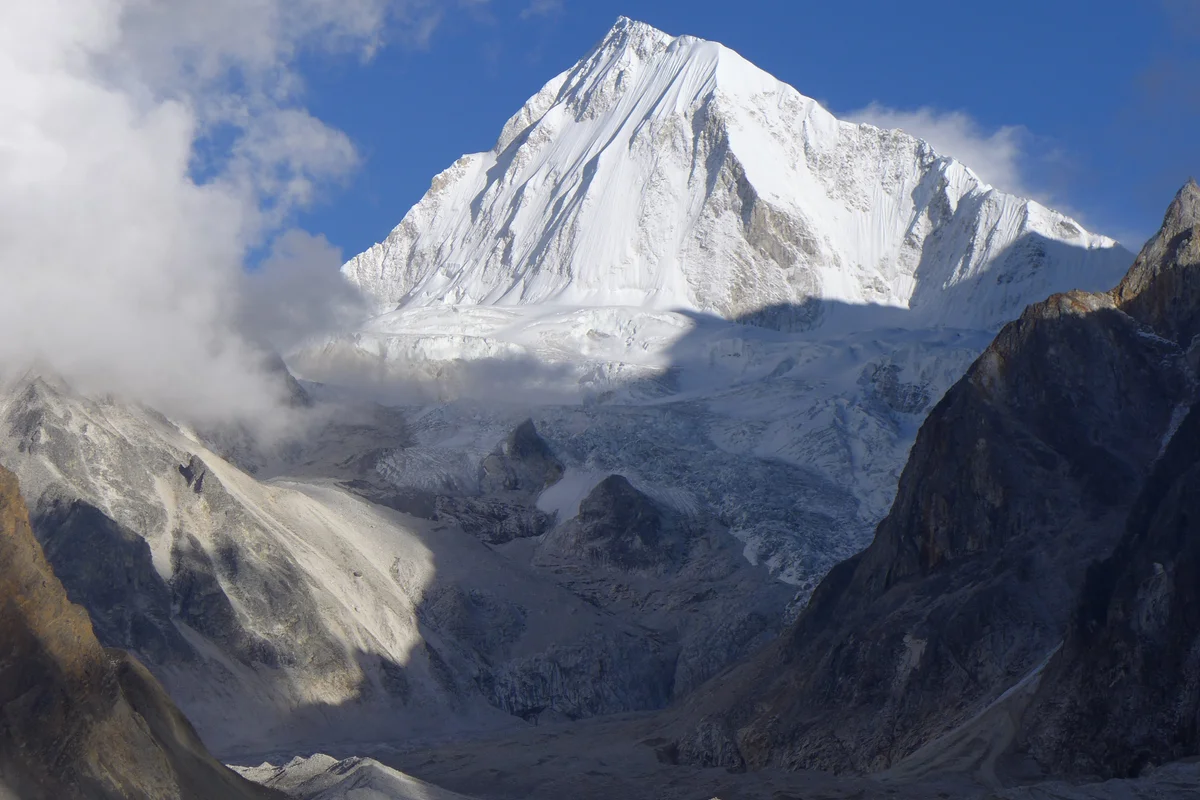
Nemjung (7,140m / 23,425 ft), rising dramatically in the Peri Himal northwest of Manaslu and guarding the southern approach to the Tibetan border plateau, was long one of the least understood high summits of northern Nepal. In early Himalayan cartography, the peak was frequently confused with Himlung Himal until official frontier surveys separated Nemjung, Himjung, and Himlung as distinct mountain massifs. In the autumn of 1983, a joint expedition organized by Hirosaki University Alpine Club and the Nepal Mountaineering Association approached the mountain from the east under the leadership of Junji Kurotaki. Navigating hazardous crevasses and icy headwalls, the team established three high camps before tackling the exposed, corniced crest of the East Ridge. On October 27, 1983, expedition leader Junji Kurotaki, accompanied by elite high-altitude mountaineers Nima Wangchu Sherpa and Ang Chopal Sherpa, reached the virgin summit, successfully completing the historic maiden first ascent of Nemjung.
Documented Team Composition
- Junji Kurotaki (Expedition Leader & Summiter, Japan)
- Nima Wangchu Sherpa (Summiter, Nepal)
- Ang Chopal Sherpa (Summiter, Nepal)
Key Statistics & Topographic Figures
- Official Outcome
- Historic Maiden First Ascent of Nemjung (7,140m)
Expedition Status
- Summit Date
- 1983-10-27
Ascent Timestamp
- Target Objective
- nemjung
Mountain Peak
- Ascent Route
- the documented ascent route
Climbing Path
- Team Size
- 3 Climbers
High-Altitude Team
- Region / Country
- Nepal (Peri Himal, Manaslu Region, Manang District, Gandaki Province, Nepal)
Geography
Defined Alpine Terminology & Concepts
- Alpine Expedition
- A planned, self-contained high-altitude mountaineering undertaking operating in remote mountain terrain subject to extreme objective hazards.
- Death Zone
- The high-altitude region above 8,000 meters where atmospheric oxygen pressure is inadequate for sustained human survival.
Frequently Asked Questions: 1983 Japanese Nemjung Historic Himalayan Maiden Ascent
What was the primary outcome and achievement of the 1983 Japanese Nemjung Historic Himalayan Maiden Ascent?
Historic Maiden First Ascent of Nemjung (7,140m). On October 27, 1983, a joint Nepalese-Japanese expedition from Hirosaki University achieved the maiden first ascent of Nemjung (7,140m) via the East Ridge.
When did the 1983 Japanese Nemjung Historic Himalayan Maiden Ascent reach the summit?
The expedition officially reached the summit on 1983-10-27, operating between 1983-09-15 and 1983-11-10.
Who were the documented climbing team members on the 1983 Japanese Nemjung Historic Himalayan Maiden Ascent?
The documented climbing roster included: Junji Kurotaki (Expedition Leader & Summiter, Japan), Nima Wangchu Sherpa (Summiter, Nepal), Ang Chopal Sherpa (Summiter, Nepal).
What climbing route and mountain objective were tackled during the 1983 Japanese Nemjung Historic Himalayan Maiden Ascent?
The expedition tackled nemjung via the the documented ascent route in Nepal (Peri Himal, Manaslu Region, Manang District, Gandaki Province, Nepal).
How are the records and summit claims of the 1983 Japanese Nemjung Historic Himalayan Maiden Ascent verified?
Summit claims, route topography, and timeline logs for the 1983 Japanese Nemjung Historic Himalayan Maiden Ascent are cross-referenced with official alpine registries, national mountaineering federations, and primary expedition journals.
Target Objective Peak

Nemjung
Nemjung (historically also called Nimjung) rises to an official surveyed elevation of 7,140 meters (23,425 feet) above sea level in the Peri Himal subrange of Manang District, Nepal, roughly 25 kilometers northwest of Manaslu. Prior to Nepal's border boundary realignment in the 1990s, early climbing literature occasionally referred to this peak as Himlung Himal before that name was officially assigned to the 7,126-meter massif approximately four kilometers to the north; Nemjung stands as the highest summit of the Nemjung–Himjung–Himlung group. Following a 1963 reconnaissance attempt by the Den Den Kyushu Alpine Club, Nemjung was first summited via its steep East Ridge on October 27, 1983, by a joint expedition from the Hirosaki University Alpine Club and Nepal led by Junji Kurotaki, with Nima Wangchu Sherpa and Ang Chopal Sherpa on the summit rope. Notable later milestones include a 1994 British ascent, a 2009 French climb, and a technical Japanese first ascent of the previously unclimbed West Face and West Ridge led by Osamu Tanabe on October 30, 2009.
Documented Sources & Archival Citations
- Primary Alpine JournalThe Himalayan Journal: Expeditions and Notes: Ascent of Nemjung ↗— by Junji Kurotakiin The Himalayan Journal, Vol. 41, pp. 211–214 (1984)(The Himalayan Club)
Supporting claim: Authoritative primary chronicle by leader Junji Kurotaki documenting the October 27, 1983 maiden ascent of Nemjung
- Archival DatabaseThe Himalayan Database: Nemjung Expedition Archives (Autumn 1983) ↗— by Elizabeth Hawleyin The Himalayan Database, Vol. NEMJ-833-01, pp. 1 (1983)(The Himalayan Database)
Supporting claim: Official Himalayan Database record confirming the summit party via the East Ridge
Share Exploration
Global Mountain Intelligence
✓ Link copied to clipboard!