Mount Shuksan
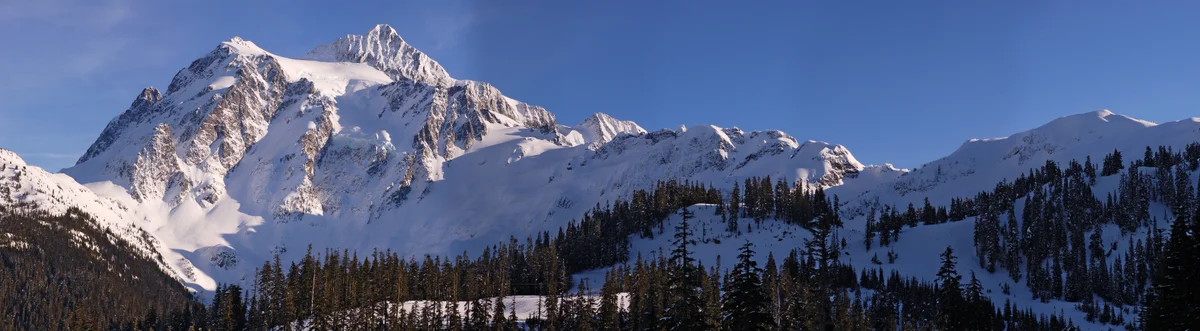
Mount Shuksan is a majestic, heavily glaciated mountain massif in the North Cascades of Washington, rising to an elevation of 2,780 metres inside North Cascades National Park. Renowned worldwide for its iconic pyramid-like summit pinnacle and reflections across Picture Lake, it is composed of ancient Shuksan blueschist and greenstone, crowned by a dozen hanging glaciers including the Curtis, Sulphide, and Price glaciers.
 United States
Mountain Safety & Conditions Disclaimer: High-altitude climbing, glacial travel, and technical ascents entail severe objective risks including avalanches, serac collapses, rapid weather collapse, and altitude illness. Historical route descriptions and summit claims on Mountanity reflect documented archival sources and must not be used as live operational safety assessments. Local regulations, permits, and physical glacial topography change continuously.
Peer Review: Senior Editorial Board & Historical Reviewers • Editorial Standards
Geographical Setting & Topography
Located just eleven miles east of Mount Baker, Mount Shuksan is an ultra-scenic non-volcanic horn in the Skagit Range of the North Cascades. Its high relief, labyrinth of hanging glaciers, and sheer north-facing ramparts above Price Lake provide some of the finest technical alpine mixed and waterfall ice routes in the Pacific Northwest.
Historic First Ascent
Date: 1897-08-01
Ascent Team: Asahel Curtis, W. Montelius Price
Key Statistics & Topographic Figures
- Summit Elevation
- 2,780 metres (9,131 feet)
- Topographic Prominence
- 1,344 metres (4,411 feet)
- First Ascent Date
- August 1897
- First Ascent Team
- Asahel Curtis & W. Montelius Price
- National Park
- North Cascades National Park, Washington
Archival Primary Source Quotations
“Shuksan stands apart from all the volcanic cones of the Cascades: a craggy, medieval fortress of ancient blue stone draped in waterfalls and hanging ice.”
Defined Alpine Terminology & Concepts
- Blueschist
- A dense, bluish metamorphic rock formed by high-pressure, low-temperature metamorphism of basaltic oceanic crust in subduction zones.
- Cirque Glacier
- A small glacier occupying a bowl-shaped alpine basin scooped out of a mountainside by glacial plucking and abrasion.
Mount Shuksan Mountain Weather Forecast
Detailed 14-Day Summit Window & Weather Timeline
Explore day-by-day summit push safety windows, wind shear analysis, and extended multi-day forecasts for Mount Shuksan.
Explore Mount Shuksan (2,780 m) in Interactive 3D
Inspect steep glacial walls, hanging seracs, ridge approaches, and elevation relief with 360° rotation and terrain tilt in WebGL.
Frequently Asked Questions: Mount Shuksan
What is Mount Shuksan and where is it situated in the Cascades?
Mount Shuksan is a heavily glaciated, non-volcanic mountain peak rising to 2,780 metres in North Cascades National Park, Washington, just east of Mount Baker.
What does the Native American name Shuksan mean?
In the indigenous Lummi language, Shuksan translates roughly to High Peak, referring to its jagged, castle-like presence above the river valleys.
Why is Mount Shuksan considered one of the most photographed mountains in the world?
Because of its stunning reflection across Picture Lake at Heather Meadows, where its sheer pyramid peak and hanging glaciers create an iconic alpine panorama.
What geological rock types compose Mount Shuksan?
Unlike volcanic Mount Baker, Mount Shuksan is composed of ancient oceanic metamorphic rocks, predominantly Shuksan greenschist and blueschist formed under extreme subduction pressures.
Who made the first ascent of Mount Shuksan and when?
The first confirmed ascent was completed in August 1897 by Asahel Curtis and W. Montelius Price via the Sulphide Glacier.
What are the classic technical climbing routes on Mount Shuksan?
Classic routes include the Fisher Chimneys (Grade III mixed route), the Price Glacier (Grade IV alpine ice face), and the standard Sulphide Glacier route.
What major glaciers cling to Mount Shuksan?
Major glaciers include the Curtis Glacier, Price Glacier, Sulphide Glacier, Upper Curtis Glacier, and Crystal Glacier.
How do climbers access Mount Shuksan for mountaineering ascents?
Climbers typically access the mountain via the Mount Baker Highway (Highway 542) from the Lake Ann trailhead or the Shannon Ridge trail on the south side.
Documented Sources & Archival Citations
- Cascade Alpine Guide: Rainy Pass to Fraser River(Fred Beckey / The Mountaineers Books)
Supporting claim: Authoritative topological and climbing route chronicle of Mount Shuksan and the North Cascades
Accessed/Documented: 2026 - Washington's Mount Shuksan(The Mountaineers)
Supporting claim: Historical records and early survey documents of Mount Shuksan
Accessed/Documented: 2026