Nanga Parbat 1895: Albert Mummery and the First Assault on an Eight-Thousander
In the summer of 1895, visionary British climber Albert F. Mummery mounted the world's first-ever expedition against an 8,000-meter peak on Nanga Parbat (8,126m), pioneering modern alpine style before vanishing forever into the mountain's mists.
Mountain Safety & Conditions Disclaimer: High-altitude climbing, glacial travel, and technical ascents entail severe objective risks including avalanches, serac collapses, rapid weather collapse, and altitude illness. Historical route descriptions and summit claims on Mountanity reflect documented archival sources and must not be used as live operational safety assessments. Local regulations, permits, and physical glacial topography change continuously.
Peer Review: Senior Editorial Board & Historical Reviewers • Editorial Standards
In the late 19th century, while conventional European climbers still treated mountaineering as an exercise in being hauled up classic alpine snow slopes by phalanxes of local Swiss guides, one man dared to imagine a completely new dimension of human capability: Albert Frederick Mummery.
A quiet, bespectacled political economist and leather merchant from Dover, Mummery was endowed with astonishing natural gymnastic agility, ferocious determination, and an uncompromising mountaineering ethic. In the Alps, he had stunned the climbing world by scaling the seemingly impossible sheer granite obelisk of the Aiguille du Grépon in 1881 via the fearsome “Mummery’s Crack” (UIAA V), followed in 1888 by the first ascent of Dych-Tau (5,205m) in the wild Central Caucasus. Mummery championed guideless climbing and pure alpine style: traveling fast, carrying minimal equipment, and accepting total personal responsibility for route-finding and safety.
By 1895, Mummery turned his gaze beyond Europe. At a time when no human being had ever stepped foot above 7,000 meters, and when high-altitude physiology was completely uncharted territory, Mummery conceived an audacious enterprise: to travel to the Western Himalayas of northern Kashmir and attempt the summit of an 8,000-meter giant—Nanga Parbat (8,126m / 26,660 ft). It was humanity’s first expedition directed against one of the Earth’s fourteen eight-thousanders.
The Audacious Team and the Diamir Face
To execute his vision, Mummery recruited a brilliant, like-minded British team: J. Norman Collie, an eminent chemist and pioneer of X-ray photography; Geoffrey Hastings, a steadfast Yorkshire rock climber; and Major Charles Granville Bruce, an officer in the 5th Gurkha Rifles who later organized the historic 1922 and 1924 British Everest expeditions. Bruce secured the invaluable support of two seasoned Gurkha soldiers, Riflemen Ragobir Thapa and Goman Singh.
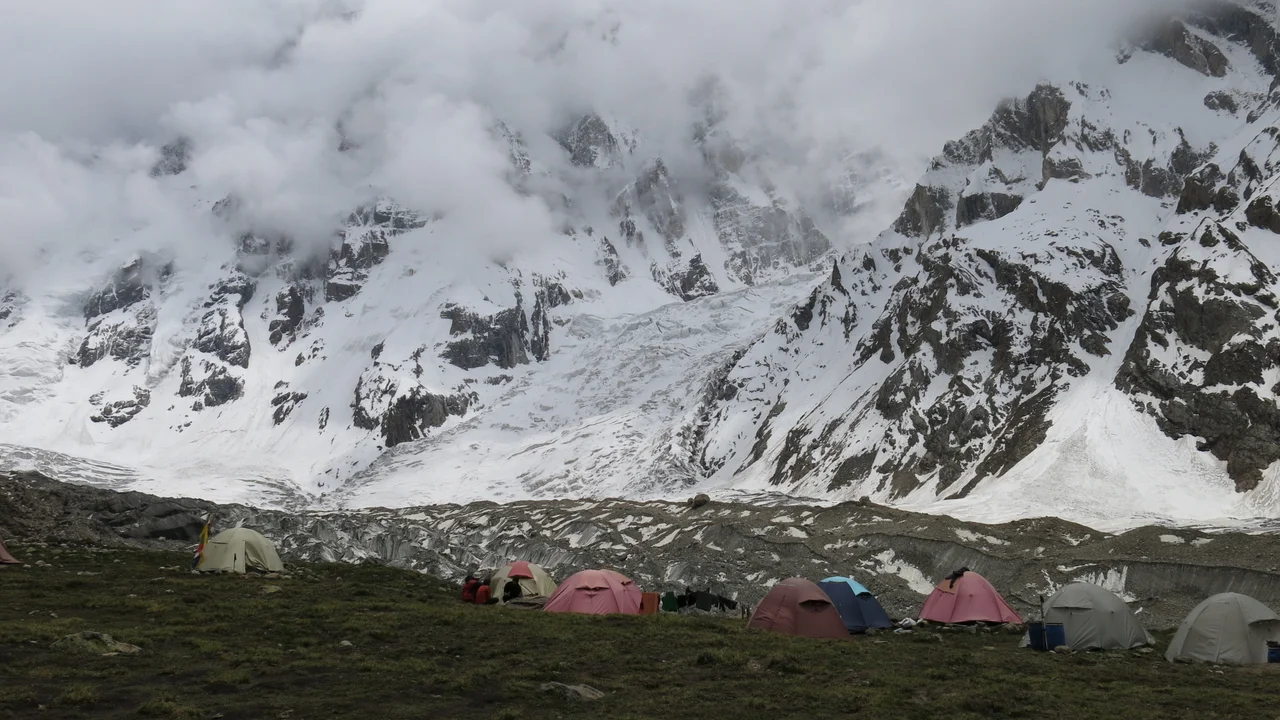
Arriving in Rawalpindi in June 1895, the party marched through the sweltering heat of the Indus Valley and into the remote, semi-independent tribal valleys of Chilas. When they crossed the high ridges and gazed into the Diamir Valley, they were struck with awe: rising before them was the colossal western rampart of Nanga Parbat—the Diamir Face—a breathtaking, sheer 4,000-meter wall of ice flutes, hanging seracs, and black rock buttresses.
Where later 20th-century expeditions would deploy hundreds of military porters, siege camps, and tons of bottled oxygen, Mummery approached this monster with four climbers, two Gurkhas, a few lightweight canvas tents, simple wool garments, and hemp ropes.
Pushing to 6,100 Meters: Mummery’s Rib
Setting up Base Camp on the grassy meadows of the Diamir Valley in July, Mummery immediately recognized the objective dangers: the face was sweeping with monstrous avalanches every afternoon, as hanging glaciers calved in the summer heat. Studying the wall, Mummery identified a prominent central rock spur that stood high above the avalanche-swept couloirs, offering a sheltered line of ascent toward the upper summit amphitheater.
Climbing with Ragobir Thapa, Mummery attacked this rock buttress—known today in mountaineering lore as Mummery’s Rib. Surmounting sheer, friable rock pitches and vertical ice steps that tested the limits of 19th-century gear, Mummery pushed methodically upward over several days, setting bivouacs in tiny snow hollows.
By mid-August, Mummery and Ragobir had reached an altitude of approximately 6,100 meters (20,000 feet). Standing higher than any human being had ever climbed on a virgin mountain, Mummery gazed up at the summit snowfields, calculating that the route ahead was technically feasible. However, the physical toll of extreme altitude on his companions was devastating. Collie and Hastings were incapacitated by severe mountain sickness, and Ragobir began vomiting blood from acute respiratory distress. With avalanches scouring the lower gullies and supplies running critically low, Mummery reluctantly ordered a retreat.
The Fatal Crossing: The Diama Pass
Down at base camp, Mummery refused to concede defeat. He reasoned that if the Diamir Face was too hazardous due to summer avalanches, the northern flank—the Rakhiot side—might offer a gentler, more stable approach. Rather than undertaking a grueling, multi-week march around the base of the massif through the scorching Indus gorges, Mummery conceived a daring shortcut: he would cross the high, unmapped glaciated ridge directly to the north, over what he named the Diama Pass (approx. 6,200m), descending into the Rakhiot Valley.
Collie and Hastings, lacking the stamina for the high-altitude crossing, agreed to lead the heavy baggage and pack animals around the long valley route, arranging to rendezvous with Mummery on the Rakhiot Glacier in four days.
On the morning of Saturday, August 24, 1895, Albert Mummery, Ragobir Thapa, and Goman Singh shouldered their lightweight rucksacks, roped together, and began ascending the upper snowfields of the Diama Glacier toward the pass. Collie watched them through his field glasses until the three tiny black specks vanished into the swirling mist beneath the hanging glaciers.
They were never seen again.
The Search and the Eternal Legacy
When Mummery failed to arrive at the agreed rendezvous on the Rakhiot Glacier, Collie and Hastings realized that disaster had struck. Marching back into the icy gorges with local guides, Collie climbed the lower moraines of the Diama Glacier, scouring the frozen slopes with a telescope. What he discovered was chilling: massive avalanches had swept down from the summit ridges, burying the upper glacial amphitheater beneath hundreds of feet of crushed blue ice and pulverized snow.
Mummery, Ragobir, and Goman Singh had almost certainly been caught by a catastrophic ice avalanche while negotiating the steep headwall beneath the Diama Pass, killed instantly and entombed in the mountain’s eternal ice.
Although Albert Mummery perished at the age of 39 on Nanga Parbat, his visionary philosophy transformed climbing forever. In an era dominated by brute force and heavy siege, Mummery proved that high-altitude mountains could be approached with humility, speed, and technical purity. Decades later, when Hermann Buhl made the historic first solo ascent of Nanga Parbat in 1953, and when Reinhold Messner achieved the first solo climb of the Diamir Face in 1978, both legends openly acknowledged Albert Frederick Mummery as the true pioneer who first showed humanity the way.
Key Statistics & Topographic Figures
- Category
- Historic Expeditions
Archival Subject
- Reading Time
- 13 min read
Narrative Length
- Key Mountain
- nanga-parbat
Objective
- Ascent Route
- rakhiot-flank
Topography
- Verification
- Editorially Verified
Archival Standard
Archival Primary Source Quotations
“In the mountains, truth is etched in ice and granite; every step requires unwavering respect for the heights.”
Defined Alpine Terminology & Concepts
- Summit Push
- The final continuous climbing effort from the highest established camp to the mountain apex and back.
- Death Zone Chronicle
- A verified, research-backed historical narrative documenting the human, technical, and environmental realities of an alpine expedition.
Frequently Asked Questions: Nanga Parbat 1895: Albert Mummery and the First Assault on an Eight-Thousander
What is the core chronicle and subject of "Nanga Parbat 1895: Albert Mummery and the First Assault on an Eight-Thousander"?
In the summer of 1895, visionary British climber Albert F. Mummery mounted the world's first-ever expedition against an 8,000-meter peak on Nanga Parbat (8,126m), pioneering modern alpine style before vanishing forever into the mountain's mists.
Which mountain peaks and routes are featured in "Nanga Parbat 1895: Albert Mummery and the First Assault on an Eight-Thousander"?
This narrative documents climbs on nanga-parbat along the rakhiot-flank in Pakistan.
Which documented expedition is chronicled in this story?
This historical chronicle captures the events of the 1895-mummery-nanga-parbat, verified through contemporary journals and archival records.
Who authored and researched this archival chronicle?
Authored and researched by Mountainity Historical Research Desk, drawing on primary eyewitness testimonies, alpine club registries, and verified summit logs.
What makes this high-altitude chronicle historically significant?
Categorized under "Historic Expeditions", this chronicle preserves critical lessons in alpine leadership, survival, tactical speed, and human endurance in the death zone.
Related Mountains


Nanga Parbat
Nanga Parbat, at 8,126 meters (26,660 ft), is the ninth-highest mountain on Earth and the western anchor of the Himalayas in Pakistan. It boasts the Rupal Face, the highest vertical precipice in the world at 4,600 meters from valley floor to summit. Known for profound climbing history, highlighted by Hermann Buhl's legendary solo summit without supplemental oxygen in 1953.
Documented Sources & Archival Citations
- From the Himalaya to the Skye(J. Norman Collie / David Douglas)
Supporting claim: Primary eyewitness account detailing the Diamir Face reconnaissance, camps, and search for Mummery
Accessed/Documented: 1902 - My Climbs in the Alps and Caucasus(Albert F. Mummery / T. Fisher Unwin)
Supporting claim: Seminal philosophical manifesto on pure alpine style and guideless mountaineering
Accessed/Documented: 1895 - The Alpine Journal: Albert Frederick Mummery (1855–1895)(The Alpine Club UK)
Supporting claim: Official expedition analysis, technical evaluation of the 6,100m high point, and memorial assessment
Accessed/Documented: 1896