The Night at 8,100 Meters: Amir Mehdi and the Unsung Heroism of K2
On July 30, 1954, Hunza climber Amir Mehdi and 24-year-old Walter Bonatti survived an 8,100-meter open bivouac on K2, carrying the oxygen that made the first summit possible.
Mountain Safety & Conditions Disclaimer: High-altitude climbing, glacial travel, and technical ascents entail severe objective risks including avalanches, serac collapses, rapid weather collapse, and altitude illness. Historical route descriptions and summit claims on Mountanity reflect documented archival sources and must not be used as live operational safety assessments. Local regulations, permits, and physical glacial topography change continuously.
Peer Review: Senior Editorial Board & Historical Reviewers • Editorial Standards
On the afternoon of July 30, 1954, high on the ice-flanked ridges of K2 (8,611m), the conquest of the world’s second-highest mountain hung on a razor’s edge.
Italian climbers Achille Compagnoni and Lino Lacedelli were entrenched in their high assault tent at Camp IX, poised for their summit bid the following morning. But they were critically short of oxygen. Below them at Camp VIII (7,620m), the expedition leaders realized that without fresh cylinders delivered immediately to Camp IX, the summit push would fail and decades of national ambition would end in retreat.
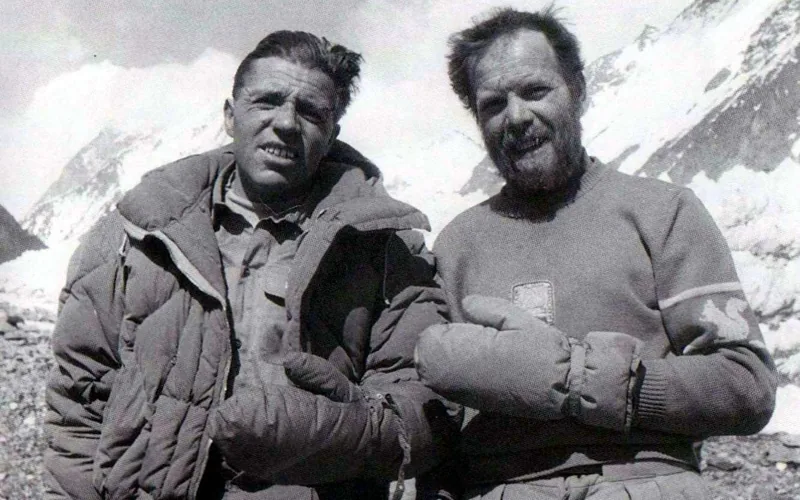
Two men stepped forward to perform the impossible. One was twenty-four-year-old Walter Bonatti, the youngest and most gifted alpinist on the Italian squad. The other was forty-year-old Amir Mehdi, an indigenous mountain veteran from the village of Hasanabad in the Hunza Valley of northern Pakistan.
The Heaviest Load in the Death Zone
Carrying two full sets of steel oxygen cylinders weighing almost 19 kilograms each, Bonatti and Mehdi set out into the darkening upper reaches of the Abruzzi Spur. In 1954, high-altitude gear was rudimentary: while the Italian climbers wore specialized double boots designed for Himalayan cold, Mehdi had only standard military issue climbing boots.
As twilight faded into ink-black night, the wind rose to hurricane fury, dropping the temperature to thirty degrees below zero. Battling heavy snow and extreme hypoxia, the two men climbed past 8,000 meters.
At approximately 8:00 PM, they reached the pre-arranged shelf where Compagnoni and Lacedelli were supposed to have pitched Camp IX. To their horror, the shelf was completely empty.
Desperately shouting into the gale, Bonatti heard a distant voice echoing through the blizzard. Compagnoni and Lacedelli had moved Camp IX higher and further to the left, pitching their tiny tent behind a steep, impassable rock traverse across an ice crevasse.
Bonatti called out into the darkness:
“We have the oxygen! We cannot find the route in the dark! Come guide us to the tent!”
A voice called back from the gloom, instructing them to leave the oxygen cylinders and head back down to Camp VIII.
Bonatti was horrified. Returning down the technical gullies in pitch darkness during a blizzard was suicide; they would surely fall thousands of meters to the Godwin-Austen Glacier. Bonatti shouted that Mehdi was freezing and could not descend. The voice from the tent replied:
“Dig in and wait for morning.”
Then the light inside Camp IX went out, leaving Bonatti and Mehdi abandoned in the freezing void at 8,100 meters.
The Highest Bivouac in History
No human being had ever survived a planned or unplanned open-air bivouac at 8,100 meters without a tent, sleeping bags, or hot fluids. At that altitude, in the heart of the Death Zone, unprotected exposure to sub-zero temperatures usually causes death within hours.
Using his ice axe, Bonatti frantically hacked a narrow shelf out of the hard snow on a fifty-degree slope. The shelf was scarcely wide enough for two men to sit side-by-side with their legs dangling over the precipice.
Bonatti pulled Mehdi close. Throughout the interminable eight hours of darkness, as hurricane-force winds threatened to blow them off the mountain, Bonatti rubbed Mehdi’s hands and kept him talking, slapping his back and urging him to stay awake. Mehdi, suffering from hallucinations and intense pain in his numbing feet, wanted to jump into the dark to escape the cold. Bonatti held him down with all his strength, anchoring their bodies to the icy slope.
At the first gray light of dawn on July 31, 1954, the gale momentarily abated. Miraculously, both men were still alive.
Bonatti carefully secured the oxygen cylinders upright in the snow with an ice axe so the summit pair could easily spot them. He then assisted Mehdi down the steep couloirs toward Camp VIII. Mehdi’s feet had turned completely white and hard as marble; every step on the frozen rock sent shockwaves of agony through his body.
Hours later, Compagnoni and Lacedelli descended to the bivouac site, picked up the full oxygen bottles left by Bonatti and Mehdi, strapped them on, and pushed through the Bottleneck to stand on the summit of K2 at 6:00 PM.
The Cost of Glory
While church bells rang across Rome and ticker-tape parades welcomed the Italian team home as national conquerors, Amir Mehdi lay in the Military Hospital in Rawalpindi. Frostbite had destroyed the circulation in his feet; military surgeons were forced to amputate all of his toes and parts of both feet to save his life from spreading gangrene.
To protect the heroic image of the expedition, early Italian reports minimized the bivouac and falsely insinuated that Bonatti and Mehdi had endangered the summit climb. For decades, Bonatti fought a bitter legal and journalistic battle to clear their names.
In Pakistan, Amir Mehdi’s immense contribution was recognized by the state. He was decorated with the prestigious Tamgha-i-Khidmat (Medal of Services) and celebrated throughout Gilgit-Baltistan as the true hero of K2.
The ultimate historical vindication came in 2004, when Lino Lacedelli published his memoir K2: The Price of Conquest, confirming Bonatti and Mehdi’s version of events and openly acknowledging that without Mehdi carrying that oxygen through the night, K2 would never have been climbed in 1954. In 2007, the Italian Alpine Club officially amended its historical records to enshrine Amir Mehdi and Walter Bonatti as the decisive saviors of the expedition.
Amir Mehdi passed away in 1999, but his endurance on that frozen ledge at 8,100 meters stands as one of the most heroic demonstrations of human grit in the history of mountaineering.
Key Statistics & Topographic Figures
- Category
- Historic Expeditions
Archival Subject
- Reading Time
- 11 min read
Narrative Length
- Key Mountain
- k2
Objective
- Ascent Route
- abruzzi-spur
Topography
- Verification
- Editorially Verified
Archival Standard
Archival Primary Source Quotations
“In the mountains, truth is etched in ice and granite; every step requires unwavering respect for the heights.”
Defined Alpine Terminology & Concepts
- Summit Push
- The final continuous climbing effort from the highest established camp to the mountain apex and back.
- Death Zone Chronicle
- A verified, research-backed historical narrative documenting the human, technical, and environmental realities of an alpine expedition.
Frequently Asked Questions: The Night at 8,100 Meters: Amir Mehdi and the Unsung Heroism of K2
What is the core chronicle and subject of "The Night at 8,100 Meters: Amir Mehdi and the Unsung Heroism of K2"?
On July 30, 1954, Hunza climber Amir Mehdi and 24-year-old Walter Bonatti survived an 8,100-meter open bivouac on K2, carrying the oxygen that made the first summit possible.
Which mountain peaks and routes are featured in "The Night at 8,100 Meters: Amir Mehdi and the Unsung Heroism of K2"?
This narrative documents climbs on k2 along the abruzzi-spur in Pakistan.
Which documented expedition is chronicled in this story?
This historical chronicle captures the events of the 1954-italian-k2, verified through contemporary journals and archival records.
Who authored and researched this archival chronicle?
Authored and researched by Mountainity Historical Research Desk, drawing on primary eyewitness testimonies, alpine club registries, and verified summit logs.
What makes this high-altitude chronicle historically significant?
Categorized under "Historic Expeditions", this chronicle preserves critical lessons in alpine leadership, survival, tactical speed, and human endurance in the death zone.
Related Mountains


K2
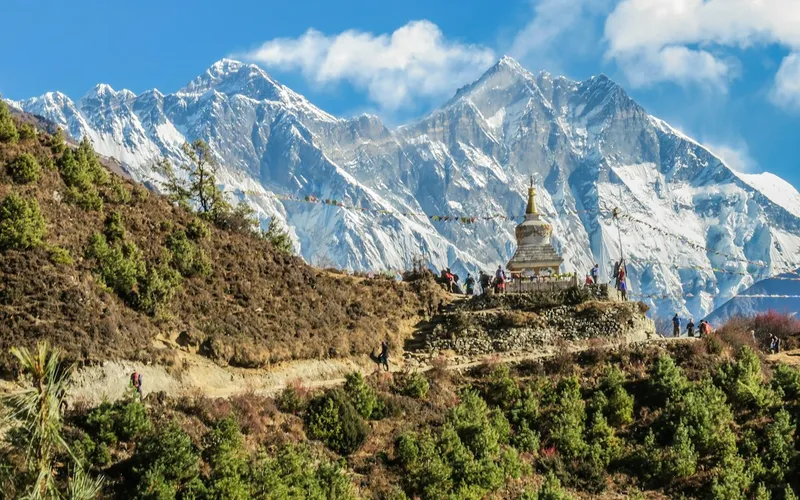
K2, at 8,611 meters (28,251 ft), is the second-highest mountain on Earth and widely regarded as the most technically demanding and lethal 8,000-meter peak. Located in the heart of the Karakoram on the border between Pakistan and China, K2 is characterized by sheer relief, severe weather anomalies, and persistent objective hazards including the notorious Bottleneck couloir.
Documented Sources & Archival Citations
- The Mountains of My Life(Walter Bonatti / Penguin Classics)
Supporting claim: Bonatti's firsthand eyewitness account of surviving the K2 open-air bivouac with Mehdi
Accessed/Documented: 2001 - K2: The Price of Conquest(Lino Lacedelli & Giovanni Cenacchi / Carreg)
Supporting claim: Lacedelli's historical confession acknowledging Bonatti and Mehdi's decisive role
- Official K2 Historical Commission Report(Club Alpino Italiano (CAI))
Supporting claim: Official CAI institutional validation and full recognition of Amir Mehdi
Accessed/Documented: 2007