The Final Continent: Dick Bass & the Birth of the Seven Summits
How a 55-year-old Texas oilman conquered Mount Vinson on April 30, 1985, to complete the world's first Seven Summits quest.

Mountain Safety & Conditions Disclaimer: High-altitude climbing, glacial travel, and technical ascents entail severe objective risks including avalanches, serac collapses, rapid weather collapse, and altitude illness. Historical route descriptions and summit claims on Mountanity reflect documented archival sources and must not be used as live operational safety assessments. Local regulations, permits, and physical glacial topography change continuously.
Peer Review: Senior Editorial Board & Historical Reviewers • Editorial Standards
The Final Continent: Dick Bass & the Birth of the Seven Summits
An Impossible Dream
In 1981, over dinner in a Salt Lake City restaurant, two middle-aged businessmen hatched an audacious idea that would transform modern mountaineering. Richard ‘Dick’ Bass, a 51-year-old Texas oilman and developer of Utah’s Snowbird ski resort, and Frank Wells, the president of Warner Brothers Studios, made a pact: they would attempt to stand atop the highest point on every one of the seven continents.
At the time, nobody had ever conceived of such an athletic grand slam. Mountain climbing was traditionally focused on national prestige or extreme single-mountain expeditions.
Over the next four years, Bass pursued the peaks with relentless energy. He summited Denali in North America, Aconcagua in South America, Mount Elbrus in Europe, Kilimanjaro in Africa, Mount Kosciuszko in Australia, and, on April 30, 1985, achieved the summit of Mount Everest in Asia.
Only one summit remained: Mount Vinson (4,892 m), locked within the frozen interior of Antarctica.
“They told me Antarctica was off-limits, that private citizens couldn’t go there, and that a businessman in his fifties had no business climbing on the polar ice cap. I told them that dreams don’t come with an expiration date.” — Dick Bass, Seven Summits, 1986
The Great Polar Airlift
In the mid-1980s, private travel to Antarctica was virtually unheard of. The continent was governed exclusively by national scientific research stations, and government transport planes like the US Navy Hercules were strictly forbidden from carrying private tourists or commercial climbers.
To solve the impossible logistics, Bass sought the guidance of Nicholas Clinch, the veteran leader of Vinson’s 1966 maiden ascent. Clinch connected Bass with Giles Kershaw, an audacious British bush pilot who possessed unmatched experience flying small aircraft in polar conditions.
Kershaw managed to modify a twin-engine Douglas DC-3 with giant skis and long-range auxiliary fuel tanks, daringly flying from Punta Arenas in Chile across the stormy Drake Passage to land on the blue ice runway of the Ellsworth Mountains. Joining Bass on the ice was David Breashears, one of the finest high-altitude mountaineers and cinematographers in American climbing history.
The March up the Branscomb
Stepping onto the ice at the base of the Sentinel Range, Bass and Breashears strapped on snowshoes and harnessed themselves to heavy sledges. The temperature hovered near -35°C, with violent winds howling down the glacier.
Under Breashears’s expert guidance, the party ascended the Branscomb Glacier, navigating between massive crevasse chasms and establishing high camps beneath the Vinson headwall. Bass, now fifty-five years old, moved with steady, bulldog determination, refusing to give in to exhaustion or the biting polar frost.
On April 30, 1985, Bass and Breashears pushed across the Vinson Plateau and climbed the final rocky arête to the summit.
History on the Polar Apex
At 2:00 PM on April 30, 1985, Dick Bass stood upon the summit of Mount Vinson: 4,892 metres above sea level.
He had done it. In standing atop Vinson, Dick Bass became the first human in history to stand on the summit of all seven continents. He had climbed Denali, Aconcagua, Elbrus, Kilimanjaro, Kosciuszko, Everest, and Vinson, turning what critics had called a midlife fantasy into a global sporting milestone.
Bass’s achievement touched off an international phenomenon. His 1986 book, Seven Summits, became a worldwide bestseller, inspiring generations of mountaineers and establishing the Seven Summits as the ultimate badge of global alpine achievement.
Key Statistics & Topographic Figures
- Category
- Polar Pioneers
Archival Subject
- Reading Time
- 15 min read
Narrative Length
- Key Mountain
- mount-vinson
Objective
- Ascent Route
- mount-vinson-normal-route
Topography
- Verification
- Editorially Verified
Archival Standard
Archival Primary Source Quotations
“In the mountains, truth is etched in ice and granite; every step requires unwavering respect for the heights.”
Defined Alpine Terminology & Concepts
- Summit Push
- The final continuous climbing effort from the highest established camp to the mountain apex and back.
- Death Zone Chronicle
- A verified, research-backed historical narrative documenting the human, technical, and environmental realities of an alpine expedition.
Frequently Asked Questions: The Final Continent: Dick Bass & the Birth of the Seven Summits
What is the core chronicle and subject of "The Final Continent: Dick Bass & the Birth of the Seven Summits"?
How a 55-year-old Texas oilman conquered Mount Vinson on April 30, 1985, to complete the world's first Seven Summits quest.
Which mountain peaks and routes are featured in "The Final Continent: Dick Bass & the Birth of the Seven Summits"?
This narrative documents climbs on mount-vinson along the mount-vinson-normal-route in Antarctica.
Which documented expedition is chronicled in this story?
This historical chronicle captures the events of the 1985-dick-bass-vinson-seven-summits, verified through contemporary journals and archival records.
Who authored and researched this archival chronicle?
Authored and researched by Mountainity Historical Research Desk, drawing on primary eyewitness testimonies, alpine club registries, and verified summit logs.
What makes this high-altitude chronicle historically significant?
Categorized under "Polar Pioneers", this chronicle preserves critical lessons in alpine leadership, survival, tactical speed, and human endurance in the death zone.
Related Mountains

Mount Vinson / Vinson Massif
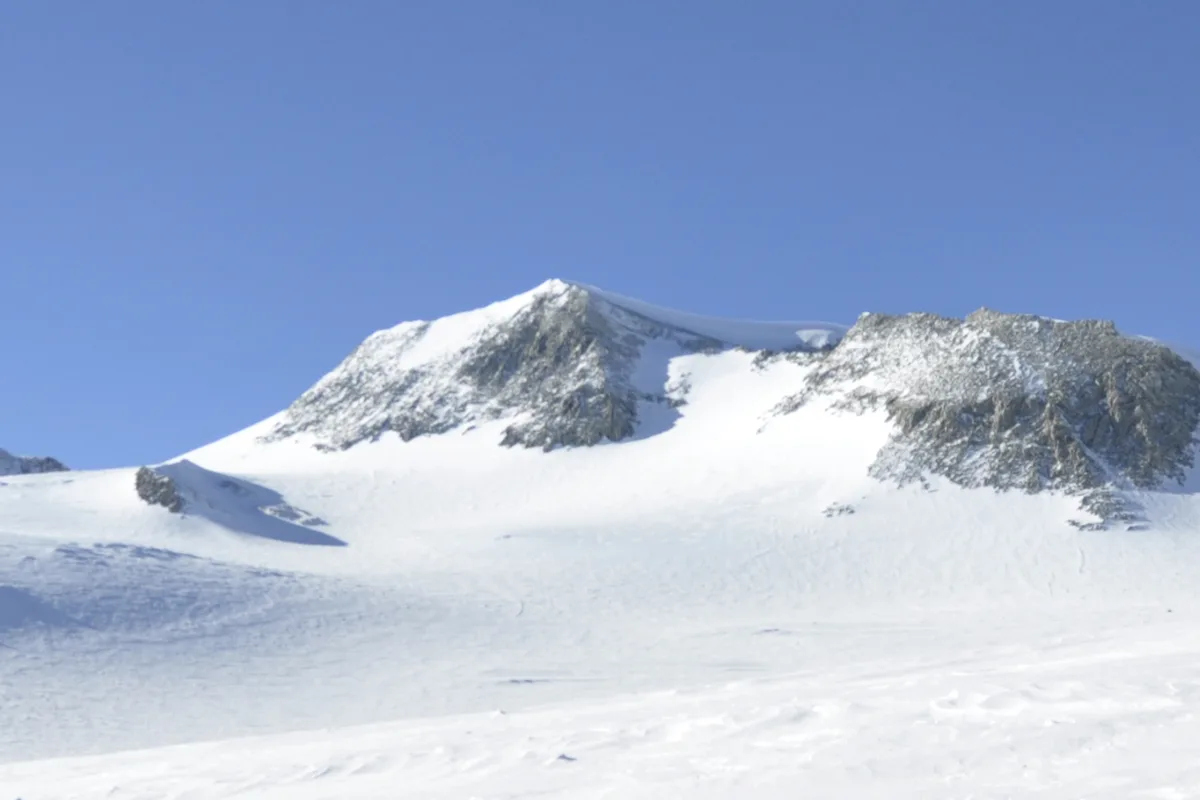
Mount Vinson is the highest peak in Antarctica at 4,892 metres (16,050 ft), situated in the Sentinel Range of the Ellsworth Mountains approximately 1,200 kilometres from the South Pole. As the summit of Antarctica, it forms one of the celebrated Seven Summits. First sighted by a US Navy aircraft in January 1958 and named after Georgia congressman Carl Vinson, the peak was conquered on December 18, 1966, by a team led by Nicholas Clinch and Barry Corbet during the historic American Antarctic Mountaineering Expedition. While technically moderate via the Branscomb Glacier, climbing Mount Vinson demands extreme endurance against temperatures plunging to -40°C and ferocious katabatic blizzards.
Documented Sources & Archival Citations
- Seven Summits(Dick Bass & Frank Wells / Warner Books)
Supporting claim: Primary autobiographical source
Accessed/Documented: 1986 - The Seven Summits Phenomenon(Alpine Journal)
Supporting claim: Historical analysis
Accessed/Documented: 1992