The Golden Obelisk: How Eternal Flame Redefined Big-Wall Free Climbing on Trango Tower
In September 1989, German climbing legends Kurt Albert and Wolfgang Güllich opened Eternal Flame on Trango Tower (6,286m), bringing extreme big-wall free climbing to the high Karakoram.
Mountain Safety & Conditions Disclaimer: High-altitude climbing, glacial travel, and technical ascents entail severe objective risks including avalanches, serac collapses, rapid weather collapse, and altitude illness. Historical route descriptions and summit claims on Mountanity reflect documented archival sources and must not be used as live operational safety assessments. Local regulations, permits, and physical glacial topography change continuously.
Peer Review: Senior Editorial Board & Historical Reviewers • Editorial Standards
The Monolith of the Baltoro
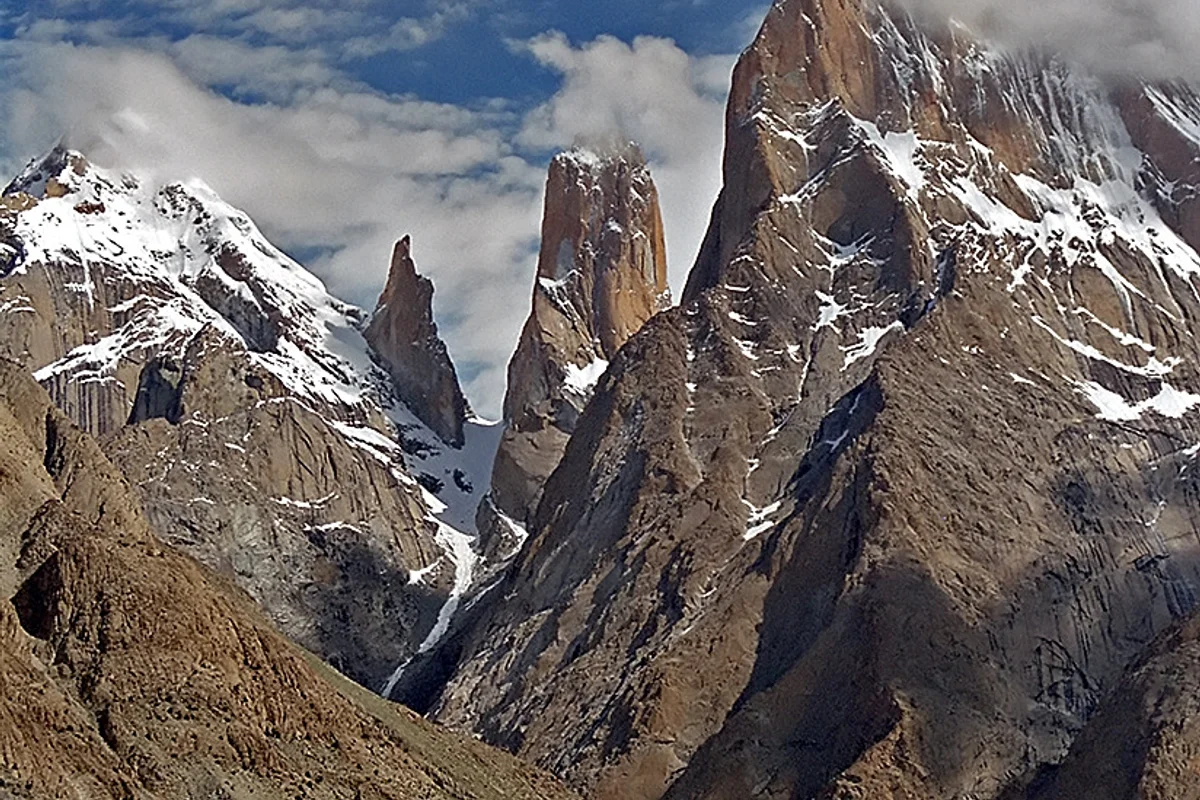
Rising like a colossal granite spear from the frozen sea of the Baltoro Glacier, Trango Tower—widely known as Nameless Tower (6,286m)—is one of the most mesmerizing geological wonders on Earth. While the surrounding eight-thousanders like K2 and Broad Peak command respect through sheer mass and glacial expanse, Trango Tower commands awe through sheer verticality. Its sheer golden walls rise unbroken for over one thousand metres, sculpted by ancient tectonic collisions and glacial scouring into an alpine cathedral of flawless, compact granite.
For decades following its 1976 first ascent by British masters Joe Brown and Mo Anthoine, climbs on Trango Tower relied heavily on traditional siege aid tactics: heavy haul bags, extensive bolt ladders, and mechanical stirrups. But as the 1980s drew to a close, a revolutionary philosophy was sweeping the rock-climbing world, spearheaded by a charismatic circle of climbers in Franconian Germany.
The Visionaries: Albert, Güllich, Stiegler, and Sykora
At the center of this revolution were two extraordinary figures: Kurt Albert, the inventor of the “redpoint” (Rotpunkt) concept that revolutionized modern sport and free climbing, and Wolfgang Güllich, widely acknowledged as the strongest and most visionary rock climber of his generation.
Albert and Güllich believed that the pure ethics of the rock crag—ascending entirely under one’s own physical power, using gear solely for protection rather than artificial progress—could and should be applied to the world’s most daunting big walls at extreme altitude. Joined by Christof Stiegler and Milan Sykora, they journeyed to Pakistan in the summer of 1989 with a daring objective: to establish the world’s first extreme-grade free climb above six thousand metres on the vertical South Face of Nameless Tower.
The Crucible on the South Face
The logistics were staggering. Just approaching the foot of the technical wall required negotiating hazardous, crumbling rock gullies and glaciated terrain above the Trango Glacier. Once established on the sunlit South Face shoulder, the climbers faced pitch after pitch of sheer, unrelenting verticality.
Living on the wall required setting up portaledges—fabric cots suspended from single-point anchors over a 1,000-metre drop. In the thin, freezing air, every physical effort was multiplied tenfold. Pumping out on steep finger cracks at 5,800 metres left the climbers gasping for air, their lungs burning from the lack of oxygen while their fingertips went numb on cold, crystalline rock holds.
Yet the quality of the granite exceeded their wildest dreams. Albert and Güllich encountered soaring splitters, elegant corner systems, and intricate face sequences on coarse, golden rock that offered exceptional friction. They climbed with minimalist rack gear, placing clean protection wherever possible and resorting to bolts only on blank stances.
Naming the Legend: Eternal Flame
As they pushed past the halfway mark of the wall, navigating a breathtaking roof and a steep headwall of breathtaking exposure, they found inspiration in a song that had accompanied their journey. The contemporary pop hit by The Bangles, Eternal Flame, had played constantly on their cassette player during the long trek up the Baltoro. To the team, the title symbolized the inextinguishable passion of the climbing spirit—a fire that burning cold and high altitude could never quench.
Over twenty-four pitches, the team conquered difficulties up to European grade IX- (French 7b+ / American 5.12c). While a handful of pitches required temporary aid points due to icy conditions in the cracks, the overwhelming majority was climbed completely free.
On September 9, 1989, Kurt Albert, Wolfgang Güllich, Christof Stiegler, and Milan Sykora stood together on the sharp summit spire of Nameless Tower (6,286m), bathed in the afternoon sun of the Karakoram. They had completed Eternal Flame.
The Legacy of an Alpine Masterpiece
The opening of Eternal Flame in 1989 is universally recognized as one of the watershed moments in mountaineering history. It bridged the divide between technical gymnastic rock climbing and high-altitude alpinism, demonstrating that extreme athletic performance was possible in the most remote corners of the planet.
In the decades that followed, Eternal Flame became the holy grail of big-wall climbing, drawing the world’s greatest alpinists. In 2009, German brothers Thomas and Alexander Huber completed the first completely free ascent (freeing the remaining aid pitches up to 7c+ / 5.13a). In 2022, Babsi Zangerl and Jacopo Larcher repeated the all-free feat as a mixed pair, and in 2024, Edu Marín made the first free single-push ascent.
Yet the route’s soul remains rooted in that golden September of 1989, when Kurt Albert and Wolfgang Güllich lit a torch on the granite monolith of the Baltoro that continues to burn brightly in the hearts of climbers worldwide.
Key Statistics & Topographic Figures
- Category
- Big Wall Alpine Legends
Archival Subject
- Reading Time
- 13 min read
Narrative Length
- Key Mountain
- trango-tower
Objective
- Ascent Route
- trango-tower-eternal-flame
Topography
- Verification
- Editorially Verified
Archival Standard
Archival Primary Source Quotations
“In the mountains, truth is etched in ice and granite; every step requires unwavering respect for the heights.”
Defined Alpine Terminology & Concepts
- Summit Push
- The final continuous climbing effort from the highest established camp to the mountain apex and back.
- Death Zone Chronicle
- A verified, research-backed historical narrative documenting the human, technical, and environmental realities of an alpine expedition.
Frequently Asked Questions: The Golden Obelisk: How Eternal Flame Redefined Big-Wall Free Climbing on Trango Tower
What is the core chronicle and subject of "The Golden Obelisk: How Eternal Flame Redefined Big-Wall Free Climbing on Trango Tower"?
In September 1989, German climbing legends Kurt Albert and Wolfgang Güllich opened Eternal Flame on Trango Tower (6,286m), bringing extreme big-wall free climbing to the high Karakoram.
Which mountain peaks and routes are featured in "The Golden Obelisk: How Eternal Flame Redefined Big-Wall Free Climbing on Trango Tower"?
This narrative documents climbs on trango-tower along the trango-tower-eternal-flame in Pakistan.
Which documented expedition is chronicled in this story?
This historical chronicle captures the events of the 1989-trango-tower-eternal-flame, verified through contemporary journals and archival records.
Who authored and researched this archival chronicle?
Authored and researched by Mountainity Historical Research Desk, drawing on primary eyewitness testimonies, alpine club registries, and verified summit logs.
What makes this high-altitude chronicle historically significant?
Categorized under "Big Wall Alpine Legends", this chronicle preserves critical lessons in alpine leadership, survival, tactical speed, and human endurance in the death zone.
Related Mountains

Trango Tower (Nameless Tower)
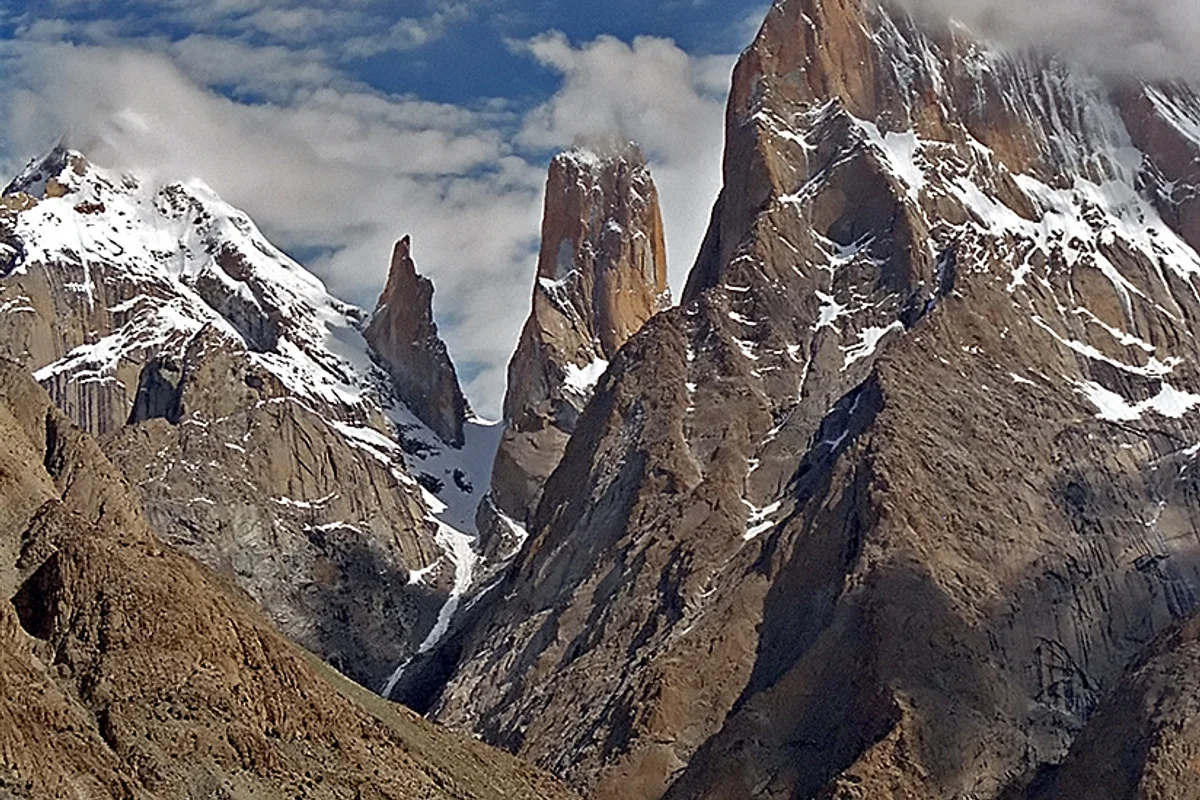
Trango Tower, universally renowned as Nameless Tower, is a stupendous 6,286-metre granite monolith rising vertically from the Baltoro Glacier basin in Gilgit-Baltistan, Pakistan. With sheer vertical rock walls exceeding 1,000 metres of vertical relief at extreme altitude, it represents the gold standard of worldwide big-wall alpine rock climbing.
Documented Sources & Archival Citations
- American Alpine Journal: Eternal Flame, Nameless Tower, Trango Group(American Alpine Club)
Supporting claim: Official expedition record by Kurt Albert detailing the 1989 first ascent
Accessed/Documented: 2026 - Rotpunkt: Kurt Albert and the Birth of Redpoint Climbing(Patagonia Books)
Supporting claim: Historical analysis of the ethics and style of the 1989 Trango Tower climb
Accessed/Documented: 2026