Trapped on the Rupal Wall: Tomaž Humar's Miracle Nanga Parbat Helicopter Rescue
In August 2005, Slovenian soloist Tomaž Humar was pinned by avalanches at 6,000 meters on Nanga Parbat's Rupal Face, surviving six days before a heroic Pakistan Army helicopter long-line rescue.
Mountain Safety & Conditions Disclaimer: High-altitude climbing, glacial travel, and technical ascents entail severe objective risks including avalanches, serac collapses, rapid weather collapse, and altitude illness. Historical route descriptions and summit claims on Mountanity reflect documented archival sources and must not be used as live operational safety assessments. Local regulations, permits, and physical glacial topography change continuously.
Peer Review: Senior Editorial Board & Historical Reviewers • Editorial Standards
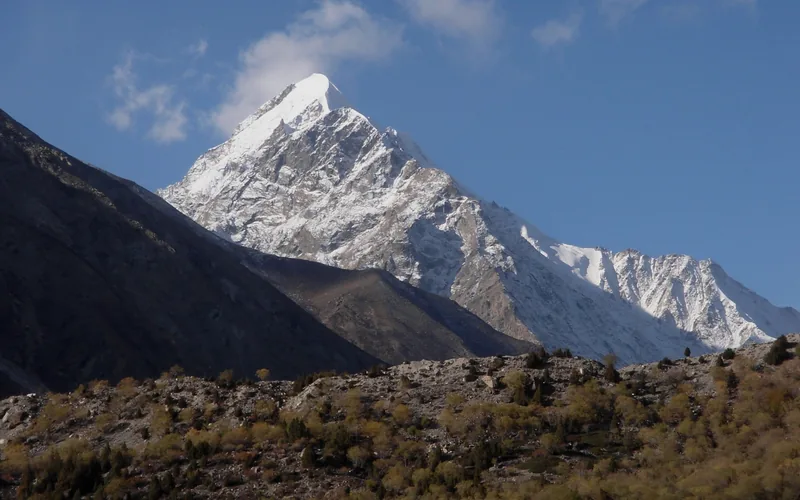
The Rupal Face of Nanga Parbat (8,126m) is widely acknowledged as the largest vertical escarpment on planet Earth. Rising 4,500 vertical meters in a sheer wall of ice, granite, and snow, the face had repelled nearly every attempt in history since the Messner brothers first climbed it in 1970. In July 2005, Slovenian alpine virtuoso Tomaž Humar set his sights on opening a new direct route up the central pillar—solo, without oxygen, and in pure alpine style.
Entering the wall on August 1, Humar made swift, impressive progress, scaling steep mixed ice pitches to reach 6,000 meters in just three days. But on August 3, unseasonably warm air masses collided with the peak, triggering a catastrophic environmental shift. Heavy wet snow began to fall, turning the entire 4,500-meter precipice into a continuous curtain of thunderous avalanches.
Pinned on a Knife-Edge Ledge
Cut off from both above and below, Humar was forced to carve out a precarious sliver of ice beneath an overhanging serac at 5,900 meters. The ledge was so narrow that he could not lie flat. For six days and nights, Humar sat hunched inside a saturated, freezing sleeping bag while continuous streams of powder spindrift battered him.
Temperatures fluctuated between bitter frost and freezing rain. Water seeped through his clothing, freezing into a solid crust of ice every evening. By August 7, suffering from trench foot, mild frostbite, and deep hypothermia, Humar’s satellite phone battery was down to its final bars. He transmitted an agonizing plea: “This is my last day. If you don’t get me out, I am going to die here.”
The Diplomatic Mobilization and the Flight
Humar’s desperate plight triggered an unprecedented international mobilization. Slovenian President Janez Drnovšek directly contacted Pakistani President Pervez Musharraf, requesting military aviation assistance. The mission was assigned to the elite pilots of the Pakistan Army Aviation Corps’ 8th Squadron (the “Fearless”), stationed in Gilgit.
No helicopter had ever successfully plucked a climber from a sheer 6,000-meter mountain face on a long line. The thin atmosphere at that altitude pushed the Eurocopter SA315B Lama light helicopter beyond its theoretical service ceiling, where rotor blades lose aerodynamic lift and wind downdrafts from the face could smash an aircraft into the rock in seconds.
The Historic Long-Line Snatch
On the morning of August 10, 2005, after two days of weather reconnaissance, a brief clear window opened over Nanga Parbat. Lieutenant Colonel Rashid Ullah Beg and Major Khalid Amir Rana stripped their Lama helicopter of all non-essential weight—including passenger seats, doors, and auxiliary tanks—to maximize lift.
Approaching the vertical wall, Lieutenant Colonel Beg battled vicious thermal updrafts and rotor downwash. Lowering a 25-meter weighted nylon rope with a rescue sling, Major Rana guided the aircraft toward the tiny ledge. As the helicopter hovered inches from the sheer rock face with rotor tips almost scraping the cliff, Humar grabbed the steel carabiner, clipped it into his climbing harness, and cut himself free from his ice anchors.
With the sudden transfer of weight, the helicopter shuddered violently in the thin air, but Lieutenant Colonel Beg applied maximum collective pitch and dove away from the face into the valley. Trailing beneath the helicopter on the long line against the backdrop of the Himalayan clouds, Tomaž Humar was flown to safety at Base Camp. The operation remains celebrated as one of the most daring and technically flawless aerial rescues in world aviation history.
Key Statistics & Topographic Figures
- Category
- High-Altitude Survival & Rescue
Archival Subject
- Reading Time
- 16 min read
Narrative Length
- Key Mountain
- nanga-parbat
Objective
- Ascent Route
- kinshofer-route
Topography
- Verification
- Editorially Verified
Archival Standard
Archival Primary Source Quotations
“In the mountains, truth is etched in ice and granite; every step requires unwavering respect for the heights.”
Defined Alpine Terminology & Concepts
- Summit Push
- The final continuous climbing effort from the highest established camp to the mountain apex and back.
- Death Zone Chronicle
- A verified, research-backed historical narrative documenting the human, technical, and environmental realities of an alpine expedition.
Frequently Asked Questions: Trapped on the Rupal Wall: Tomaž Humar's Miracle Nanga Parbat Helicopter Rescue
What is the core chronicle and subject of "Trapped on the Rupal Wall: Tomaž Humar's Miracle Nanga Parbat Helicopter Rescue"?
In August 2005, Slovenian soloist Tomaž Humar was pinned by avalanches at 6,000 meters on Nanga Parbat's Rupal Face, surviving six days before a heroic Pakistan Army helicopter long-line rescue.
Which mountain peaks and routes are featured in "Trapped on the Rupal Wall: Tomaž Humar's Miracle Nanga Parbat Helicopter Rescue"?
This narrative documents climbs on nanga-parbat along the kinshofer-route in Pakistan.
Which documented expedition is chronicled in this story?
This historical chronicle captures the events of the 2005-tomaz-humar-nanga-parbat, verified through contemporary journals and archival records.
Who authored and researched this archival chronicle?
Authored and researched by Mountainity Historical Research Desk, drawing on primary eyewitness testimonies, alpine club registries, and verified summit logs.
What makes this high-altitude chronicle historically significant?
Categorized under "High-Altitude Survival & Rescue", this chronicle preserves critical lessons in alpine leadership, survival, tactical speed, and human endurance in the death zone.
Related Mountains


Nanga Parbat
Nanga Parbat, at 8,126 meters (26,660 ft), is the ninth-highest mountain on Earth and the western anchor of the Himalayas in Pakistan. It boasts the Rupal Face, the highest vertical precipice in the world at 4,600 meters from valley floor to summit. Known for profound climbing history, highlighted by Hermann Buhl's legendary solo summit without supplemental oxygen in 1953.
Documented Sources & Archival Citations
- National Geographic: Miracle Rescue on Nanga Parbat(National Geographic)
Supporting claim: Detailed investigative report on the 6,000-meter long-line helicopter rescue by Pakistan Army Aviation
Accessed/Documented: 2005-09-01 - Dawn: Pakistan Army Pilots Honored for Heroic Nanga Parbat Rescue(Dawn Newspaper)
Supporting claim: Official reporting on Sitara-i-Basalat military decorations conferred upon the rescue pilots
Accessed/Documented: 2005-08-12