Dhaulagiri I: Summiting the White Mountain in a Tempest
How Nirmal Purja and his Nepali team fought 70-knot summit winds and blinding whiteouts to conquer Dhaulagiri I.
Mountain Safety & Conditions Disclaimer: High-altitude climbing, glacial travel, and technical ascents entail severe objective risks including avalanches, serac collapses, rapid weather collapse, and altitude illness. Historical route descriptions and summit claims on Mountanity reflect documented archival sources and must not be used as live operational safety assessments. Local regulations, permits, and physical glacial topography change continuously.
Peer Review: Senior Editorial Board & Historical Reviewers • Editorial Standards
The Fortress of the White Mountain
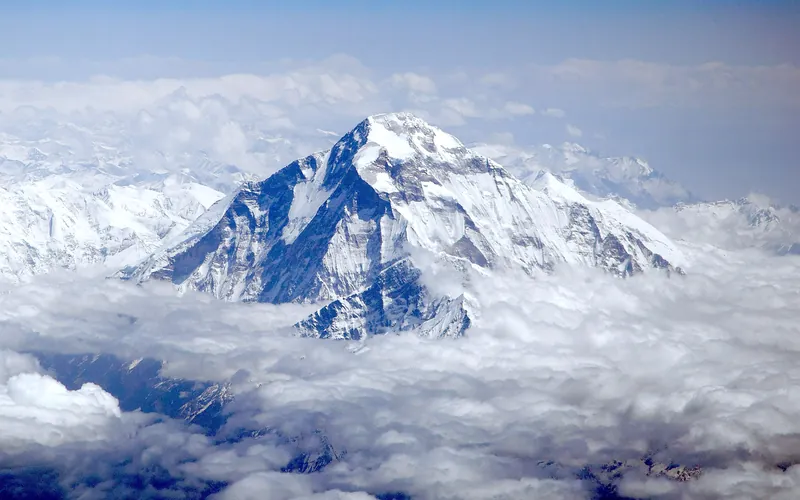
Immediately after the harrowing rescue on Annapurna, Nirmal Purja turned his sights westward to Dhaulagiri I (8,167m), the ‘White Mountain’. Rising abruptly above the Kali Gandaki gorge, Dhaulagiri is notorious for unpredictable microclimates and savage jet-stream gales that funnel directly over its razor-sharp Northeast Ridge.
By the first week of May 2019, dozens of commercial climbers had set up camp at the base of Dhaulagiri, but none had dared venture above Camp 2. A succession of severe low-pressure systems battered the upper mountain, stripping fixed lines, blowing away empty tents, and dumping deep slabs of unstable wind-crust across the upper couloirs.
Launching into the Storm
Purja refused to let the strict Project Possible timeline slip. Assessing the meteorological reports, he identified a narrow operational window—not of calm skies, but of wind speeds that remained just below the physical threshold of blowing climbers off the mountain. Accompanied by Mingma David Sherpa and Gesman Tamang, Purja set out from Camp 3 in heavy snowfall.
As the team crossed 7,600 meters into the Death Zone, winds accelerated to over 70 knots (130 km/h). Blinding spindrift reduced visibility to less than two meters. Navigating purely by compass bearing, instinct, and memory of the terrain, Purja broke trail through knee-deep drifts on the knife-edge crest. At 18:15 on May 12, 2019, through freezing gloom, the team stood on the summit of Dhaulagiri.
The Proof of Concept
Descending through the pitch-black night amidst sustained gale-force winds, the team safely reached Camp 3 in an incredible display of high-altitude navigation. Dhaulagiri proved that Purja’s Special Forces tactical training and mental resilience could overcome conditions that completely paralyzed conventional commercial expeditions.
Key Statistics & Topographic Figures
- Category
- Storm Ascents
Archival Subject
- Reading Time
- 8 min read
Narrative Length
- Key Mountain
- dhaulagiri
Objective
- Ascent Route
- dhaulagiri-northeast-ridge
Topography
- Verification
- Editorially Verified
Archival Standard
Archival Primary Source Quotations
“In the mountains, truth is etched in ice and granite; every step requires unwavering respect for the heights.”
Defined Alpine Terminology & Concepts
- Summit Push
- The final continuous climbing effort from the highest established camp to the mountain apex and back.
- Death Zone Chronicle
- A verified, research-backed historical narrative documenting the human, technical, and environmental realities of an alpine expedition.
Frequently Asked Questions: Dhaulagiri I: Summiting the White Mountain in a Tempest
What is the core chronicle and subject of "Dhaulagiri I: Summiting the White Mountain in a Tempest"?
How Nirmal Purja and his Nepali team fought 70-knot summit winds and blinding whiteouts to conquer Dhaulagiri I.
Which mountain peaks and routes are featured in "Dhaulagiri I: Summiting the White Mountain in a Tempest"?
This narrative documents climbs on dhaulagiri along the dhaulagiri-northeast-ridge in Nepal.
Which documented expedition is chronicled in this story?
This historical chronicle captures the events of the 2019-purja-dhaulagiri, verified through contemporary journals and archival records.
Who authored and researched this archival chronicle?
Authored and researched by Mountanity Research Desk, drawing on primary eyewitness testimonies, alpine club registries, and verified summit logs.
What makes this high-altitude chronicle historically significant?
Categorized under "Storm Ascents", this chronicle preserves critical lessons in alpine leadership, survival, tactical speed, and human endurance in the death zone.
Related Mountains

Dhaulagiri I
Dhaulagiri I, at 8,167 meters (26,795 ft), is the seventh-highest mountain on Earth and the highest peak situated entirely within Nepal. Rising steeply above the Kali Gandaki Gorge—the deepest gorge on Earth—opposite Annapurna, Dhaulagiri forms a staggering 7,000-meter vertical rise from the river valley.