Makalu: Sealing the Unbelievable 48-Hour Triple Crown
Nirmal Purja completes Everest, Lhotse, and Makalu in 48 hours and 30 minutes, concluding Phase One of Project Possible.
Mountain Safety & Conditions Disclaimer: High-altitude climbing, glacial travel, and technical ascents entail severe objective risks including avalanches, serac collapses, rapid weather collapse, and altitude illness. Historical route descriptions and summit claims on Mountanity reflect documented archival sources and must not be used as live operational safety assessments. Local regulations, permits, and physical glacial topography change continuously.
Peer Review: Senior Editorial Board & Historical Reviewers • Editorial Standards
The 48-Hour Clock
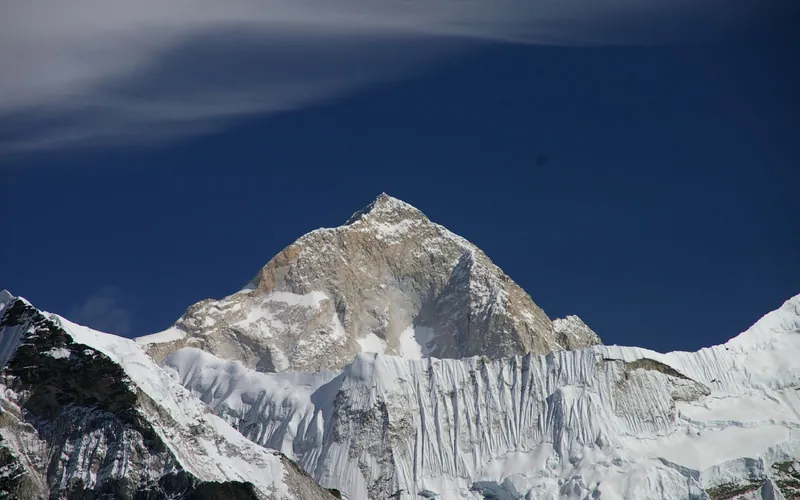
On the morning of May 23, 2019, Nirmal Purja touched down at Makalu Base Camp by helicopter. His body had already endured the grueling summits of Everest and Lhotse over the preceding 24 hours. Normal acclimatization protocol for Makalu (8,485m)—a notoriously steep, isolated granite behemoth—demands weeks of rotation. Purja had zero hours to spare.
Gearing up immediately, Purja, Mingma David Sherpa, and Gesman Tamang commenced an uninterrupted speed ascent up the Northwest Ridge. Skipping standard staging camps, they pushed continuously through the afternoon and night, relying purely on the residual red-blood-cell acclimatization forged on Everest.
Conquering the French Couloir
Above 7,800 meters, Makalu throws up severe mixed climbing on granite slabs and wind-scoured ice ribs. In the early morning hours of May 24, as exhaustion threatened to overwhelm the team, Purja took the point, hammering crampons into hard verglas and kicking steps through the French Couloir.
At 06:00 AM on May 24, 2019, Nirmal Purja stepped onto the summit pinnacle of Makalu. He had stood atop Everest, Lhotse, and Makalu within an astonishing 48 hours and 30 minutes—a feat that high-altitude physiologists had previously declared mathematically and physically impossible.
Phase One Complete: 6 Giants in 31 Days
With Makalu conquered, Phase One of Project Possible was concluded. In just 31 days (April 23 to May 24), Purja had climbed Annapurna I, Dhaulagiri I, Kangchenjunga, Mount Everest, Lhotse, and Makalu. The global climbing community realized that a historic revolution in alpinism was unfolding before their eyes.
Key Statistics & Topographic Figures
- Category
- Record Expeditions
Archival Subject
- Reading Time
- 8 min read
Narrative Length
- Key Mountain
- makalu
Objective
- Ascent Route
- makalu-normal-route
Topography
- Verification
- Editorially Verified
Archival Standard
Archival Primary Source Quotations
“In the mountains, truth is etched in ice and granite; every step requires unwavering respect for the heights.”
Defined Alpine Terminology & Concepts
- Summit Push
- The final continuous climbing effort from the highest established camp to the mountain apex and back.
- Death Zone Chronicle
- A verified, research-backed historical narrative documenting the human, technical, and environmental realities of an alpine expedition.
Frequently Asked Questions: Makalu: Sealing the Unbelievable 48-Hour Triple Crown
What is the core chronicle and subject of "Makalu: Sealing the Unbelievable 48-Hour Triple Crown"?
Nirmal Purja completes Everest, Lhotse, and Makalu in 48 hours and 30 minutes, concluding Phase One of Project Possible.
Which mountain peaks and routes are featured in "Makalu: Sealing the Unbelievable 48-Hour Triple Crown"?
This narrative documents climbs on makalu along the makalu-normal-route in Nepal.
Which documented expedition is chronicled in this story?
This historical chronicle captures the events of the 2019-purja-makalu, verified through contemporary journals and archival records.
Who authored and researched this archival chronicle?
Authored and researched by Mountanity Research Desk, drawing on primary eyewitness testimonies, alpine club registries, and verified summit logs.
What makes this high-altitude chronicle historically significant?
Categorized under "Record Expeditions", this chronicle preserves critical lessons in alpine leadership, survival, tactical speed, and human endurance in the death zone.
Related Mountains


Makalu
Makalu, at 8,485 meters (27,838 ft), is the fifth-highest mountain on Earth, located 19 km southeast of Mount Everest. An isolated four-sided granite pyramid, it is known for technical knife-edge ridges, severe exposure, and punishing weather, making it one of the most challenging eight-thousanders.