1980 Reinhold Messner Solo Mount Everest Expedition
Reinhold Messner's historic solo ascent of Mount Everest from the Tibetan north side during the monsoon season without supplemental oxygen, fixed camps, or radio contact.
Mountain Safety & Conditions Disclaimer: High-altitude climbing, glacial travel, and technical ascents entail severe objective risks including avalanches, serac collapses, rapid weather collapse, and altitude illness. Historical route descriptions and summit claims on Mountanity reflect documented archival sources and must not be used as live operational safety assessments. Local regulations, permits, and physical glacial topography change continuously.
Peer Review: Senior Editorial Board & Historical Reviewers • Editorial Standards
Official Expedition Narrative & Archival Record
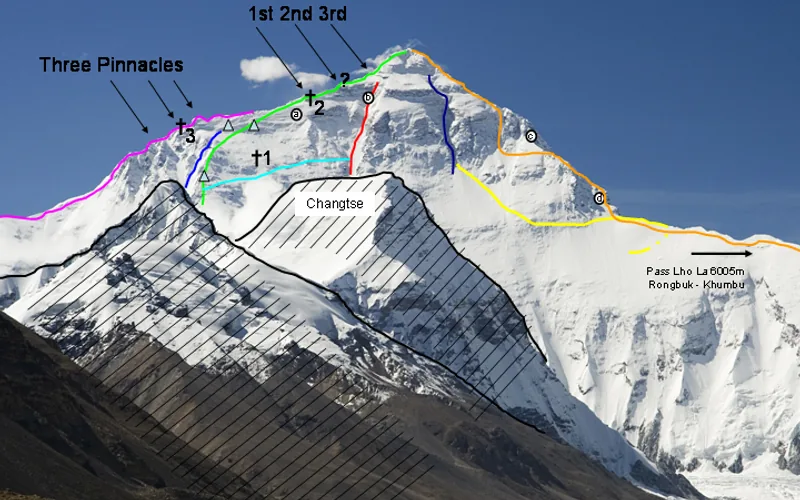
In August 1980, Reinhold Messner launched what many mountaineering historians consider the greatest high-altitude achievement in history: a solo ascent of Mount Everest (8,848.86m) from the north side during the monsoon season. Accompanied only by his companion Nena Holguín at Advanced Base Camp on the Rongbuk Glacier, Messner carried a lightweight rucksack weighing under 20 kilograms, containing a lightweight bivouac tent, camera, and basic supplies—without supplemental oxygen, radio communication, high-altitude porters, or fixed ropes. On his first day, an accidental fall into an 8-meter crevasse nearly ended the expedition before he managed to climb out along an ice wedge. Battling driving snow, treacherous monsoon powder, and extreme physical exhaustion, Messner navigated past the North Col and traversed diagonally through the North Face into the Great Couloir (Norton Couloir). On August 20, 1980, hallucinatory and drawing on the absolute limits of physical will, Messner stepped onto the summit of Mount Everest at 3:00 PM, collapsing in tears of relief. He spent just 40 minutes at the summit taking documentary photographs before descending safely to Advanced Base Camp, proving that an individual climber could take on the highest point on Earth in total self-reliance.
Documented Team Composition
- Reinhold Messner (Solo Summit Climber)
- Nena Holguín (Base Camp Support)
Key Statistics & Topographic Figures
- Summit Date
- August 20, 1980
First Completely Solo Ascent
- Climber
- Reinhold Messner (Solo)
Without Oxygen, Radio, or Camps
- Ascent Route
- North Face / Norton Couloir
Tibet Approach
- Season
- Monsoon (August)
Heavy Snow Conditions
Archival Primary Source Quotations
“I was in continual agony; I have never in my whole life been so tired as on the summit of Everest that day. I just sat down and didn’t care about anything.”
Defined Alpine Terminology & Concepts
- Norton Couloir (Great Couloir)
- A deep, sheer gully cutting vertically through the upper North Face of Mount Everest, named after Edward Norton who reached 8,570m in it in 1924.
- Solo Alpinism
- Climbing alone in remote alpine terrain with no climbing partner, no belay partner, and total personal accountability for safety.
Frequently Asked Questions: 1980 Reinhold Messner Solo Mount Everest Expedition
Who completed the first completely solo ascent of Mount Everest?
Reinhold Messner completed the first solo ascent of Mount Everest from base camp to summit without supplemental oxygen, porters, or fixed camps on August 20, 1980.
What route did Reinhold Messner take during his 1980 solo climb?
Messner climbed from the Tibetan North side, traversing across the North Face to ascend via the Norton Couloir (Great Couloir), avoiding the Second Step on the North Ridge.
Why did Reinhold Messner climb Everest during the monsoon season in 1980?
Messner deliberately chose the August monsoon season because the Chinese authorities granted him exclusive access to the mountain, ensuring complete isolation and solitude with zero other expeditions on the peak.
What dangerous incident almost ended Messner’s solo climb?
On his first morning above Advance Base Camp at 5:00 AM, a snow bridge collapsed and Messner plunged eight meters down into a dark glacial crevasse. By sheer luck, he landed on a narrow snow bridge inside the crevasse and managed to ice-climb out.
Ascent Route & Topography
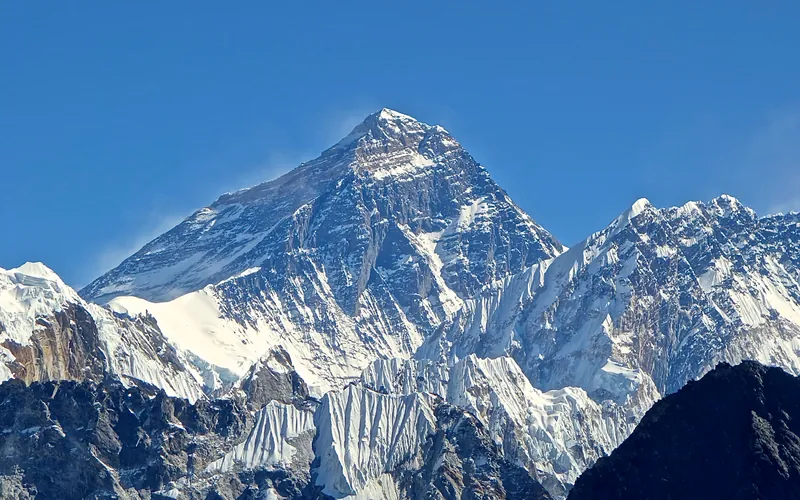
South Col & Southeast Ridge (Normal Route)
The South Col Route along the Southeast Ridge is the historic path of the 1953 first ascent and the most popular route on Mount Everest. Starting from Base Camp on the Khumbu Glacier in Nepal, climbers navigate the shifting seracs of the Khumbu Icefall into the Western Cwm. The route then scales the icy 45-degree slope of the Lhotse Face to the South Col at 7,925 meters, launching the final summit bid through the Balcony, South Summit, and Hillary Step to the summit of Earth at 8,848.86 meters.
Target Objective Peak
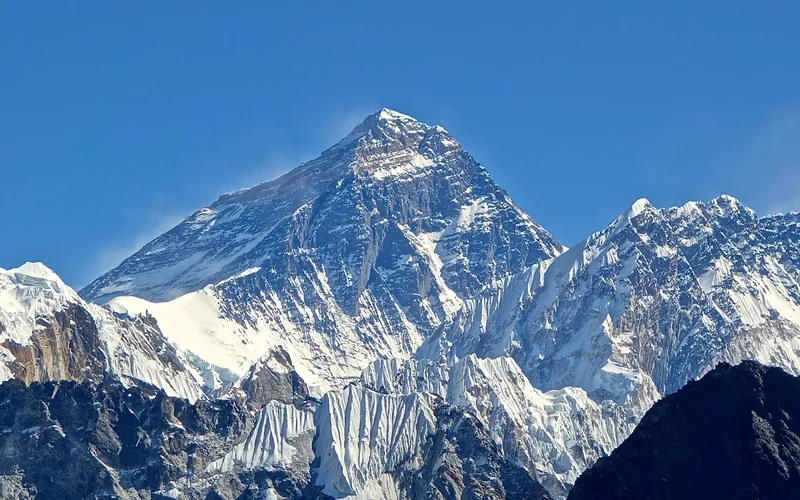


Mount Everest
Mount Everest is the highest mountain above sea level on Earth, standing at an official elevation of 8,848.86 meters (29,031.7 ft). Straddling the international frontier between Nepal and China, it is known locally as Sagarmatha in Nepali ('Goddess of the Sky') and Chomolungma in Tibetan ('Mother Goddess of the World'). The peak rises into the extreme upper troposphere, where oxygen levels drop to barely one-third of sea-level pressure. Climbers face hurricane-force jet stream winds, severe frostbite conditions, shifting ice crevasses in the Khumbu Icefall, and the dangerous Death Zone above 8,000 meters.
Featured Expedition Climber
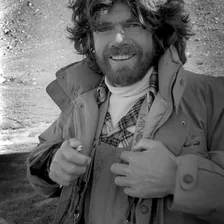
Reinhold Messner
Reinhold Messner was born on September 17, 1944, in Bressanone (Brixen), South Tyrol, Italy, and grew up in the rugged Villnöß valley beneath the towering limestone spires of the Geisler Peaks (Odle). Guided by his father Josef, Messner completed his first alpine ascent at age five. By his late teens, Reinhold and his younger brother Günther had evolved into one of the most prolific and technically daring climbing partnerships in European mountaineering history, establishing hundreds of first ascents across the Dolomites, Western Alps, and Central Europe. In 1968, Messner penned the seminal climbing essay 'The Murder of the Impossible' (Die Ermordung des Unmöglichen), launching a vehement ethical rebellion against the heavy siege tactics, expansion bolts, and mechanical apparatus dominating mid-century mountaineering. He argued passionately that technical artificial aids killed the genuine spiritual and physical challenge of climbing, advocating instead for strict self-reliance, minimal equipment, and clean alpine style. In 1970, Messner stepped onto the global stage during the Austro-German Expedition to Nanga Parbat (8,126m) led by Karl Maria Herrligkoffer. Alongside his brother Günther, Messner completed the audacious first ascent of the Rupal Face—the largest direct rock and ice wall on the planet, rising 4,500 vertical meters above the valley floor. After reaching the summit in fading light on June 27, Günther succumbed to severe altitude exhaustion, making a descent back down the terrifying Rupal Face impossible. In a desperate bid for survival, the brothers undertook the first complete traverse of an 8,000-meter mountain by descending the unexplored Diamir Face. Near the base of the mountain, Günther was swept away and killed by an ice avalanche. Reinhold, hallucinating and suffering catastrophic frostbite, stumbled into local pastures days later, subsequently undergoing surgical amputation of six toes and parts of his fingertips. Rather than ending his mountaineering career, the physical trauma accelerated Messner's transformation into the purest lightweight high-altitude climber of the modern era. In May 1978, Messner and Austrian partner Peter Habeler stunned medical researchers and high-altitude physiologists by summiting Mount Everest (8,848.86m) entirely without supplemental oxygen via the South Col. Prominent scientists had insisted that atmospheric pressure at 8,848 meters made oxygenless human survival impossible. Just three months later, in August 1978, Messner scored another historic milestone by soloing Nanga Parbat from base camp to summit via an unclimbed route on the Diamir Face—the first completely solo ascent of an 8,000-meter peak from base to summit. Messner pushed self-sufficiency to its historical absolute in August 1980 during a solo monsoon ascent of Mount Everest from the Tibetan north side. Operating without oxygen, porters, fixed camps, or two-way radio communication, he survived an 8-meter crevasse fall and battled deep monsoon snow to summit via the North Face and Great Couloir (Norton Couloir). In the summers that followed, he demonstrated the speed and agility of alpine style on giants like K2, Kangchenjunga, and Gasherbrum I and II. In 1982, teaming up with Pakistani climbers Nazir Sabir and Sher Khan, he completed a back-to-back traverse of Gasherbrum II and Broad Peak within nine days. On October 16, 1986, by standing on the summit of Lhotse (8,516m), Messner completed the ascent of all fourteen 8,000-meter peaks on Earth—the first human to achieve the Grand Slam of mountaineering, every single peak climbed without bottled oxygen. Having redefined high-altitude mountaineering, Messner turned his boundless endurance toward horizontal planetary wildernesses. Between 1989 and 1990, he and German polar explorer Arved Fuchs completed the first crossing of Antarctica on foot and skis via the South Pole without motor or dog assistance, covering 2,800 kilometers in 92 days. He subsequently crossed Greenland and traversed the 2,000-kilometer expanse of the Gobi Desert on foot. Messner served as a Member of the European Parliament for the Italian Green Party from 1999 to 2004, championing mountain conservation and Alpine culture. He established the Messner Mountain Museum (MMM)—a network of six architectural museums across South Tyrol and Belluno dedicated to human engagement with mountains, art, and high-altitude history. Messner remains the enduring benchmark for ethics, psychological fortitude, and alpine purity.
Associated Historical Chronicles & Stories
1980 Everest Solo: Reinhold Messner's Ultimate Epic
The epic chronicle of Reinhold Messner summiting Mount Everest completely solo, without oxygen or radio, during the monsoon season.
Documented Sources & Archival Citations
- The Crystal Horizon: Everest - The First Solo Ascent(Reinhold Messner / The Mountaineers Books)
Supporting claim: Detailed firsthand account of the 1980 solo north face monsoon ascent of Mount Everest
Accessed/Documented: 1989 - American Alpine Journal: Everest Solo(American Alpine Club)
Supporting claim: Official expedition record and route documentation of the 1980 solo climb
Accessed/Documented: 1981