1986 Polish K2 South Face & First Female Summit Expedition
The dramatic summer 1986 season on K2 in which Wanda Rutkiewicz made history on June 23 as the first woman to summit K2 without supplemental oxygen, followed on July 8 by Jerzy Kukuczka and Tadeusz Piotrowski's monumental first ascent of the terrifying Polish Line on the central South Face.
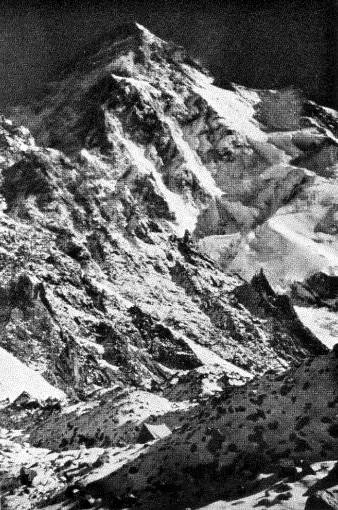
Mountain Safety & Conditions Disclaimer: High-altitude climbing, glacial travel, and technical ascents entail severe objective risks including avalanches, serac collapses, rapid weather collapse, and altitude illness. Historical route descriptions and summit claims on Mountanity reflect documented archival sources and must not be used as live operational safety assessments. Local regulations, permits, and physical glacial topography change continuously.
Peer Review: Senior Editorial Board & Historical Reviewers • Editorial Standards
Official Expedition Narrative & Archival Record
The summer of 1986 on K2 (8,611m) was a season of unprecedented triumph and harrowing tragedy. On June 23, Polish mountaineer Wanda Rutkiewicz, climbing without supplemental oxygen alongside French alpinists Liliane and Maurice Barrard, reached the summit of K2, becoming the first woman in history to conquer the Savage Mountain. Tragically, both Barrards died on the descent in worsening weather, leaving Rutkiewicz to fight her way down alone to Base Camp. Two weeks later, Polish titans Jerzy Kukuczka and Tadeusz Piotrowski launched an audacious alpine-style assault on the colossal, unclimbed central South Face of K2. Over five days of continuous technical mixed climbing beneath overhanging seracs, they forced a direct line that Reinhold Messner called 'suicidal', reaching the summit at 6:25 PM on July 8, 1986. During their descent down the Abruzzi Spur on July 10, disaster struck at 7,900 meters when Piotrowski's crampons slipped off his boots and he fell 1,000 meters to his death. Kukuczka barely survived, reaching Base Camp exhausted. To this day, the Polish Line on K2 has never been repeated.
Documented Team Composition
- Jerzy Kukuczka (Summit Climber, South Face)
- Tadeusz Piotrowski (Summit Climber, South Face - Perished)
- Wanda Rutkiewicz (Summit Climber, Abruzzi Spur)
- Liliane Barrard (Summit Climber - Perished)
- Maurice Barrard (Summit Climber - Perished)
Key Statistics & Topographic Figures
- First Female K2 Summit
- June 23, 1986
Wanda Rutkiewicz (No O2)
- Polish Line Summit
- July 8, 1986 (6:25 PM)
Kukuczka & Piotrowski
- South Face Height
- 3,200 meters
Godwin-Austen to Summit
- Route Status
- Unrepeated in History
K2 Polish Line
Archival Primary Source Quotations
“This route on K2 is suicidal. Only someone of Kukuczka’s inhuman stamina could have survived.”
Defined Alpine Terminology & Concepts
- Polish Line (K2)
- The direct central route up K2’s South Face pioneered in 1986 by Jerzy Kukuczka and Tadeusz Piotrowski, considered one of the boldest and most hazardous routes in alpinism.
- Bottleneck (K2)
- A narrow 80-degree couloir at 8,200 meters on K2 directly beneath a 100-meter hanging serac, notorious as the most dangerous bottleneck on Earth.
Frequently Asked Questions: 1986 Polish K2 South Face & First Female Summit Expedition
Who was the first woman to climb K2?
Polish mountaineer Wanda Rutkiewicz became the first woman in history to summit K2 (8,611m) on June 23, 1986, climbing via the Abruzzi Spur without supplemental oxygen.
What was the Polish Line on K2 pioneered in 1986?
The Polish Line was a revolutionary, direct route up the central South Face of K2 climbed in July 1986 by Jerzy Kukuczka and Tadeusz Piotrowski in alpine style without oxygen.
Why did Reinhold Messner call the K2 Polish Line "suicidal"?
Because the route ascends directly beneath colossal hanging seracs and ice cliffs that continuously discharge catastrophic avalanches across the central wall.
How did Tadeusz Piotrowski die on K2 in 1986?
During their descent down the Abruzzi Spur on July 10, Piotrowski’s crampons detached from his boots at 7,900m; he lost his footing on steep ice and fell over 1,000 meters to his death.
Did Wanda Rutkiewicz use supplemental oxygen on K2?
No. Wanda Rutkiewicz summited K2 on June 23, 1986, entirely without supplemental bottled oxygen, becoming only the third human to reach the summit without oxygen.
Why was the 1986 summer on K2 called the "Black Summer"?
Thirteen elite international climbers died in violent storms, falls, and avalanches on K2 between June and August 1986, making it the deadliest season in K2 history.
Has the K2 Polish Line ever been repeated?
No. The Polish Line on K2 has never been repeated by any mountaineer to this day, remaining one of the most perilous unrepeated routes in the world.
What tragedy struck Wanda Rutkiewicz’s French partners on K2?
French climbers Maurice and Liliane Barrard, who summited shortly after Rutkiewicz, were lost in a severe storm during their descent and perished near the Bottleneck.
Ascent Route & Topography
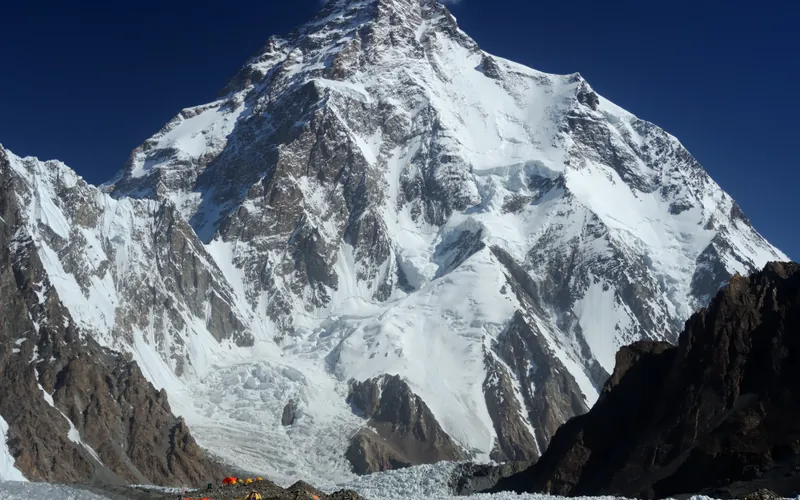
Abruzzi Spur (Southeast Ridge)
The Abruzzi Spur is the most famous and frequently climbed route on K2, tracing the mountain's steep southeast ridge from the Godwin-Austen Glacier to the summit. First explored in 1909 by Prince Luigi Amedeo, Duke of the Abruzzi, it was successfully climbed to the summit in 1954 by an Italian team. The route requires extreme physical endurance and high-grade technical climbing on rock, ice, and mixed terrain through legendary cruxes like House's Chimney, the Black Pyramid, and the Bottleneck couloir.
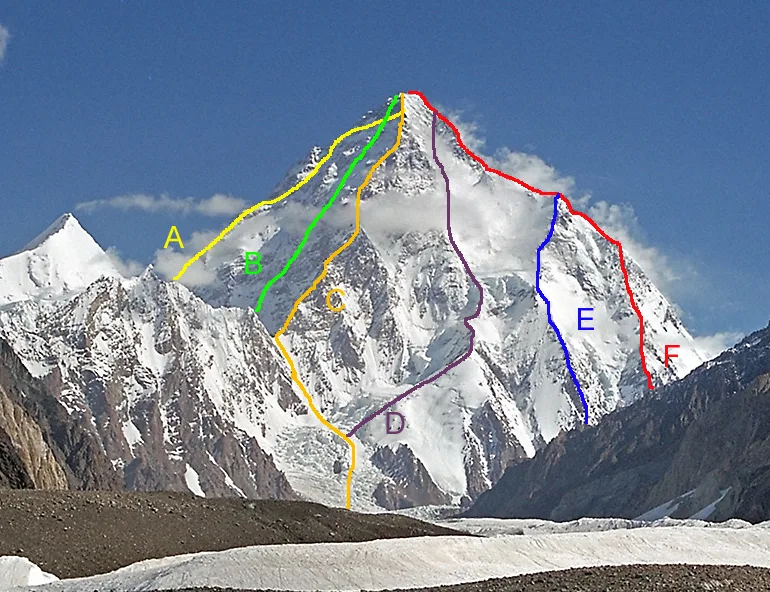
K2 South Face (The Polish Line)
The Polish Line on the South Face of K2 (8,611m) is widely regarded as one of the most perilous and audacious routes ever climbed in high-altitude mountaineering history. Tackling the direct 3,200-meter wall between the Abruzzi Spur and the Magic Line (South-Southwest Pillar), the route ascends through a chaotic labyrinth of hanging seracs, avalanche funnels, and vertical rock bands. Pioneered in alpine style over five harrowing days in July 1986 by Jerzy Kukuczka and Tadeusz Piotrowski without supplemental oxygen, Reinhold Messner famously dubbed it 'suicidal'. Kukuczka and Piotrowski reached the summit on July 8, but tragedy struck during their desperate descent via the Abruzzi Spur when Piotrowski lost both crampons and plunged to his death. To this day, the Polish Line remains unrepeated.
Target Objective Peak
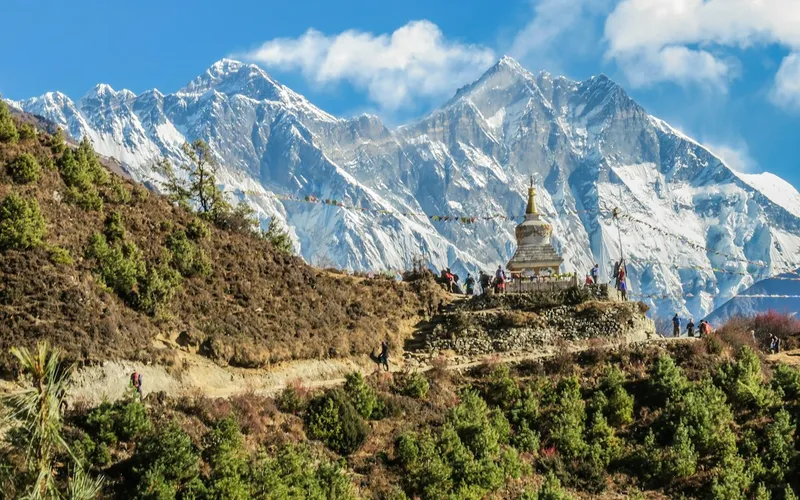


K2
K2, at 8,611 meters (28,251 ft), is the second-highest mountain on Earth and widely regarded as the most technically demanding and lethal 8,000-meter peak. Located in the heart of the Karakoram on the border between Pakistan and China, K2 is characterized by sheer relief, severe weather anomalies, and persistent objective hazards including the notorious Bottleneck couloir.
Featured Expedition Climbers
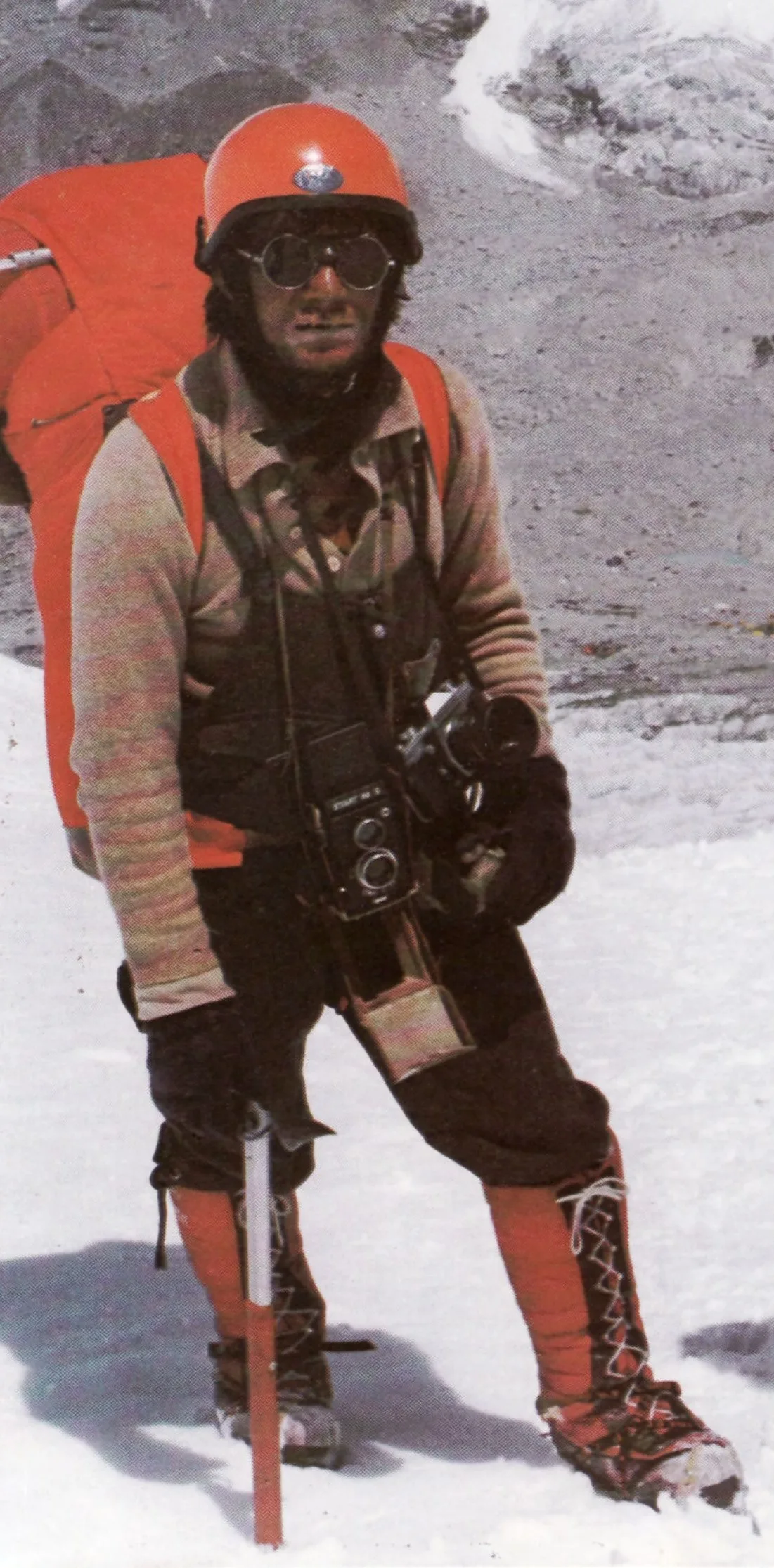
Jerzy Kukuczka
Jerzy Kukuczka was born on March 24, 1948, in Katowice, in the industrial heartland of Silesia, Poland. Working as an electrical technician in local coal mines, he found liberation and transcendence in the granite crags of the High Tatras during the 1960s. Despite severe material shortages under Communist rule, Kukuczka and his peers in the Katowice Mountaineering Club fabricated their own pitons, tents, and down parkas from discarded scraps. His immense physical stamina, quiet psychological resilience, and preternatural ability to withstand extreme cold soon set him apart from his contemporaries. Kukuczka burst onto the global mountaineering stage in 1979 with an ascent of Lhotse (8,516m) without supplemental oxygen. In the spring of 1980, he joined the Polish national expedition to Mount Everest led by Andrzej Zawada. Paired with Andrzej Czok, Kukuczka pioneered a daring new route up the South Pillar, summiting on May 19, 1980—his only 8,000-meter ascent using supplemental oxygen. The following year, in autumn 1981, he pulled off a stunning solo first ascent of Makalu (8,485m) via the Northwest Ridge, surviving multiple exposed bivouacs on the knife-edge crest in pure lightweight style. What distinguished Kukuczka from all other climbers was his refusal to repeat established normal routes. Between 1979 and 1987, he summited all fourteen 8,000-meter peaks in just under eight years—half the time it took Reinhold Messner. Remarkably, eleven of his fourteen ascents were accomplished by new routes, four were completed in the brutal depths of Himalayan winter, and one was executed completely solo. In winter 1985, he pulled off the near-impossible: after summiting Dhaulagiri I (8,167m) in winter on January 21, he raced across Nepal to join another team and made the first winter ascent of Cho Oyu (8,188m) on February 15—two winter 8,000m summits within 25 days. In July 1986, Kukuczka teamed up with Tadeusz Piotrowski to tackle the formidable South Face of K2 (8,611m). Over five grueling days in pure alpine style, they forced a direct route through catastrophic hanging seracs and vertical rock bands, establishing the 'Polish Line'. Reinhold Messner later famously termed the line 'suicidal'. Though they reached the summit on July 8, their descent down the Abruzzi Spur turned to tragedy when Piotrowski lost both crampons and plunged to his death, leaving Kukuczka to crawl into Base Camp alone and near death. The Polish Line has never been repeated. On September 18, 1987, Kukuczka summited Shishapangma (8,027m) via a new route on the Western Ridge, becoming the second person in history to climb all fourteen eight-thousanders. Reinhold Messner sent him a legendary congratulatory telegram: 'You are not the second; you are great.' At the 1988 Calgary Winter Olympics, Kukuczka was awarded the Silver Olympic Order for his mountaineering achievements. Driven by an unquenchable desire to test human limits, Kukuczka returned to Nepal in autumn 1989 to attempt the unclimbed 3,300-meter South Face of Lhotse—the 'Last Great Problem' of the Himalayas. On October 24, 1989, climbing at 8,200 meters near the summit headwall, a secondhand 7mm rope purchased in a Kathmandu bazaar snapped over a sharp rock rib. Kukuczka fell 2,000 meters into the abyss. His body remains entombed in the ice of Lhotse's South Face. He remains the undisputed benchmark for high-altitude suffering, boldness, and alpine creativity.
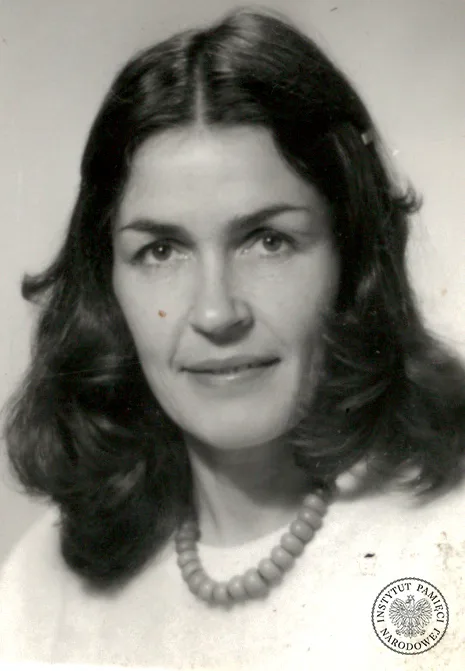
Wanda Rutkiewicz
Wanda Rutkiewicz was born on February 4, 1943, in Plungė, Lithuania (then under German occupation), to Polish parents. After World War II, her family was repatriated to Wrocław, Poland. A gifted athlete and competitive volleyball player in Poland's national first division, Rutkiewicz earned a degree in electrical engineering from the Wrocław University of Science and Technology. In 1961, an engine breakdown on her motorcycle near the Falcon Mountains (Góry Sokole) introduced her to a group of local rock climbers. She took up climbing instantly, quickly displaying exceptional technical grace, balance, and an iron will. Rutkiewicz rapidly shattered gender barriers across European mountaineering. In 1968, she completed the iconic East Face of the Aiguille du Grépon in the Mont Blanc massif. In August 1973, she led an all-female team in making the first female ascent of the fearsome North Face of the Eiger (Heckmair Route) under harsh icy conditions. Moving to the Karakoram in 1975, Rutkiewicz organized and led the historic Polish Women's Expedition to Gasherbrum III (7,952m)—at the time the highest unclimbed peak in the world—successfully making its first ascent alongside Alison Chadwick-Onyszkiewicz, Janusz Onyszkiewicz, and Krzysztof Zdzitowiecki. On October 16, 1978, Rutkiewicz achieved global fame by reaching the summit of Mount Everest (8,848m) via the South Col as part of a German-Austrian expedition led by Karl Herrligkoffer. She became the first Polish citizen, the first European woman, and only the third woman in world history to stand on top of Everest. By an extraordinary historical coincidence, on the very day she reached the summit, fellow Pole Karol Wojtyła was elected Pope John Paul II in Rome. When they met the following year, the Pope famously told her: 'Good Lord willed that we both went so high on the same day.' Rutkiewicz's most celebrated achievement occurred on June 23, 1986, on K2 (8,611m), the 'Savage Mountain'. Climbing without supplemental oxygen as part of a small team with French alpinists Liliane and Maurice Barrard, Rutkiewicz endured grueling physical suffering to become the first woman in history to stand on the summit of K2. Her triumph, however, was quickly overshadowed by tragedy when both Barrards perished during the descent in worsening weather, leaving Rutkiewicz to fight her way down the Abruzzi Spur alone to safety. Determined to climb all fourteen 8,000-meter peaks, Rutkiewicz launched her ambitious 'Caravan of Dreams' project in the late 1980s. Despite severe financial constraints, lack of sponsorship, and severe injuries from an accident in the Caucasus, she summited eight 8,000-meter giants, including Nanga Parbat (1985, first all-female ascent), Gasherbrum II, Gasherbrum I, Cho Oyu, and Annapurna (1991, solo via the South Face). In May 1992, at age 49, Rutkiewicz attempted Kangchenjunga (8,586m) alongside Mexican climber Carlos Carsolio. Suffering from extreme exhaustion, she bivouacked at 8,300 meters on the northwest face. Carsolio, descending from the summit on May 12, encountered her huddled in a snow cave and urged her to turn back with him. Rutkiewicz refused, stating she would rest and make her summit bid the next morning. She was never seen again. Her body was never recovered. Wanda Rutkiewicz remains a towering global symbol of female independence, uncompromising courage, and high-altitude mastery.
Associated Historical Chronicles & Stories
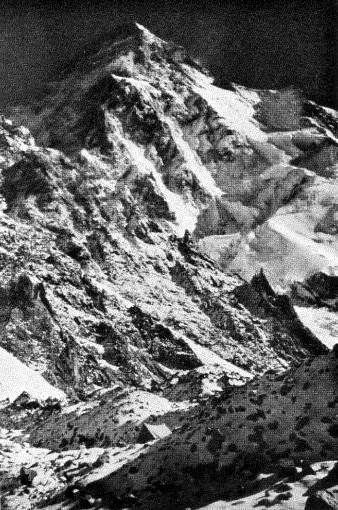
K2 1986: Wanda Rutkiewicz's Historic Summit and Kukuczka's Polish Line
During the dramatic summer of 1986 on K2, Wanda Rutkiewicz made history as the first woman to summit the Savage Mountain, while Jerzy Kukuczka conquered the terrifying, unrepeated Polish Line.
Documented Sources & Archival Citations
- My Vertical World: Climbing the 8000-Metre Peaks(Jerzy Kukuczka / The Mountaineers)
Supporting claim: Autobiographical account of the five-day South Face climb and Piotrowski's death
Accessed/Documented: 1992 - K2: Triumph and Tragedy(Jim Curran / Grafton Books)
Supporting claim: Comprehensive historical investigation into the 1986 K2 season, Rutkiewicz's summit, and the disasters
Accessed/Documented: 1987