Aoraki / Mount Cook vs Matterhorn: Elevation & Routes
Aoraki / Mount Cook (3,724 m) and Matterhorn (4,478 m) represent one of the most compelling comparative studies in high-altitude mountaineering. Highlighting the premier technical symbols of mountaineering in New Zealand and the European Alps, these two summits attract international attention for their contrasting topography, climatic extremes, and historical significance.
Compare Any Two Mountains Side by Side
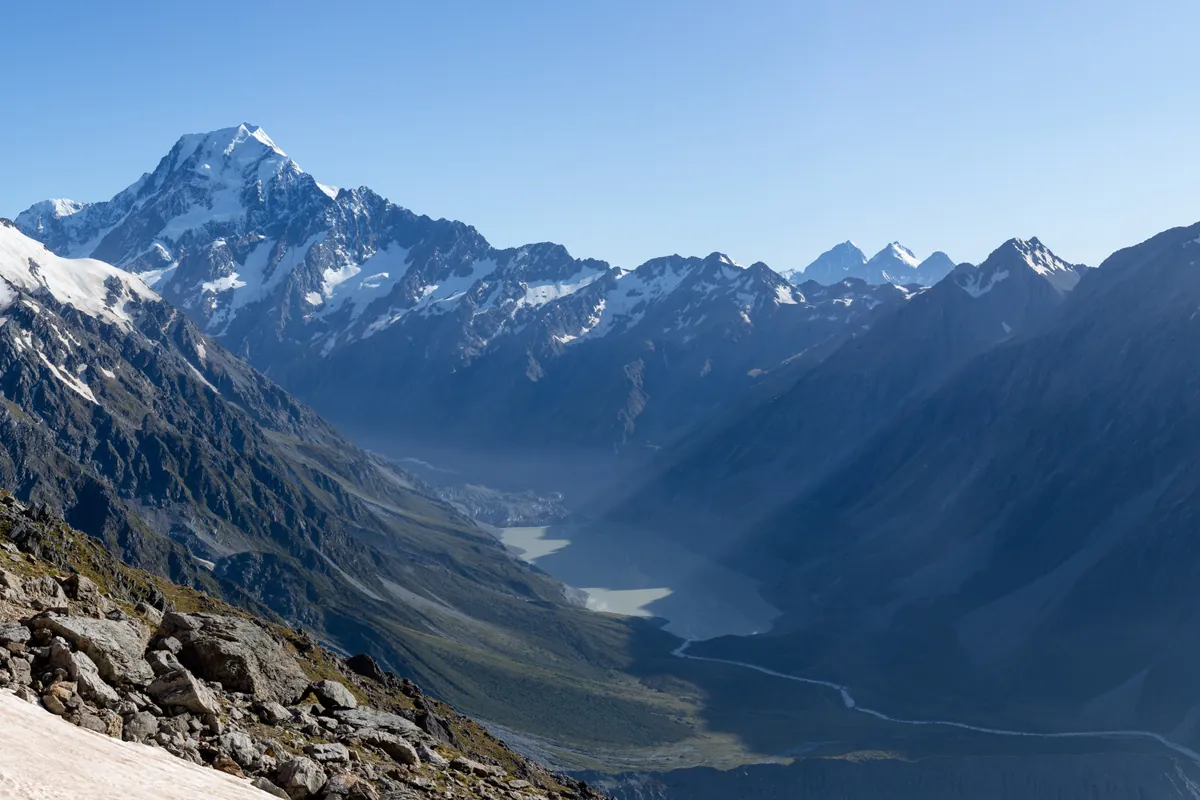
Aoraki / Mount Cook
Aoraki / Mount Cook is the highest mountain in New Zealand at 3,724 meters (12,218 ft). Located in the Southern Alps, it is an ultra-prominent glaciated peak rising dramatically above the Tasman Glacier. It is sacred in Māori mythology as the ancestor Aoraki. The mountain is renowned as the formative training ground where Sir Edmund Hillary developed his high-altitude icecraft. On January 30, 1948, Hillary completed the historic first ascent of the technical South Ridge alongside Harry Ayres. Climbing Aoraki requires expert crampon technique, glacier navigation, and vigilance against severe maritime storms.
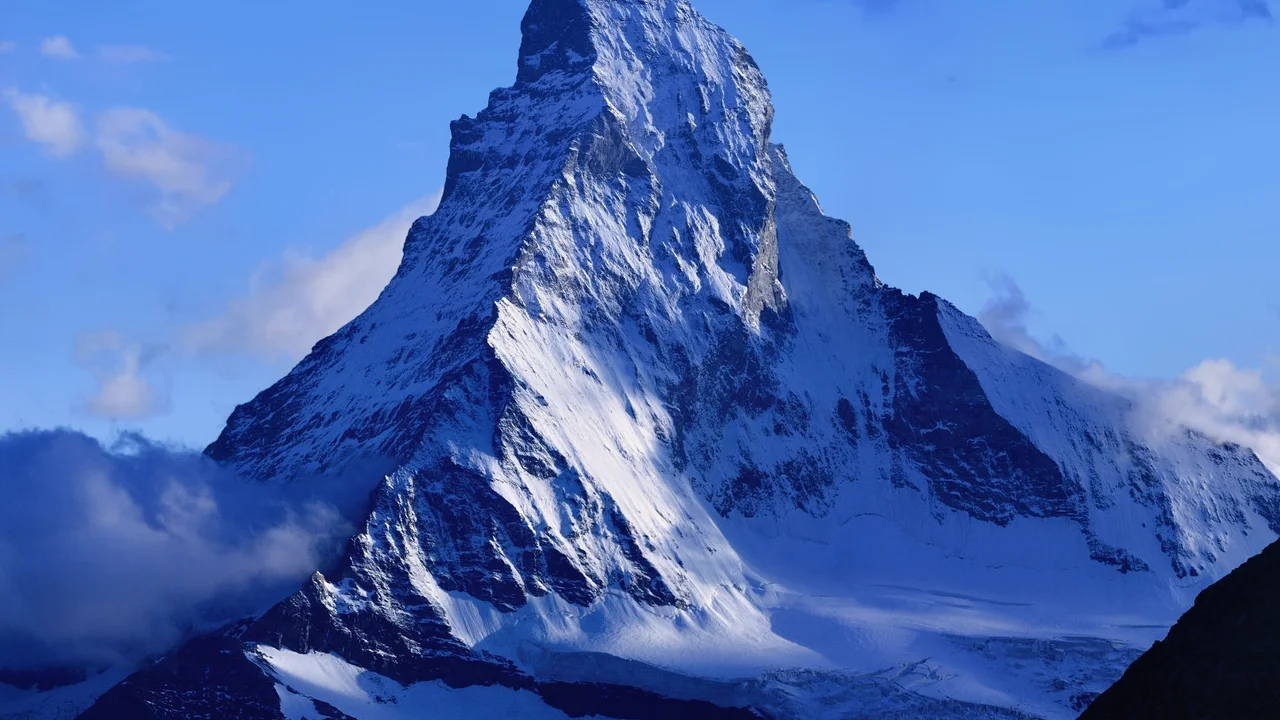
Matterhorn
The Matterhorn (Monte Cervino), at 4,478 meters (14,692 ft), is one of the most recognizable and dramatic pyramidal peaks in the world. Straddling the border between Zermatt, Switzerland, and Breuil-Cervinia, Italy, its four triangular faces match the cardinal points of the compass. Its historic first ascent by Edward Whymper on July 14, 1865, and the tragic fall of four teammates on the descent marked the end of the Golden Age of Alpinism.
Visual Elevation Comparison & Atmosphere Scale
📊A. Mountain Identity and Physical Statistics
Dimensions & Geodesy| Metric | Aoraki / Mount Cook | Matterhorn |
|---|---|---|
| Surveyed Elevation | 3,724 m (12,218 ft) | 4,478 m (14,692 ft) |
| Global Elevation Ranking | Documented in peak dossier | Documented in peak dossier |
| Topographic Prominence | 3,724 m (12,218 ft) | 1,042 m (3,419 ft) |
| Country & Sovereignty | NZ | CH, IT |
| Geographic Coordinates | 43°35′42″ S, 170°08′30″ E | 45°58′35″ N, 7°39′30″ E |
| Massif Classification | Glaciated Alpine Massif | Pyramidal Horn Peak |
| Alternative / Native Names | Aoraki, Mount Cook | Monte Cervino, Mont Cervin |
🗺️B. Geography, Mountain Range & Terrain Characteristics
Topography & Relief| Primary Mountain Range | southern-alps | alps |
| Geographical Context | Aoraki / Mount Cook National Park, Canterbury region, South Island, New Zealand. | Pennine Alps subrange of the Central Alps, presiding over the watershed between Zermatt in the Canton of Valais and the Valtournenche in the Aosta Valley. |
| Glacial Basin & Watershed | Canterbury, West Coast, South Island | Valais, Aosta Valley |
| Geographical Separation | The summits are separated by approximately 18,611 kilometers (11,564 miles) of planetary terrain. | |
🧗C. Standard Climbing Routes & Technical Lines
Route Topography| Standard / Normal Route | Standard expedition ascent line | Standard expedition ascent line |
| First Ascent Route | Pioneered during first successful expedition | Pioneered during first successful expedition |
| Documented Route Guides | 2 technical route profiles in Mountainity directory | 2 technical route profiles in Mountainity directory |
⚠️D. Climbing Difficulty, Objective Hazards & Physiological Demands
Objective Safety| Physiological Altitude Zone | High Altitude Alpine (<4,500m)Classic technical alpine climbing zone. Acclimatization recommended for multi-day ridge pushes. | High Altitude Alpine (<4,500m)Classic technical alpine climbing zone. Acclimatization recommended for multi-day ridge pushes. |
| Oxygen Availability (Sea Level = 100%) | ~64% barometric oxygen partial pressure | ~59% barometric oxygen partial pressure |
| Primary Objective Hazards | Exposed ridgelines, rapid weather shifts, sudden temperature drops, and technical rockfall. | Exposed ridgelines, rapid weather shifts, sudden temperature drops, and technical rockfall. |
📜E. Mountaineering History & Pioneer First Ascents
Historical Annals| First Ascent Date | December 25, 1894 | July 14, 1865 |
| First Ascent Team | Tom Fyfe, Jack Clarke, and George Graham | Edward Whymper, Lord Francis Douglas, Charles Hudson, Douglas Hadow, Michel Croz, Peter Taugwalder Sr., Peter Taugwalder Jr. |
| Historical Expedition | Historical expedition annals | Historical expedition annals |
| First Winter Ascent | Documented in winter archives or seasonal ascents | Documented in winter archives or seasonal ascents |
🌤️F. Summit Meteorology, Atmospheric Conditions & Seasons
Live Forecasts & Climate| Typical Climbing Season | Regional Summer (Consult local weather forecasts & seasonal precipitation charts) | Late June to Mid-September (Alpine Summer) & January–March (Winter/Ski Mountaineering) |
| Live Summit Meteorology | View Aoraki / Mount Cook Live Summit Forecast → | View Matterhorn Live Summit Forecast → |
🎒G. Expedition Planning, Logistics & Alpine Tools
2027 Planning SuitesAoraki / Mount Cook Expedition Tools2027 Active
Access dedicated financial modeling and gateway flight intelligence calibrated for this summit.
Matterhorn Expedition Tools2027 Active
Access dedicated financial modeling and gateway flight intelligence calibrated for this summit.
H. Synthesis & Comparative Verdict
Aoraki / Mount Cook (3,724 m) and Matterhorn (4,478 m) represent distinct high-altitude mountaineering challenges. Matterhorn commands higher absolute altitude by 754 m (2,474 ft). When evaluating overall commitment, technical crux ratings, exposure, objective hazards such as avalanches or serac collapse, and regional weather stability prove as decisive as sheer summit altitude. Neither peak represents a universal winner; each demands dedicated conditioning, technical competence, and meticulous logistical preparation.
Alpine Monograph: Aoraki / Mount Cook vs Matterhorn
Aoraki / Mount Cook (3,724 m) and Matterhorn (4,478 m) represent one of the most compelling comparative studies in high-altitude mountaineering. Highlighting the premier technical symbols of mountaineering in New Zealand and the European Alps, these two summits attract international attention for their contrasting topography, climatic extremes, and historical significance. While Matterhorn commands greater vertical elevation by 754 meters, sheer summit altitude is only one variable in determining the physical and psychological commitment demanded on each mountain.
From a technical standpoint, the difficulty profiles diverge across terrain and objective hazards. On Aoraki / Mount Cook, alpinists must contend with extreme maritime storm systems, crumbling greywacke rock, steep ice faces, and massive glaciers. Conversely, climbing Matterhorn presents a different matrix of alpine challenges, dominated by sustained exposed rock ridges, loose gneiss, and intense climber congestion on the normal route. Route selection, seasonal snowpack stability, and exposure to high-velocity winds prove decisive on both massifs.
Historically, both peaks occupy celebrated chapters in alpine literature, having witnessed pioneering first ascents and daring modern traverses. In modern 2027 expedition planning, successful ascents require specialized acclimatization profiles, meticulous logistical preparation, and respect for local environmental regulations. Whether evaluating physiological strain in the upper atmosphere or technical rock-and-ice grades, each mountain stands as an elite benchmark of global mountaineering achievement.
Key Contrasting Differences
- Matterhorn stands 754 meters higher than Aoraki / Mount Cook, creating a measurable atmospheric and barometric difference.
- Aoraki / Mount Cook is situated in NZ (southern-alps), whereas Matterhorn anchors CH/IT (alps).
- The primary crux on Aoraki / Mount Cook centers on extreme maritime storm systems, whereas Matterhorn is defined by sustained exposed rock ridges.
- Climbing styles and permit requirements reflect differing regional protocols between their respective mountaineering federations.
- Optimal 2027 weather windows depend on regional seasonal cycles and prevailing high-altitude jet-stream patterns.
Category-by-Category Analysis
📊Elevation & Identity Analysis
Aoraki / Mount Cook (3,724 m) versus Matterhorn (4,478 m), separated by 754 meters of vertical relief.
🗺️Geographical & Tectonic Contrast
Aoraki / Mount Cook anchors the southern-alps in NZ. Matterhorn is located in the alps in CH/IT.
🧗Route Topography & Crux Difficulty
Standard ascents on Aoraki / Mount Cook follow established routes, while Matterhorn requires navigating its recognized classic line.
⚠️Objective Hazards & Death Zone Exposure
Aoraki / Mount Cook tests endurance against extreme maritime storm systems, crumbling greywacke rock, steep ice faces, and massive glaciers. Matterhorn demands technical competence against sustained exposed rock ridges, loose gneiss, and intense climber congestion on the normal route.
📜Pioneer History & Expedition Milestones
Both peaks feature celebrated expedition chronicles documented in historic archives and pioneer mountaineering annals.
🌤️Meteorological Windows & Jet Stream Influence
Seasonal meteorological conditions dictate that 2027 attempts align with optimal regional stability windows.
🎒Expedition Staging, Approach Treks & Gateway Logistics
Expedition planning requires dedicated base camp infrastructure, local porter support, and national park permits.
Connected Mountain Dossiers & Exploration Tools
Aoraki / Mount Cook Intelligence Resources
Explore dedicated profiles, routes, live meteorology, and historical records.
Matterhorn Intelligence Resources
Explore dedicated profiles, routes, live meteorology, and historical records.
Frequently Asked Questions: Aoraki / Mount Cook vs Matterhorn
Which mountain is higher, Aoraki / Mount Cook or Matterhorn?
Matterhorn (4,478 m) is higher than Aoraki / Mount Cook (3,724 m) by exactly 754 meters (2,474 feet).
Which mountain is technically more difficult to climb?
Technical difficulty depends on the chosen route. Aoraki / Mount Cook is characterized by extreme maritime storm systems, while Matterhorn is renowned for sustained exposed rock ridges.
In which countries are Aoraki / Mount Cook and Matterhorn located?
Aoraki / Mount Cook is located in NZ within the southern-alps, whereas Matterhorn is located in CH/IT within the alps.
What is the best climbing season for these mountains in 2027?
Climbing windows vary by region: Himalayan and Karakoram peaks typically favor pre-monsoon spring or mid-summer dry periods, whereas Andean and equatorial summits follow regional dry seasons.
Related Mountain Comparisons
Aconcagua vs Denali: High Altitude & Extreme Cold
Compare Aconcagua (6,961m) and Denali (6,190m): Southern vs Northern Hemisphere giants, extreme sub-zero weather, altitude sickness, and logistics.
Annapurna vs Nanga Parbat: Routes & History
Compare Annapurna I (8,091m) and Nanga Parbat (8,126m): Rupal Face, avalanche hazard, technical cruxes, and mountaineering death rates in 2027.
Eiger vs Matterhorn: Classic Alpine Icons
Compare the Eiger (3,967m) and Matterhorn (4,478m): the legendary Nordwand, Hörnli Ridge, technical rock cruxes, and pioneering Swiss ascents.
Compare Any Other Summits Across Earth
Use our interactive Mountain Comparison Engine to contrast any two peaks across elevation, topography, climbing routes, and summit meteorology.
Share Exploration
Global Mountain Intelligence
✓ Link copied to clipboard!