Elbrus vs Mont Blanc: European High Points
Mount Elbrus (5,642 m) in the Caucasus Mountains and Mont Blanc (4,808 m) in the Graian Alps represent the central axis of the historic debate surrounding the geographic crown of the European continent. For mountaineers pursuing the global Seven Summits, Mount Elbrus is recognized as the official continental highest point under the standard Messner and Bass lists, rising on the northern side of the Caucasus watershed in southern Russia.
Compare Any Two Mountains Side by Side
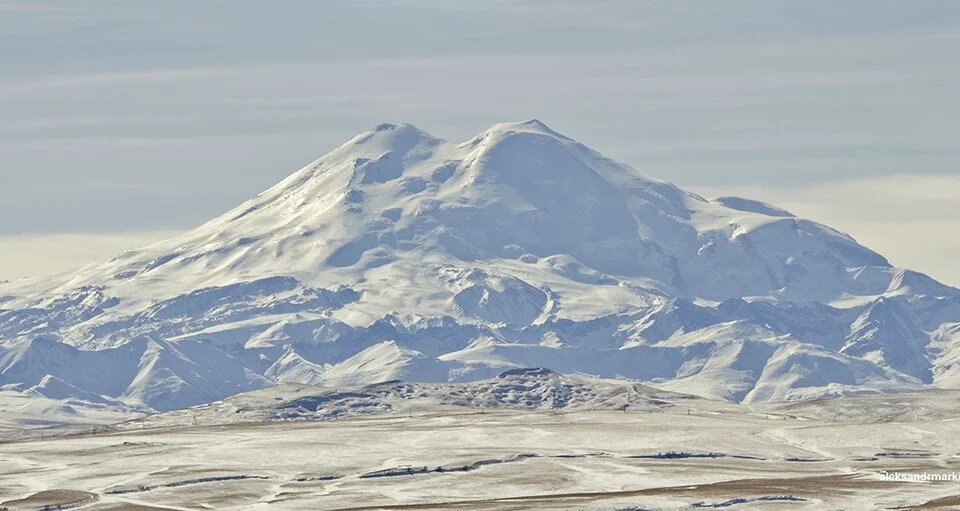
Mount Elbrus
Mount Elbrus is the highest mountain in Russia and Europe, soaring to 5,642 metres as the tenth-most topographically prominent peak on Earth and one of the Seven Summits. Situated in the Russian Caucasus near the Georgian border, this colossal dormant stratovolcano features two ice-capped volcanic domes separated by a high saddle at 5,416 metres. The eastern summit (5,621 m) was first climbed in 1829 by Circassian scout Killar Khashirov, while the true continental high point on the western summit (5,642 m) was conquered in 1874 by Florence Craufurd Grove, Frederick Gardiner, Horace Walker, Peter Knubel, and Balkar guide Ahiya Sottaev.
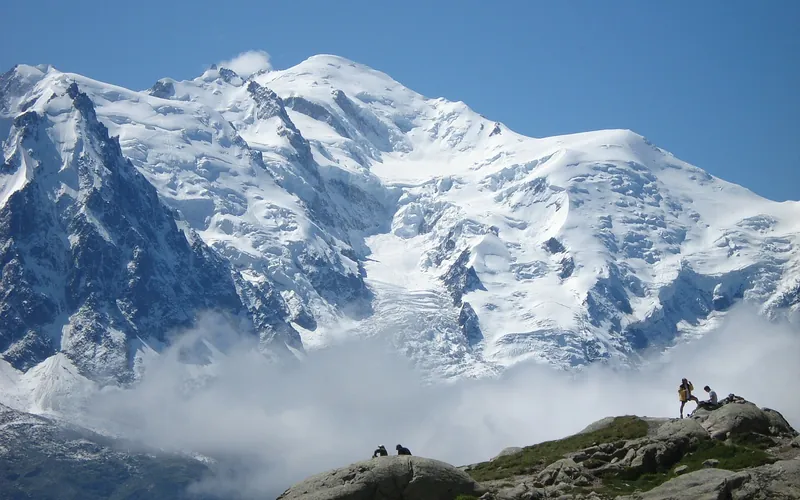
Mont Blanc
Mont Blanc (Monte Bianco), at 4,808 meters (15,774 ft), is the highest mountain in the Alps and Western Europe. Rising on the Franco-Italian watershed, this iconic glacier-draped granite massif is revered as the historic cradle of modern mountaineering following its celebrated first ascent in 1786. Featuring towering seracs, complex crevasse systems, and classic ridges like the Goûter and Bosses, it attracts climbers from around the globe.
Visual Elevation Comparison & Atmosphere Scale
📊A. Mountain Identity and Physical Statistics
Dimensions & Geodesy| Metric | Mount Elbrus | Mont Blanc |
|---|---|---|
| Surveyed Elevation | 5,642 m (18,510 ft) | 4,808 m (15,774 ft) |
| Global Elevation Ranking | Documented in peak dossier | Documented in peak dossier |
| Topographic Prominence | 4,741 m (15,554 ft) | 4,696 m (15,407 ft) |
| Country & Sovereignty | RU | FR, IT |
| Geographic Coordinates | 43°20′60″ N, 42°26′43″ E | 45°49′58″ N, 6°51′55″ E |
| Massif Classification | Ultra-Prominent Dormant Stratovolcano with Twin Glaciated Caldron Domes | Glaciated Granite Massif |
| Alternative / Native Names | Mingi Taw, Oshkhamakhua, Highest Peak in Europe, Elborus | Monte Bianco, La Dame Blanche, The White Mountain |
🗺️B. Geography, Mountain Range & Terrain Characteristics
Topography & Relief| Primary Mountain Range | caucasus-mountains | alps |
| Geographical Context | Located 100 kilometres north of the Black Sea and 370 kilometres west of the Caspian Sea, Elbrus is draped in a 138-square-kilometre ice cap feeding twenty-two major glaciers. Positioned north of the Main Caucasus Watershed, it dominates the skyline of Ciscaucasia with immense vertical relief, severe sub-polar blizzards, and an altitude producing severe hypoxic challenges. | Graian Alps subrange, situated between the Chamonix Valley in Haute-Savoie, France, and Courmayeur in the Aosta Valley, Italy. |
| Glacial Basin & Watershed | Kabardino-Balkaria, Karachay-Cherkessia, Greater Caucasus, Prielbrusye National Park | Haute-Savoie, Aosta Valley |
| Geographical Separation | The summits are separated by approximately 2,807 kilometers (1,744 miles) of planetary terrain. | |
🧗C. Standard Climbing Routes & Technical Lines
Route Topography| Standard / Normal Route | Standard expedition ascent line | Standard expedition ascent line |
| First Ascent Route | Pioneered during first successful expedition | Pioneered during first successful expedition |
| Documented Route Guides | 1 technical route profiles in Mountainity directory | 1 technical route profiles in Mountainity directory |
⚠️D. Climbing Difficulty, Objective Hazards & Physiological Demands
Objective Safety| Physiological Altitude Zone | Very High Altitude (4,500m–5,999m)Acute Mountain Sickness (AMS) common without staged ascent. Typical base camp altitude in the Greater Ranges. | Very High Altitude (4,500m–5,999m)Acute Mountain Sickness (AMS) common without staged ascent. Typical base camp altitude in the Greater Ranges. |
| Oxygen Availability (Sea Level = 100%) | ~51% barometric oxygen partial pressure | ~56% barometric oxygen partial pressure |
| Primary Objective Hazards | Exposed ridgelines, rapid weather shifts, sudden temperature drops, and technical rockfall. | Exposed ridgelines, rapid weather shifts, sudden temperature drops, and technical rockfall. |
📜E. Mountaineering History & Pioneer First Ascents
Historical Annals| First Ascent Date | 1874-07-28 | August 8, 1786 |
| First Ascent Team | Florence Craufurd Grove, Frederick Gardiner, Horace Walker, Peter Knubel, Ahiya Sottaev | Jacques Balmat and Dr. Michel-Gabriel Paccard |
| Historical Expedition | Historical expedition annals | Historical expedition annals |
| First Winter Ascent | Documented in winter archives or seasonal ascents | Documented in winter archives or seasonal ascents |
🌤️F. Summit Meteorology, Atmospheric Conditions & Seasons
Live Forecasts & Climate| Typical Climbing Season | Regional Summer (Consult local weather forecasts & seasonal precipitation charts) | Late June to Mid-September (Alpine Summer) & January–March (Winter/Ski Mountaineering) |
| Live Summit Meteorology | View Mount Elbrus Live Summit Forecast → | View Mont Blanc Live Summit Forecast → |
🎒G. Expedition Planning, Logistics & Alpine Tools
2027 Planning SuitesMount Elbrus Expedition Tools2027 Active
Access dedicated financial modeling and gateway flight intelligence calibrated for this summit.
Mont Blanc Expedition Tools2027 Active
Access dedicated financial modeling and gateway flight intelligence calibrated for this summit.
H. Synthesis & Comparative Verdict
Mount Elbrus (5,642 m) and Mont Blanc (4,808 m) represent distinct high-altitude mountaineering challenges. Mount Elbrus commands higher absolute altitude by 834 m (2,736 ft). When evaluating overall commitment, technical crux ratings, exposure, objective hazards such as avalanches or serac collapse, and regional weather stability prove as decisive as sheer summit altitude. Neither peak represents a universal winner; each demands dedicated conditioning, technical competence, and meticulous logistical preparation.
Alpine Monograph: Mount Elbrus vs Mont Blanc
Mount Elbrus (5,642 m) in the Caucasus Mountains and Mont Blanc (4,808 m) in the Graian Alps represent the central axis of the historic debate surrounding the geographic crown of the European continent. For mountaineers pursuing the global Seven Summits, Mount Elbrus is recognized as the official continental highest point under the standard Messner and Bass lists, rising on the northern side of the Caucasus watershed in southern Russia. In contrast, Mont Blanc, towering on the border of France and Italy, is universally revered as the historic birthplace of modern mountaineering, where Jacques Balmat and Michel-Gabriel Paccard completed their pioneering ascent in August 1786.
Physically and climatically, the two giants present contrasting mountaineering profiles. Mount Elbrus is an inactive dual-cone stratovolcano crowned by an extensive permanent icecap. Its standard South Route is technically moderate but physically demanding due to high altitude (over 5,600 meters) and notoriously vicious blizzard whiteouts that disorient climbers on the featureless volcanic slopes. Mont Blanc, while 834 meters lower, requires navigating complex glaciated terrain, active serac barriers, and the notorious Grand Couloir rockfall zone on the standard Goûter Route.
Analyzing Elbrus alongside Mont Blanc illustrates the distinction between volcanic high-altitude endurance and classic glaciated alpine climbing. Both summits serve as vital benchmarks for mountaineers progressing toward the greater ranges of the Andes, Pamirs, and Himalayas.
Key Contrasting Differences
- Mount Elbrus (5,642 m) is 834 meters higher than Mont Blanc (4,808 m) and is the recognized continental peak for the Seven Summits.
- Mont Blanc is the historical birthplace of modern mountaineering (first climbed in 1786), over eight decades before Elbrus's West Peak was summited in 1874.
- Mount Elbrus is a volcanic double-peaked massif, whereas Mont Blanc is a glaciated granite batholith.
- Mont Blanc's Goûter Route presents acute objective rockfall hazard through the Grand Couloir ('Bowling Alley'), a hazard absent on Elbrus's volcanic snowfields.
- Elbrus experiences rapid, catastrophic temperature drops and whiteouts that make navigation on the broad saddle between summits critically hazardous.
Category-by-Category Analysis
📊Elevation & Identity Analysis
Elbrus rises to 5,642 m (prominence 4,741 m) in Kabardino-Balkaria/Karachay-Cherkessia, Russia. Mont Blanc rises to 4,808 m (prominence 4,696 m) on the France-Italy frontier.
🗺️Geographical & Tectonic Contrast
Elbrus anchors the Greater Caucasus Range between the Black Sea and Caspian Sea. Mont Blanc anchors the Mont Blanc Massif in the Graian and Pennine Alps of Western Europe.
🧗Route Topography & Crux Difficulty
Elbrus's standard line is the South Route via the Garabashi cable car and Pastukhov Rocks. Mont Blanc's normal line is the Goûter Route via the Tête Rousse and Goûter huts.
⚠️Objective Hazards & Death Zone Exposure
Elbrus demands greater physiological stamina against hypoxia above 5,000 meters. Mont Blanc demands classic glaciated mountaineering skills with crampons, crevasse rescue proficiency, and exposure management.
📜Pioneer History & Expedition Milestones
Balmat and Paccard's 1786 ascent of Mont Blanc launched modern mountaineering. Elbrus's higher West Summit was first reached on July 28, 1874 by an English expedition led by Florence Craufurd Grove.
🌤️Meteorological Windows & Jet Stream Influence
Both massifs generate extreme weather volatility: Elbrus is exposed to Arctic cold fronts from the Russian steppes, while Mont Blanc catches moist Atlantic frontal systems.
🎒Expedition Staging, Approach Treks & Gateway Logistics
Elbrus is supported by high-altitude snowcat transport up to 4,700 m from Azau village. Mont Blanc is supported by the Mont Blanc Tramway to Nid d'Aigle from Chamonix or Saint-Gervais.
Connected Mountain Dossiers & Exploration Tools
Mount Elbrus Intelligence Resources
Explore dedicated profiles, routes, live meteorology, and historical records.
Mont Blanc Intelligence Resources
Explore dedicated profiles, routes, live meteorology, and historical records.
Frequently Asked Questions: Mount Elbrus vs Mont Blanc
Is Mount Elbrus or Mont Blanc the highest mountain in Europe?
Geographically, Mount Elbrus (5,642 m) in the Russian Caucasus is considered the highest peak in Europe by most geographers and the official Seven Summits lists. Mont Blanc (4,808 m) is the highest peak in Western Europe and the Alps.
How much higher is Mount Elbrus than Mont Blanc?
Mount Elbrus (5,642 m / 18,510 ft) is 834 meters (2,736 ft) taller than Mont Blanc (4,808 m / 15,774 ft).
Which is more technically difficult, Elbrus or Mont Blanc?
Mont Blanc is technically more demanding than the standard route on Elbrus, requiring steeper snow/ice climbing, exposed ridge traversal on the Bosses Ridge, and crossing the rockfall-prone Grand Couloir. Elbrus is technically moderate on its normal route but demands greater high-altitude acclimatization.
Related Mountain Comparisons
Aconcagua vs Denali: High Altitude & Extreme Cold
Compare Aconcagua (6,961m) and Denali (6,190m): Southern vs Northern Hemisphere giants, extreme sub-zero weather, altitude sickness, and logistics.
Annapurna vs Nanga Parbat: Routes & History
Compare Annapurna I (8,091m) and Nanga Parbat (8,126m): Rupal Face, avalanche hazard, technical cruxes, and mountaineering death rates in 2027.
Eiger vs Matterhorn: Classic Alpine Icons
Compare the Eiger (3,967m) and Matterhorn (4,478m): the legendary Nordwand, Hörnli Ridge, technical rock cruxes, and pioneering Swiss ascents.
Compare Any Other Summits Across Earth
Use our interactive Mountain Comparison Engine to contrast any two peaks across elevation, topography, climbing routes, and summit meteorology.
Share Exploration
Global Mountain Intelligence
✓ Link copied to clipboard!