To the Edge of the Sky: Humboldt's 1802 Chimborazo Altitude Record
On June 23, 1802, Prussian polymath Alexander von Humboldt, botanist Aimé Bonpland, and Carlos Montúfar climbed to 5,878 metres on Chimborazo, setting a 30-year world altitude record and founding modern ecological science.
Mountain Safety & Conditions Disclaimer: High-altitude climbing, glacial travel, and technical ascents entail severe objective risks including avalanches, serac collapses, rapid weather collapse, and altitude illness. Historical route descriptions and summit claims on Mountanity reflect documented archival sources and must not be used as live operational safety assessments. Local regulations, permits, and physical glacial topography change continuously.
Peer Review: Senior Editorial Board & Historical Reviewers • Editorial Standards
To the Edge of the Sky: Humboldt’s 1802 Chimborazo Altitude Record
The Crown of the Known World
In the opening years of the nineteenth century, European geography recognized a single supreme titan above all mountains on the globe: Nevado Chimborazo (6,263 m). Rising in solitary volcanic splendour above the Ecuadorian paramo, its massive glaciated dome was believed to be the highest point on planet Earth, exceeding any known summit in the Alps or Caucasus.
When thirty-two-year-old Prussian naturalist Alexander von Humboldt, his brilliant French botanist companion Aimé Bonpland, and the young Ecuadorian nobleman Carlos Montúfar reached Riobamba in June 1802, Humboldt was already convinced that mountains were living laboratories. Having traversed the Orinoco river basin and the volcanic highlands of Colombia, Humboldt gazed at Chimborazo’s ice-bound walls with an audacious ambition: to climb as high as human lungs and limbs could endure.
“A mountain is not an isolated rock, but a great living organism where climate, vegetation, and geology form a single, harmonious cosmos.” — Alexander von Humboldt, Ansichten der Natur
The Assault of June 23, 1802
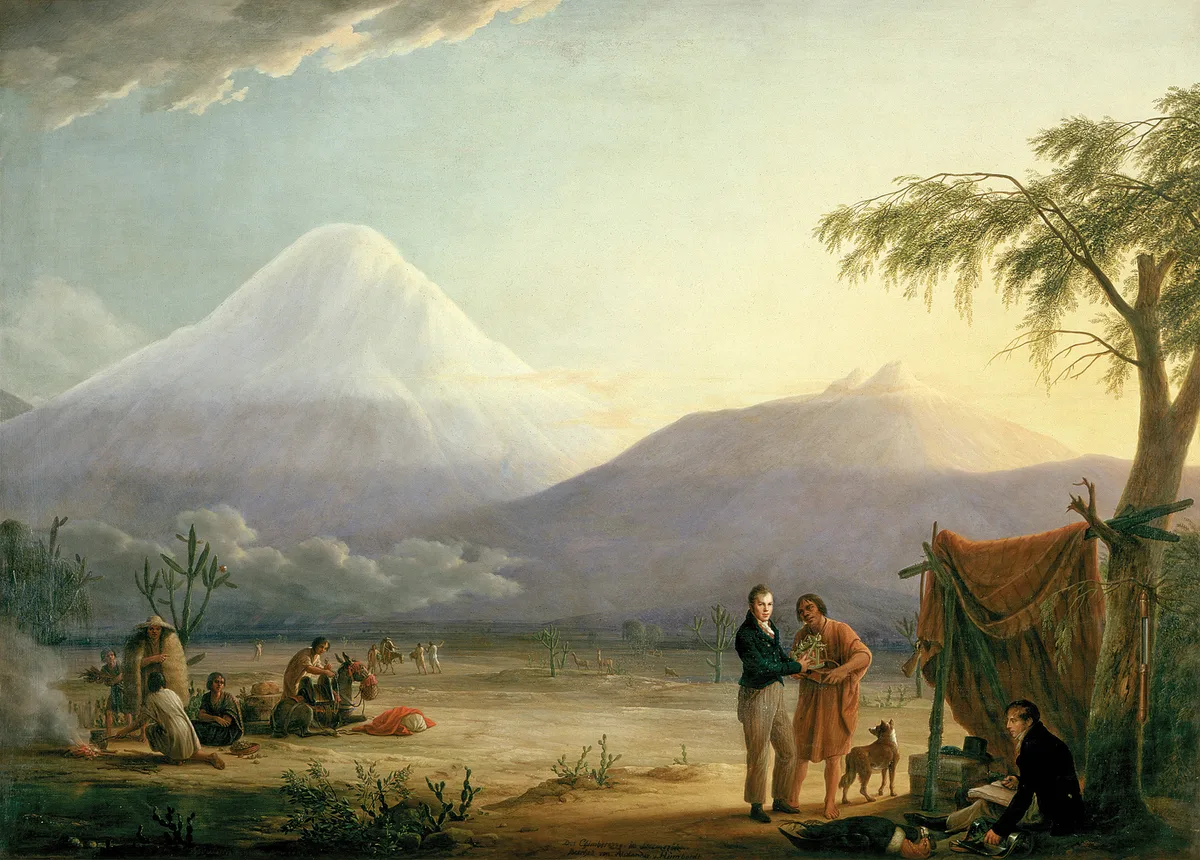
Before dawn on June 23, 1802, Humboldt, Bonpland, and Montúfar departed their highland encampment. By contemporary alpine standards, their equipment was shockingly inadequate: ordinary boots, woollen overcoats, and broad-brimmed hats. They possessed no crampons, ropes, or ice axes. What they did carry was fifty pounds of scientific instruments—fragile glass thermometers, mercury barometers, a sextant, an electrometer, and a cyanometer to measure the blueness of the sky.
Ascending a narrow, shattered volcanic rock rib that dropped steeply into bottomless ravines on either side, the climbers encountered punishing conditions. At 4,800 metres, their indigenous guides refused to proceed further, convinced that the volcano was inhabited by malevolent spirits. Humboldt, Bonpland, Montúfar, and a single local servant pressed on alone into the swirling mists.
Above 5,000 metres, the air grew desperately thin. The party began to suffer the agonizing symptoms of acute mountain sickness: intense nausea, vertigo, splitting cephalalgia, and blood oozing from their gums, lips, and eyelids. Ice-crusted winds chilled their hands until they could barely grasp the basalt ledges. Yet Humboldt paused every few hundred paces, planting his barometer in the snow, waiting for the mercury column to stabilize, and jotting down atmospheric readings with numb fingers.
The Chasm at 5,878 Metres
At one o’clock in the afternoon, the ridge steepened into an impassable obstacle. A yawning crevasse—a transverse chasm in the rock and ice four hundred feet wide and sixty feet deep—cut completely across their path. The summit ice cap loomed tantalizingly close above them, but traversing the chasm without ropes or cutting gear was physical suicide.
Humboldt set up his barometer one final time. The mercury column stood at 14 inches and 2 lines, indicating an elevation of 5,878 metres (19,286 feet). It was the highest point on Earth ever stood upon by human beings.
Realizing that hypothermia and thick freezing clouds were closing in, Humboldt ordered a cautious descent. Shivering violently and slipping on loose scree, the exhausted explorers regained the safety of the paramo by nightfall, their boots shredded and faces blackened by equatorial sun glare and frost.
The Birth of Ecological Science
Though Chimborazo’s ultimate summit remained untrodden for another seventy-eight years, Humboldt’s 1802 ascent transformed human understanding of the natural world. Synthesizing his barometric and botanical notes, Humboldt created his legendary Tableau Physique des Andes—a cross-sectional illustration of Chimborazo that mapped plant distribution, temperature gradients, and barometric pressure from tropical sea level to the permanent snowline.
This revolutionary diagram founded the modern disciplines of biogeography, climatology, and physical geography. Humboldt proved that nature was an interconnected, global web of life, where high mountain ecosystems on the equator mirror arctic conditions at the poles. Today, Humboldt’s historic push on Chimborazo remains celebrated as one of the defining moments where alpine exploration and scientific revelation merged.
Key Statistics & Topographic Figures
- Category
- Andean Pioneers
Archival Subject
- Reading Time
- 15 min read
Narrative Length
- Key Mountain
- chimborazo
Objective
- Ascent Route
- chimborazo-whymper-route
Topography
- Verification
- Editorially Verified
Archival Standard
Archival Primary Source Quotations
“In the mountains, truth is etched in ice and granite; every step requires unwavering respect for the heights.”
Defined Alpine Terminology & Concepts
- Summit Push
- The final continuous climbing effort from the highest established camp to the mountain apex and back.
- Death Zone Chronicle
- A verified, research-backed historical narrative documenting the human, technical, and environmental realities of an alpine expedition.
Frequently Asked Questions: To the Edge of the Sky: Humboldt's 1802 Chimborazo Altitude Record
What is the core chronicle and subject of "To the Edge of the Sky: Humboldt's 1802 Chimborazo Altitude Record"?
On June 23, 1802, Prussian polymath Alexander von Humboldt, botanist Aimé Bonpland, and Carlos Montúfar climbed to 5,878 metres on Chimborazo, setting a 30-year world altitude record and founding modern ecological science.
Which mountain peaks and routes are featured in "To the Edge of the Sky: Humboldt's 1802 Chimborazo Altitude Record"?
This narrative documents climbs on chimborazo along the chimborazo-whymper-route in Ecuador.
Which documented expedition is chronicled in this story?
This historical chronicle captures the events of the 1802-humboldt-bonpland-chimborazo-record, verified through contemporary journals and archival records.
Who authored and researched this archival chronicle?
Authored and researched by Mountainity Historical Research Desk, drawing on primary eyewitness testimonies, alpine club registries, and verified summit logs.
What makes this high-altitude chronicle historically significant?
Categorized under "Andean Pioneers", this chronicle preserves critical lessons in alpine leadership, survival, tactical speed, and human endurance in the death zone.
Related Mountains
Chimborazo
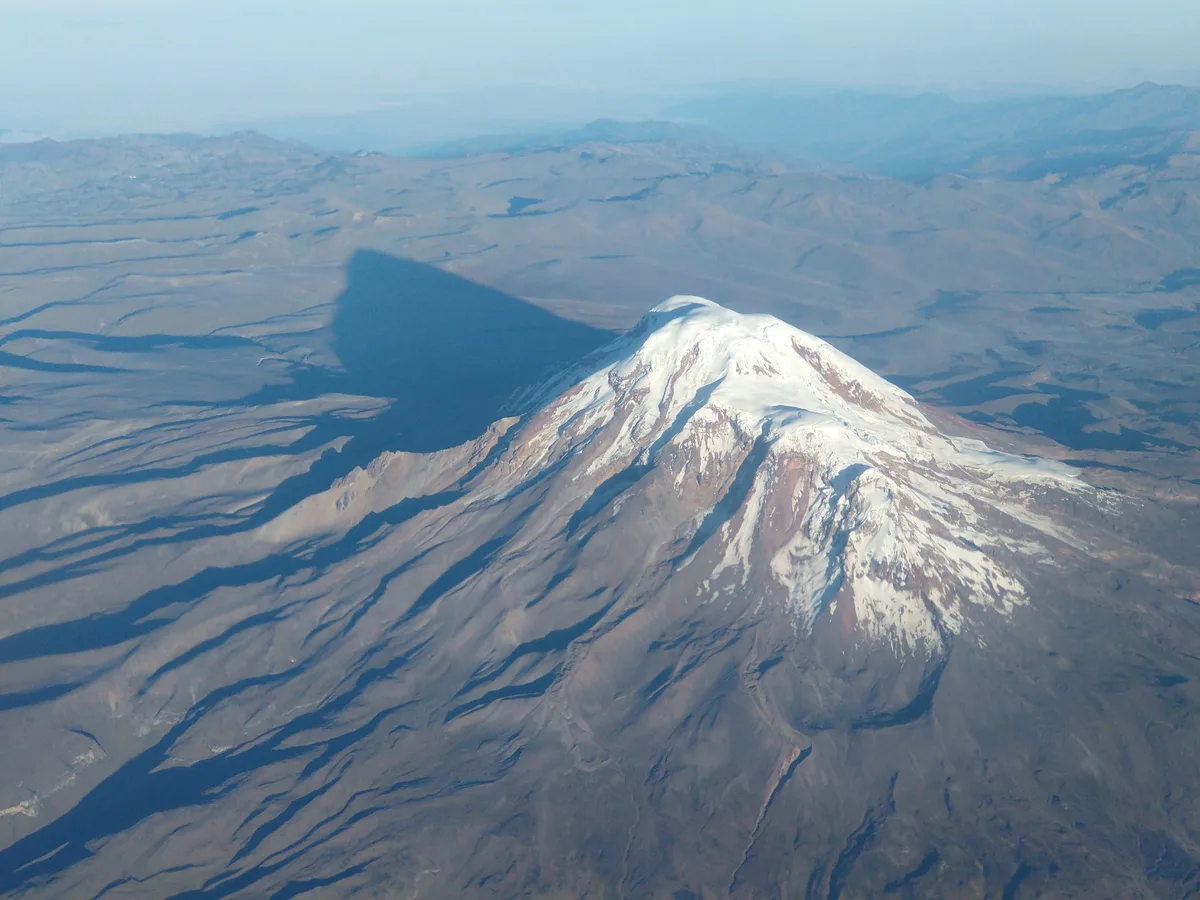
Nevado Chimborazo is a colossal 6,263-metre glaciated stratovolcano in the Cordillera Occidental of Ecuador. Because Earth is an oblate spheroid with an equatorial bulge, Chimborazo's summit is the furthest terrestrial point from the center of the Earth (6,384.4 km), making it the closest place on the planet's surface to the Sun. Renowned in exploration history, it was attempted by Alexander von Humboldt in 1802 and finally summited on January 4, 1880, by Edward Whymper alongside Val Tournanche alpine guides Louis Carrel and Jean-Antoine Carrel.
Documented Sources & Archival Citations
- Personal Narrative of Travels to the Equinoctial Regions of America(Alexander von Humboldt / Longman, Hurst, Rees, Orme & Brown)
Supporting claim: Firsthand expedition journal and barometric measurements of the 1802 Chimborazo attempt
Accessed/Documented: 1814 - The Invention of Nature: Alexander von Humboldt's New World(Andrea Wulf / Alfred A. Knopf)
Supporting claim: Historical analysis of Humboldt's world altitude record on Chimborazo and scientific findings
Accessed/Documented: 2015