Matterhorn 1865: Whymper's Triumph and the Broken Rope Tragedy
On July 14, 1865, Edward Whymper conquered the supposedly unscalable Matterhorn (4,478m) via the Swiss Hörnli Ridge, only for victory to turn into one of mountaineering's greatest disasters when a rope snapped on descent, claiming four lives.
Mountain Safety & Conditions Disclaimer: High-altitude climbing, glacial travel, and technical ascents entail severe objective risks including avalanches, serac collapses, rapid weather collapse, and altitude illness. Historical route descriptions and summit claims on Mountanity reflect documented archival sources and must not be used as live operational safety assessments. Local regulations, permits, and physical glacial topography change continuously.
Peer Review: Senior Editorial Board & Historical Reviewers • Editorial Standards
By the summer of 1865, the greatest peaks of the European Alps had fallen one by one to a cadre of intrepid British climbers and their Swiss and French guides in what historians call the Golden Age of Alpinism. Mont Blanc, the Monte Rosa, the Dom, the Weisshorn, and the Schreckhorn had all been surmounted. Only one colossal giant remained defiant: the Matterhorn (4,478 meters / 14,692 ft), known across the Italian frontier as Monte Cervino.
Rising as a lone, razor-sharp pyramidal obelisk on the border between Switzerland and Italy, the Matterhorn inspired terror among local mountain folk. Legends persisted that its black, wind-whipped cliffs were guarded by ancient demons who hurled boulders at intruders, and that its summit plateau was crowned by an enchanted ruined city. Even seasoned alpine guides shook their heads, declaring the mountain absolutely impossible for human feet to scale.
The Obsession of Edward Whymper
Among those captivated by the Matterhorn’s sublime profile was a 25-year-old English wood engraver and artist from London, Edward Whymper. Dispatched to the Alps in 1860 to sketch illustrations for a travel publisher, Whymper had quickly developed into a fierce, athletic mountaineer. Between 1861 and 1865, he mounted seven unsuccessful attempts on the mountain, nearly all from the Italian side via the southwest Lion Ridge.
On these early attempts, Whymper climbed alongside Jean-Antoine Carrel, a proud, muscular bersagliere veteran and native mountain guide from the Italian village of Breuil (now Cervinia). Carrel was passionately patriotic; he dreamed of claiming the Cervino for the newly unified Kingdom of Italy and was reluctant to share the ultimate glory with an Englishman. In early July 1865, while Whymper was in Breuil preparing for another attempt, Carrel secretly accepted a substantial financial commission from the Italian Alpine Club in Turin to lead an all-Italian assault. When Whymper discovered that Carrel had deceived him and slipped away onto the Italian ridge with his countrymen, he was consumed by competitive rage.
Stranded without guides in Breuil, Whymper scrambled across the high Théodule Pass into Zermatt on July 12. Having previously observed from afar that the Swiss Northeast Ridge—the Hörnli Ridge—appeared much less steep in profile than it seemed from below, Whymper resolved to attack the mountain from the Swiss side.
The Seven-Man Coalition
In Zermatt, Whymper met Lord Francis Douglas, a daring 18-year-old Scottish nobleman who had just engaged veteran Zermatt guide Peter Taugwalder and his 22-year-old son, Peter Taugwalder Jr. Soon after, another party arrived at the Monte Rosa Hotel: Reverend Charles Hudson, one of Britain’s most accomplished amateur climbers, accompanied by his 19-year-old protégé Douglas Hadow and Michel Croz, widely revered as the finest mountain guide in Chamonix.
Recognizing that they were racing against Carrel’s Italian team on the opposite side of the mountain, Whymper and Hudson immediately agreed to merge their forces into a single, powerhouse seven-man team: Whymper, Hudson, Douglas, Hadow, Croz, and the two Taugwalders.
The Ascent: July 13–14, 1865
At 5:30 AM on Thursday, July 13, 1865, the party departed Zermatt under a cloudless sky. Ascending gently past the Schwarzsee, they turned onto the foot of the Hörnli Ridge. To Whymper’s delight, the rock strata sloped inward like natural stairs, providing secure footing. By noon, they reached a broad shoulder at 3,380 meters (near the site of the modern Hörnli Hut), where they pitched their canvas tent and enjoyed an evening of jovial camaraderie, watching the sunset illuminate the Italian glaciers.
Before dawn on Friday, July 14, they roped up and resumed the climb. Moving swiftly across the lower ledges, they made astonishing progress. Only young Douglas Hadow—who lacked mountaineering experience and was wearing smooth-soled boots—showed signs of clumsiness on the rock, requiring occasional assistance from Michel Croz.
By 10:00 AM, they stood at 4,260 meters near the base of the final pyramid. Here, the Hörnli Ridge reared up into a sheer, icy rock headwall (the modern Moseley Slabs and Roof). Veering slightly onto the precipitous North Face, Croz carefully chipped steps in hard water-ice and guided each member up the icy granite ledges.
At 1:40 PM, the gradient abruptly flattened out. Croz and Whymper untied from the rope and sprinted across a gentle snow crest. Stepping onto the virgin summit of the Matterhorn, they found not a single footprint. Whymper peered anxiously over the southern cornice toward Italy: hundreds of meters below, trudging slowly up the Italian crest, were Jean-Antoine Carrel and his companions. Whymper and Croz shouted, whistled, and rolled stones down the cliff until Carrel looked up, saw the figures dancing on the summit crest, and turned back in crushing heartbreak.
The Matterhorn had been conquered.
The Snapping of the Rope
The team remained on the summit for one hour, overwhelmed by emotion, carving their names on a wooden staff and reveling in their historic triumph. At 2:40 PM, they tied in for the perilous descent.
The order of the rope was crucial: Michel Croz went first, followed by young Douglas Hadow, Reverend Charles Hudson, Lord Francis Douglas, Peter Taugwalder Sr., Edward Whymper, and finally Peter Taugwalder Jr. at the rear. Because the upper slab was steep and glazed with verglas, only one man moved at a time while the others anchored themselves against the rock.
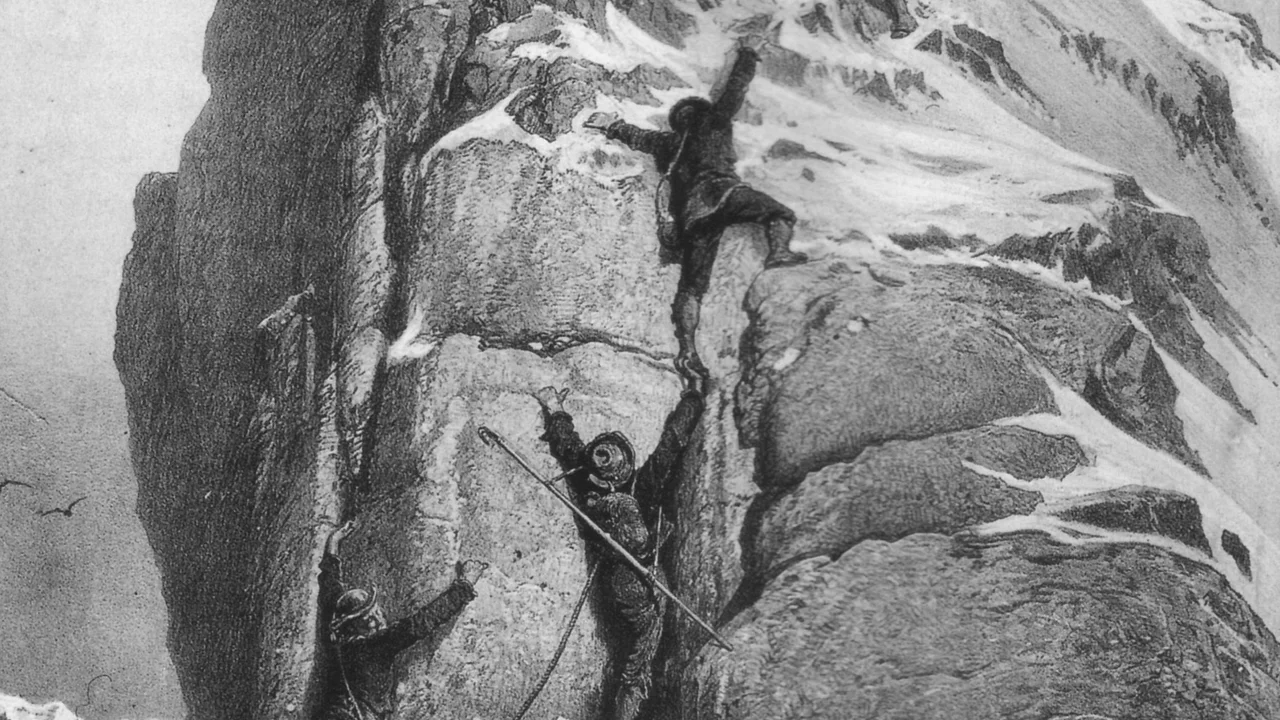
Just below the summit crest, Croz turned around to assist Hadow by placing his feet one by one into the cut ice steps. Croz had laid down his ice axe and was in the act of turning back to descend himself when Hadow suddenly slipped, both feet flying from beneath him.
Hadow’s body struck Croz from behind, knocking the powerful guide violently off his perch. Both men plummeted down the North Face. The sudden, ferocious shock-load instantly wrenched Reverend Hudson and Lord Francis Douglas from their footholds. Hearing Croz’s startled scream, Whymper and the elder Taugwalder jammed their feet into rock crevices and braced with every ounce of their strength.
The rope tightened with terrifying force. For one agonizing second, the strain held—and then, with a sharp, sickening crack, the hemp rope severed midway between Lord Francis Douglas and Peter Taugwalder.
Whymper and the Taugwalders watched in paralyzed horror as their four companions slid uncontrollably down the snow slope on their backs, clawing frantically for purchase, before disappearing over the vertical 4,000-foot precipice of the North Face.
The Aftermath and Legend
For thirty minutes, Whymper and the two Taugwalders remained frozen on the rock, weeping and trembling, unable to move. Eventually, summoning sheer survival instinct, Whymper inspected the severed rope in Taugwalder’s hands and was horrified to discover that it was not the stout Alpine Club climbing rope they had used during the ascent, but an old, thin Manila sash line brought along merely as emergency cord.
Moving with meticulous care, the shattered survivors crawled down the Hörnli Ridge, bivouacking in misery on the mountain before reaching Zermatt the next morning to deliver the grim news. Search parties later recovered the broken bodies of Croz, Hadow, and Hudson from the glacier below; the body of Lord Francis Douglas was never found.
The tragedy triggered an international outcry across Europe. The British press questioned the moral justification of mountaineering, and Queen Victoria herself considered an act of Parliament to ban the sport. Whymper was cleared of all wrongdoing at an official inquest, but the catastrophe haunted him for the rest of his life. In the closing words of his 1871 masterpiece Scrambles Amongst the Alps, Whymper penned one of the most famous epitaphs in literature:
“Climb if you will, but remember that courage and strength are nought without prudence, and that a momentary negligence may destroy the happiness of a lifetime. Do nothing in haste; look well to each step; and from the beginning think what may be the end.”
Key Statistics & Topographic Figures
- Category
- Historic Expeditions
Archival Subject
- Reading Time
- 14 min read
Narrative Length
- Key Mountain
- matterhorn
Objective
- Ascent Route
- matterhorn-hornli-ridge
Topography
- Verification
- Editorially Verified
Archival Standard
Archival Primary Source Quotations
“In the mountains, truth is etched in ice and granite; every step requires unwavering respect for the heights.”
Defined Alpine Terminology & Concepts
- Summit Push
- The final continuous climbing effort from the highest established camp to the mountain apex and back.
- Death Zone Chronicle
- A verified, research-backed historical narrative documenting the human, technical, and environmental realities of an alpine expedition.
Frequently Asked Questions: Matterhorn 1865: Whymper's Triumph and the Broken Rope Tragedy
What is the core chronicle and subject of "Matterhorn 1865: Whymper's Triumph and the Broken Rope Tragedy"?
On July 14, 1865, Edward Whymper conquered the supposedly unscalable Matterhorn (4,478m) via the Swiss Hörnli Ridge, only for victory to turn into one of mountaineering's greatest disasters when a rope snapped on descent, claiming four lives.
Which mountain peaks and routes are featured in "Matterhorn 1865: Whymper's Triumph and the Broken Rope Tragedy"?
This narrative documents climbs on matterhorn along the matterhorn-hornli-ridge in Switzerland.
Which documented expedition is chronicled in this story?
This historical chronicle captures the events of the 1865-whymper-matterhorn, verified through contemporary journals and archival records.
Who authored and researched this archival chronicle?
Authored and researched by Mountainity Historical Research Desk, drawing on primary eyewitness testimonies, alpine club registries, and verified summit logs.
What makes this high-altitude chronicle historically significant?
Categorized under "Historic Expeditions", this chronicle preserves critical lessons in alpine leadership, survival, tactical speed, and human endurance in the death zone.
Related Mountains
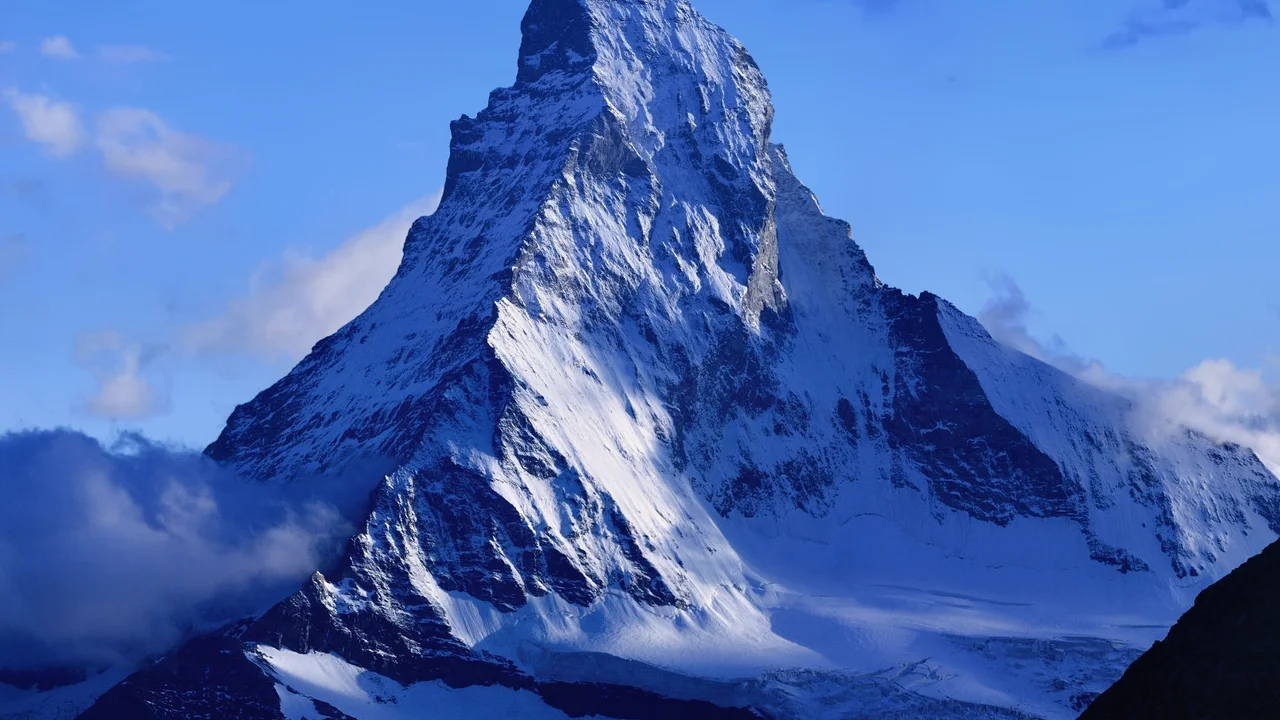


Matterhorn
The Matterhorn (Monte Cervino), at 4,478 meters (14,692 ft), is one of the most recognizable and dramatic pyramidal peaks in the world. Straddling the border between Zermatt, Switzerland, and Breuil-Cervinia, Italy, its four triangular faces match the cardinal points of the compass. Its historic first ascent by Edward Whymper on July 14, 1865, and the tragic fall of four teammates on the descent marked the end of the Golden Age of Alpinism.
Documented Sources & Archival Citations
- Scrambles Amongst the Alps in the Years 1860–69(Edward Whymper / John Murray)
Supporting claim: Definitive first-hand autobiographical narrative of the seven attempts, summit triumph, and the broken rope accident
Accessed/Documented: 1871 - The Alpine Journal: Official Record of the Matterhorn Inquiry(The Alpine Club UK)
Supporting claim: Judicial depositions, forensic analysis of the severed reserve rope, and eyewitness testimony
Accessed/Documented: 1866 - The Matterhorn: Centenary of the First Ascent(Swiss Alpine Club (SAC))
Supporting claim: Historical re-examination of the Whymper-Carrel rivalry and technical evaluation of the Hörnli Ridge
Accessed/Documented: 1965