Caverns in the Clouds: The 1870 First Ascent of Mount Rainier
On August 17, 1870, Hazard Stevens and Philemon Beecher Van Trump achieved the first documented ascent of Mount Rainier. Scaling the crumbling volcanic precipice of Gibraltar Rock, they reached the summit crater at dusk and survived a freezing night inside boiling geothermal steam vents.
Mountain Safety & Conditions Disclaimer: High-altitude climbing, glacial travel, and technical ascents entail severe objective risks including avalanches, serac collapses, rapid weather collapse, and altitude illness. Historical route descriptions and summit claims on Mountanity reflect documented archival sources and must not be used as live operational safety assessments. Local regulations, permits, and physical glacial topography change continuously.
Peer Review: Senior Editorial Board & Historical Reviewers • Editorial Standards
The Great White Monarch of the Sound
In the summer of 1870, the Pacific Northwest remained a vast, sparsely mapped frontier of ancient temperate rainforests and colossal volcanic massifs. Dominating the eastern horizon above the wooden houses of Puget Sound was Mount Rainier (4,392 m), known to the native Yakama, Nisqually, and Cowlitz peoples as Tahoma or Takhoma, meaning the mother of waters.
No European or settler had ever stood upon its summit. Rumors of failed attempts by army officers and trappers in the 1850s were common, but the mountain was widely regarded as physically inaccessible, guarded by impenetrable cedar tangles, yawning glacial crevasses, and volatile volcanic weather.
In the territorial capital of Olympia, two men formed a bond over their shared fascination with the great mountain: General Hazard Stevens, a battle-hardened Civil War veteran and Medal of Honor recipient, and Philemon Beecher Van Trump, private secretary to the territorial governor. Neither possessed formal mountaineering training, yet both were endowed with iron frontier resolve.
Sluiskin’s Warning at Timberline
Stevens and Van Trump departed Olympia on horseback in early August 1870, navigating dense river valleys to the homestead of James Longmire. There, they hired Sluiskin, an experienced Yakama hunter, to guide them through the roadless wilderness to the alpine meadows beneath the Nisqually Glacier.
On August 16, as the party established a base camp in the wildflower-filled parklands near Paradise, Sluiskin observed the climbers preparing their ropes and iron-tipped alpenstocks with mounting dread. Sitting cross-legged by the campfire, Sluiskin delivered an impassioned oration in Chinook Jargon, warning them that an evil spirit dwelt within the fire-mouthed summit of Takhoma. Sluiskin insisted that no mortal human could enter the clouds without being hurled into the bottomless crevasses or suffocated by fiery winds, pleading with them to turn back.
When Stevens and Van Trump calmly replied that they intended to climb regardless, Sluiskin wept, demanding that they leave their paper notes and watches so he could return them to their grieving families in Olympia.
The Ramparts of Gibraltar Rock
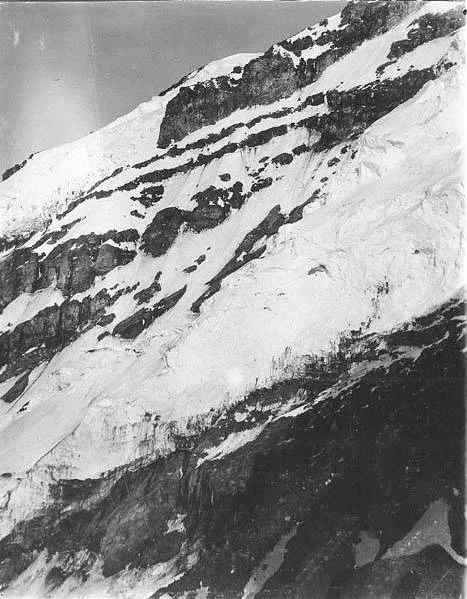
At six o’clock on the morning of August 17, 1870, Stevens and Van Trump set out across the crunching summer ice of the Nisqually Glacier. Moving upward beneath clear skies, they climbed steep snow slopes toward a colossal, imposing volcanic fortress rising 1,200 feet above the glacier: Gibraltar Rock.
To reach the upper volcanic dome, the climbers were forced to navigate a narrow, slanting ledge cut into the vertical flank of Gibraltar. The rock was intensely fractured and crumbly, showering them with volcanic debris at every step. Below their boots, the cliff dropped thousands of feet into the gaping chasms of the Nisqually icefall.
Working with meticulous care, gripping loose handholds and testing every footing with their alpenstocks, Stevens and Van Trump gingerly edged past the ledge and gained the steep, frozen snow chute above. After hours of relentless climbing on wind-scoured ice, they cleared the final bergschrund and stepped onto the crater rim of Mount Rainier at five in the afternoon.
Bivouac in the Caverns of Steam
Standing upon the volcanic caldera, Stevens named the southern rim Point Success, observing the sweeping panorama that reached from the Pacific Ocean to Mount Hood and Mount Adams. Yet their triumph was instantly tempered by mortal danger. A ferocious gale began howling across the summit, dropping temperatures far below zero as twilight gathered.
Descending the loose, disintegrating ledges of Gibraltar Rock in freezing pitch darkness was impossible. As frostbite gripped their extremities, the pair discovered a miracle of geothermal nature: inside the western rim of the snow-filled crater, steam vents were hissing from fissures in the volcanic rock, melting subterranean ice domes and carving hollow caverns beneath the summit snowpack.
Diving into a steam vent, Stevens and Van Trump huddled in the cramped darkness. While their backs froze against the sub-zero ice walls, the sulfurous volcanic vapors scalded their boots and coats. For eleven agonizing hours, choked by bitter fumes and shivering violently, they waited out the night.
At sunrise on August 18, bruised, smoke-blackened, and frost-nipped, the climbers emerged onto the sparkling snows of Mount Rainier and safely descended to base camp, where Sluiskin greeted them with stunned reverence, believing he was gazing upon ghosts returned from the realm of the spirits.
Key Statistics & Topographic Figures
- Category
- Cascade Volcano Lore
Archival Subject
- Reading Time
- 14 min read
Narrative Length
- Key Mountain
- mount-rainier
Objective
- Ascent Route
- mount-rainier-disappointment-cleaver
Topography
- Verification
- Editorially Verified
Archival Standard
Archival Primary Source Quotations
“In the mountains, truth is etched in ice and granite; every step requires unwavering respect for the heights.”
Defined Alpine Terminology & Concepts
- Summit Push
- The final continuous climbing effort from the highest established camp to the mountain apex and back.
- Death Zone Chronicle
- A verified, research-backed historical narrative documenting the human, technical, and environmental realities of an alpine expedition.
Frequently Asked Questions: Caverns in the Clouds: The 1870 First Ascent of Mount Rainier
What is the core chronicle and subject of "Caverns in the Clouds: The 1870 First Ascent of Mount Rainier"?
On August 17, 1870, Hazard Stevens and Philemon Beecher Van Trump achieved the first documented ascent of Mount Rainier. Scaling the crumbling volcanic precipice of Gibraltar Rock, they reached the summit crater at dusk and survived a freezing night inside boiling geothermal steam vents.
Which mountain peaks and routes are featured in "Caverns in the Clouds: The 1870 First Ascent of Mount Rainier"?
This narrative documents climbs on mount-rainier along the mount-rainier-disappointment-cleaver in United States.
Which documented expedition is chronicled in this story?
This historical chronicle captures the events of the 1870-stevens-van-trump-mount-rainier, verified through contemporary journals and archival records.
Who authored and researched this archival chronicle?
Authored and researched by Mountainity Historical Research Desk, drawing on primary eyewitness testimonies, alpine club registries, and verified summit logs.
What makes this high-altitude chronicle historically significant?
Categorized under "Cascade Volcano Lore", this chronicle preserves critical lessons in alpine leadership, survival, tactical speed, and human endurance in the death zone.
Related Mountains

Mount Rainier
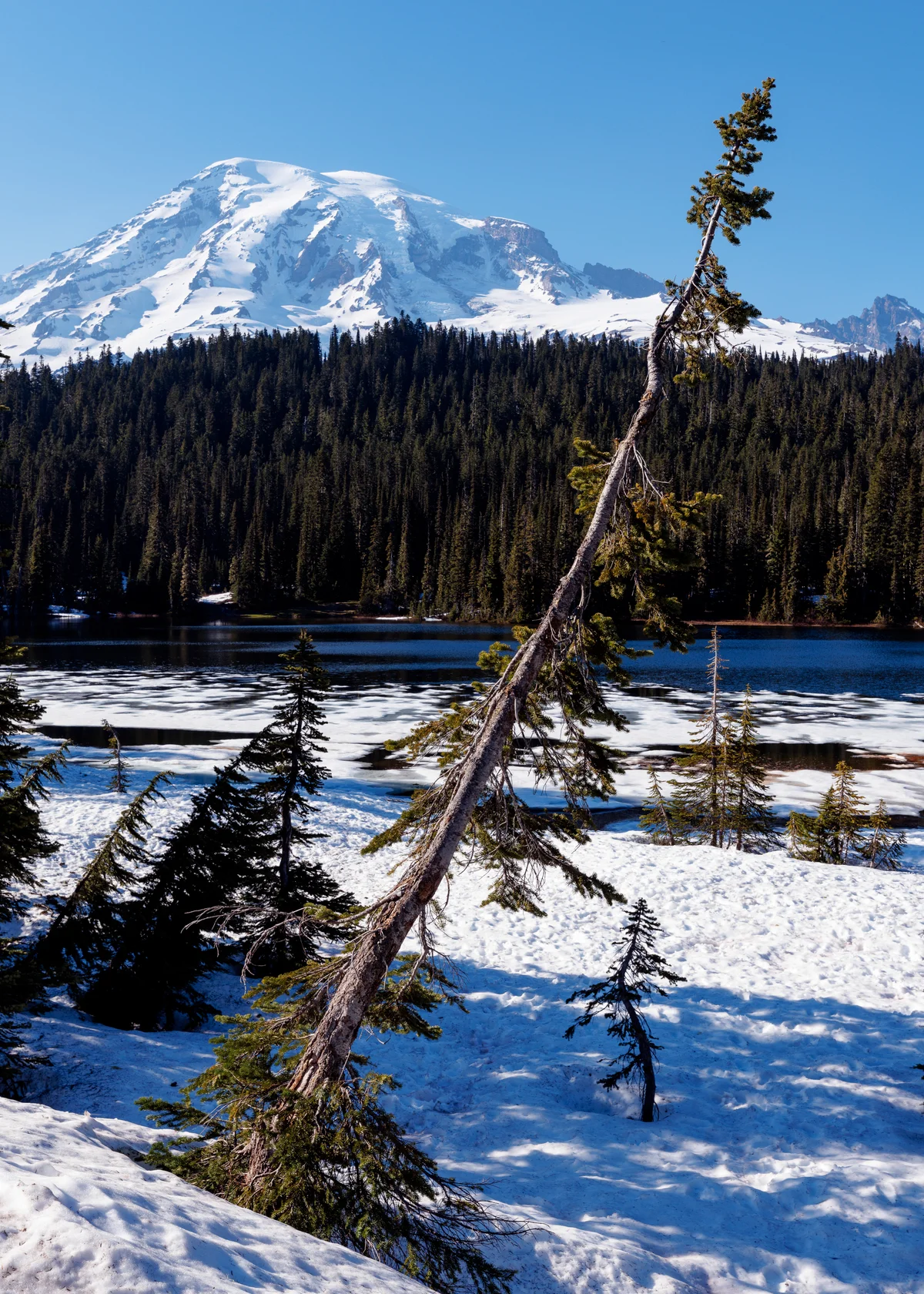
Mount Rainier is an episodic active stratovolcano in the Cascade Range of Washington, rising to an elevation of 4,392 metres as the highest peak in Washington and the Cascade Volcanic Arc. Enveloped by twenty-five major named glaciers spanning over thirty-five square miles of perpetual snow and ice, it is the most heavily glaciated peak in the contiguous United States, serving as the proving ground for American high-altitude mountaineering.
Documented Sources & Archival Citations
- The Ascent of Takhoma (The Atlantic Monthly, 1876)(Hazard Stevens)
Supporting claim: Primary first-hand account of the historic 1870 first ascent of Mount Rainier
Accessed/Documented: 2026 - The Challenge of Rainier(Dee Molenaar / The Mountaineers Books)
Supporting claim: Detailed chronicle of the 1870 Stevens-Van Trump pioneering expedition
Accessed/Documented: 2026