The Secret of the Vanishing Lake: Gottfried Merzbacher's 1902 Tien Shan Odyssey
German explorer Gottfried Merzbacher penetrates the colossal Inylchek Glacier in 1902, discovering Lake Merzbacher beneath the marble pyramid of Khan Tengri.

Mountain Safety & Conditions Disclaimer: High-altitude climbing, glacial travel, and technical ascents entail severe objective risks including avalanches, serac collapses, rapid weather collapse, and altitude illness. Historical route descriptions and summit claims on Mountanity reflect documented archival sources and must not be used as live operational safety assessments. Local regulations, permits, and physical glacial topography change continuously.
Peer Review: Senior Editorial Board & Historical Reviewers • Editorial Standards
The Myth of the Celestial Mountains
At the beginning of the twentieth century, the interior of Central Asia remained one of the most enigmatic blanks on the global geographic map. High above the scorching Taklamakan and Karakum deserts rose the Tien Shan—the Celestial Mountains. Nomadic Kyrgyz horsemen spoke in whispered reverence of a colossal white marble tooth that pierced the heavens, known as Khan Tengri: the Lord of the Spirits.
For decades, European cartographers debated whether Khan Tengri truly existed or was merely an exaggerated desert mirage. Russian explorer Pyotr Semenov had sighted its pink-tinted summit from afar in 1857, but no expedition had ever reached its base. The mountain was defended by an impenetrable natural fortress: the Inylchek Glacier, a sixty-kilometre river of shattered moraine and bottomless crevasses flowing through vertical canyons of rock.
In 1902, a fifty-eight-year-old Bavarian merchant turned explorer named Gottfried Merzbacher resolved to solve the mystery of the Celestial Mountains. Having already made pioneering ascents in the Caucasus, Merzbacher secured the backing of the Imperial Russian Geographical Society and assembled a formidable team of German geologists and Tyrolean alpine guides.
Into the Heart of the Inylchek
Departing from the frontier outpost of Karakol on the shores of Lake Issyk-Kul in May 1902, Merzbacher’s expedition pushed deep into the Saryjaz river canyon. The journey was a harrowing test of wilderness survival. Swollen glacial torrents swept away pack horses, while torrential rockfalls crashed through their high-altitude camps.
Entering the mouth of the Inylchek Glacier, Merzbacher was staggered by its sheer scale. Surrounded by unclimbed peaks rising above 6,000 metres, the glacier groaned and cracked with primeval power. Hauling heavy glass-plate cameras, theodolites, and scientific barometers, the party forced their way up the ice.
Then, thirty kilometres up the glacier, they encountered a phenomenon that stopped them in their tracks.
The Lake That Vanishes
Spanning the junction between the North and South Inylchek glaciers lay an extraordinary body of water: a crystal-clear, deep turquoise alpine lake spanning four kilometres, choked with thousands of floating, luminous white icebergs. High-altitude ice dams held back millions of tons of water, forming a surreal Arctic seascape in the heart of Asia.
While Merzbacher and his team camped along the cliffs above the lake, a deafening roar echoed through the gorge. The water began to churn violently as subterranean tunnels opened deep within the glacier bed. Within twenty-four hours, the entire lake completely drained before their eyes, sucked down through abyssal crevasses into a roaring subglacial torrent that flooded the valleys eighty kilometres below, leaving giant icebergs stranded like shattered marble monuments on the muddy lakebed.
Merzbacher had discovered one of the greatest glaciological wonders on Earth: a recurrent glacial outburst lake, known to world science ever since as Lake Merzbacher.
The Vision of Khan Tengri
Bypassing the empty lake basin, Merzbacher pushed further into the upper glacier. Finally, the icy walls parted, and before him rose Khan Tengri in all its terrifying magnificence.
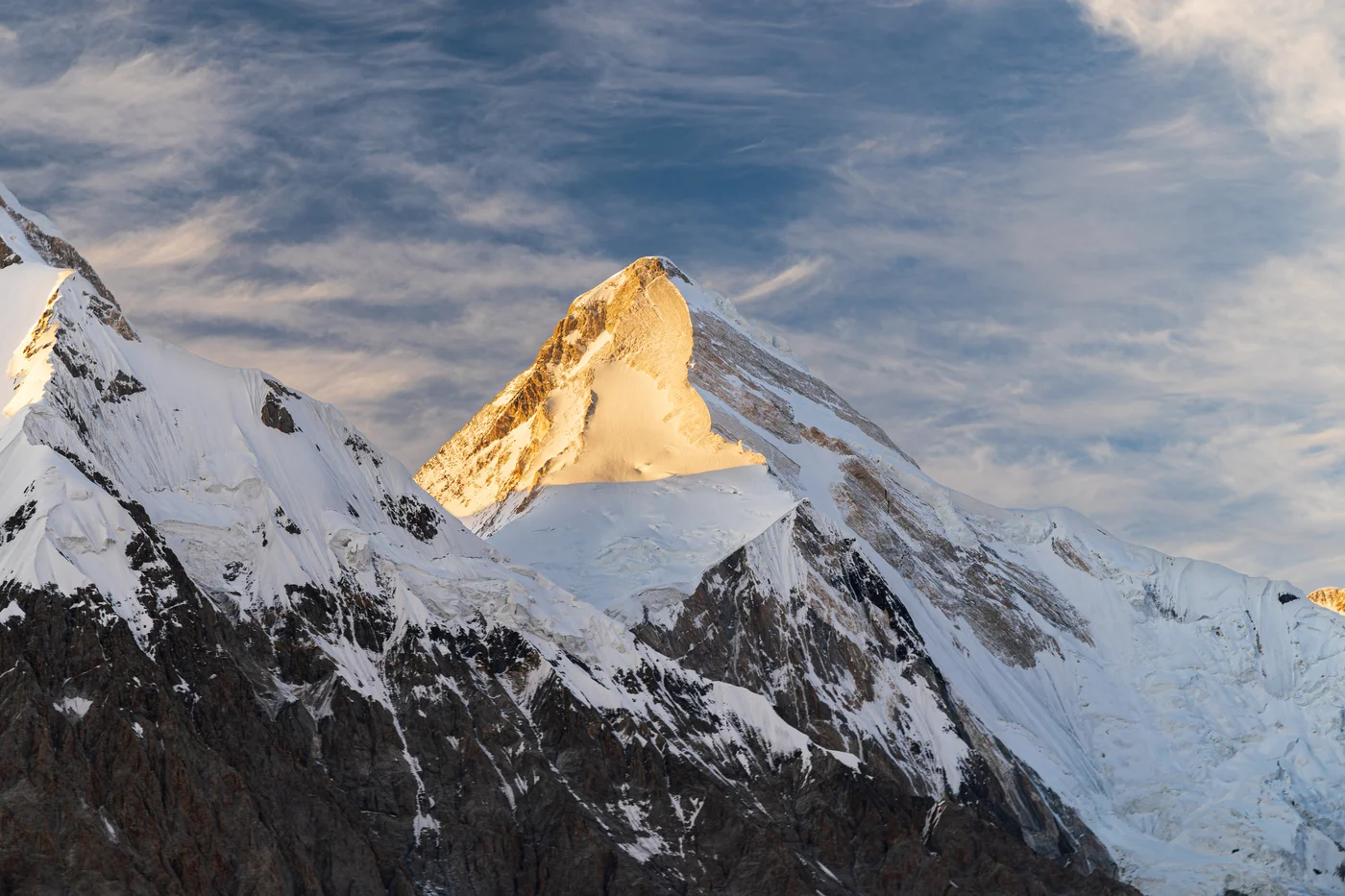
A flawless four-sided pyramid of polished white and pink marble, Khan Tengri soared over 7,000 metres into the deep blue sky. At sunset, its marble facets caught the dying alpine glow, burning with an incandescent crimson flame while the surrounding valleys lay in shadow.
Although technical barriers, altitude sickness, and violent blizzards halted Merzbacher’s party at 5,500 metres, his expedition was a triumph of world exploration. In 1905, he published his monumental work The Central Tian-Shan Mountains, providing the first accurate maps, geological cross-sections, and meteorological records of the range.
Through Gottfried Merzbacher’s visionary daring, the Celestial Mountains had been unveiled to human knowledge.
Key Statistics & Topographic Figures
- Category
- Central Asian Pioneers
Archival Subject
- Reading Time
- 18 min read
Narrative Length
- Key Mountain
- khan-tengri
Objective
- Ascent Route
- khan-tengri-west-ridge
Topography
- Verification
- Editorially Verified
Archival Standard
Archival Primary Source Quotations
“In the mountains, truth is etched in ice and granite; every step requires unwavering respect for the heights.”
Defined Alpine Terminology & Concepts
- Summit Push
- The final continuous climbing effort from the highest established camp to the mountain apex and back.
- Death Zone Chronicle
- A verified, research-backed historical narrative documenting the human, technical, and environmental realities of an alpine expedition.
Frequently Asked Questions: The Secret of the Vanishing Lake: Gottfried Merzbacher's 1902 Tien Shan Odyssey
What is the core chronicle and subject of "The Secret of the Vanishing Lake: Gottfried Merzbacher's 1902 Tien Shan Odyssey"?
German explorer Gottfried Merzbacher penetrates the colossal Inylchek Glacier in 1902, discovering Lake Merzbacher beneath the marble pyramid of Khan Tengri.
Which mountain peaks and routes are featured in "The Secret of the Vanishing Lake: Gottfried Merzbacher's 1902 Tien Shan Odyssey"?
This narrative documents climbs on khan-tengri along the khan-tengri-west-ridge in Kyrgyzstan.
Which documented expedition is chronicled in this story?
This historical chronicle captures the events of the 1902-merzbacher-central-tien-shan-exploration, verified through contemporary journals and archival records.
Who authored and researched this archival chronicle?
Authored and researched by Gottfried Merzbacher, drawing on primary eyewitness testimonies, alpine club registries, and verified summit logs.
What makes this high-altitude chronicle historically significant?
Categorized under "Central Asian Pioneers", this chronicle preserves critical lessons in alpine leadership, survival, tactical speed, and human endurance in the death zone.
Related Mountains



Khan Tengri / Lord of the Spirits
Khan Tengri is a breathtakingly symmetrical, marble-stratified pyramid rising to 7,010 metres (22,999 ft, including summit ice cap) in the Tengri-Tag range of the Central Tien Shan, straddling the borders of Kyrgyzstan, Kazakhstan, and China. Revered in ancient Tengrism as the sacred 'Lord of the Spirits' and famous for its fiery pink glow at sunset, the peak is one of the premier challenges of high-altitude mountaineering. First conquered on September 11, 1931, by a Ukrainian expedition led by Mikhail Pogrebetsky via the West Ridge, it was the scene of an epic survival climb in 1936 by the Abalakov brothers.
Documented Sources & Archival Citations
- The Central Tian-Shan Mountains: 1902–1903(John Murray, London / Gottfried Merzbacher)
Supporting claim: Primary geographic memoirs and discovery narrative
Accessed/Documented: 1905