K2 1909: The Duke of the Abruzzi, Vittorio Sella, and the Genesis of the Abruzzi Spur
In 1909, Prince Luigi Amedeo, Duke of the Abruzzi, and master photographer Vittorio Sella mounted a monumental expedition into the Karakoram, unlocking the secrets of K2, naming the Abruzzi Spur, and setting a world altitude record of 7,498m on Chogolisa.
Mountain Safety & Conditions Disclaimer: High-altitude climbing, glacial travel, and technical ascents entail severe objective risks including avalanches, serac collapses, rapid weather collapse, and altitude illness. Historical route descriptions and summit claims on Mountanity reflect documented archival sources and must not be used as live operational safety assessments. Local regulations, permits, and physical glacial topography change continuously.
Peer Review: Senior Editorial Board & Historical Reviewers • Editorial Standards
In the early spring of 1909, one of the most remarkable figures of the late 19th and early 20th centuries set his sights on the most intimidating mountain on the planet. Prince Luigi Amedeo of Savoy, Duke of the Abruzzi—grandson of King Victor Emmanuel II of Italy, admiral in the Italian Royal Navy, and seasoned explorer of Alaska and the Arctic—resolved to launch an expedition to the heart of the Karakoram to unlock the mysteries of K2 (8,611 meters / 28,251 ft).
At that time, K2 (Chogori) was known to the Western world only through distant trigonometric surveys and the ill-fated 1902 expedition led by Oscar Eckenstein and Aleister Crowley, which had collapsed in illness and discord on the lower glacier. No comprehensive topographical survey existed; no route had been proven viable; and scientists still debated whether human lungs could function at elevations exceeding 7,000 meters without fatal asphyxiation.
The Duke brought to the task royal resources, naval military discipline, and an extraordinary cadre of specialists. Foremost among them was Vittorio Sella, then 50 years old and already celebrated across Europe as the undisputed master of mountain photography. Accompanying them were physician and chronicler Dr. Filippo De Filippi, topographer Federico Negrotto, and four elite alpine mountain guides from Courmayeur led by the legendary Joseph Petigax.
The Great March Across the Baltoro
Arriving in Rawalpindi in April 1909, the expedition assembled a caravan of 260 Balti porters, carrying over eight tons of provisions, scientific equipment, and Sella’s precious photographic apparatus. Sella had brought heavy wooden large-format cameras and hundreds of fragile 30x40 cm glass-plate negatives, which had to be transported across raging glacial torrents and crumbling scree on the backs of specialized porters without breaking a single plate.
Departing Skardu, the expedition marched up the Shigar Valley and into the arid granite gorges of the Braldu River. By late May, they stepped onto the snout of the Baltoro Glacier—a 62-kilometer frozen highway of moraine and ice flanked by some of the most dramatic rock monoliths on Earth, including the Trango Towers, Cathedral Peak, and the sheer obelisk of Muztagh Tower.
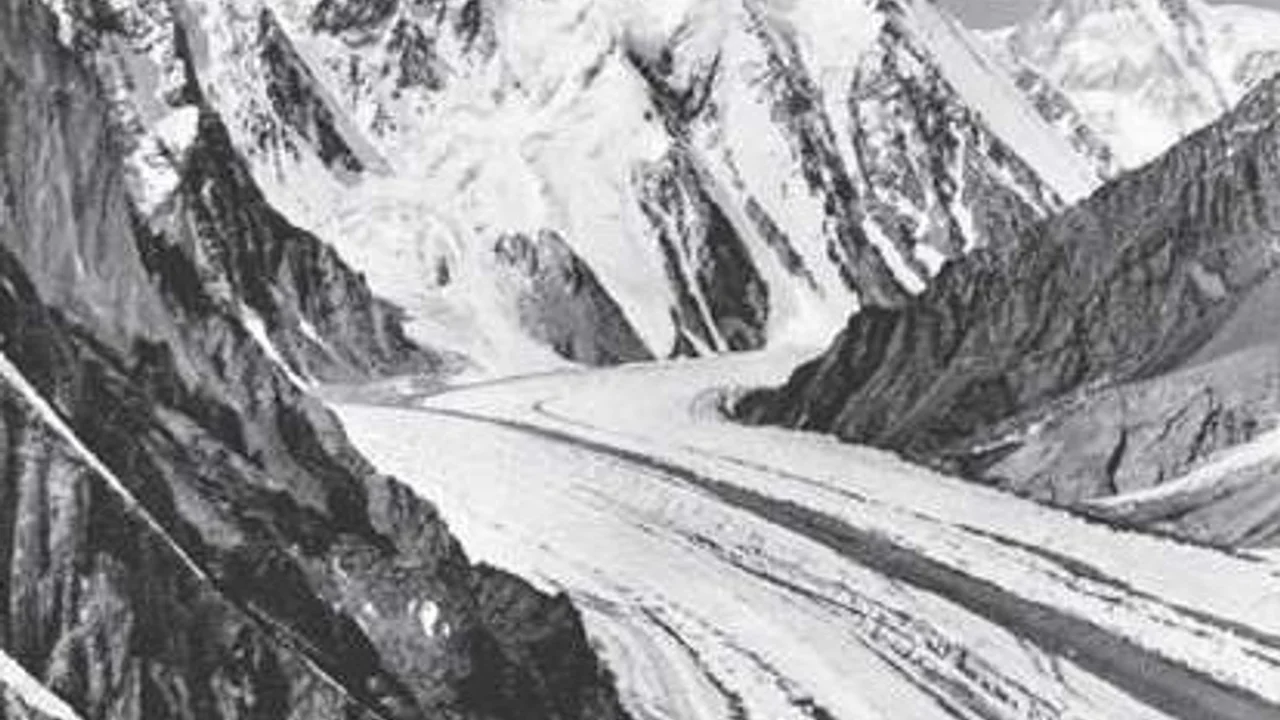
At Concordia, the vast glacial junction where the Godwin-Austen and Baltoro glaciers converge, K2 suddenly revealed itself in all its terrifying majesty: a colossal four-sided pyramid of black gneiss and glittering ice rising almost three vertical miles above the glacier bed.
Scouting K2: Discovering the Abruzzi Spur
Establishing Base Camp on the Godwin-Austen Glacier beneath the eastern flanks of K2 in early June, the Duke and his Courmayeur guides methodically reconnoitered the mountain from every compass direction. They scrambled up the Savoia Glacier to the West Ridge, only to find an impossibly steep rampart of crumbling rock towers swept by avalanches. They explored the North Face via the Skyang Kangri col, finding sheer, lightless precipices dropping toward China.
Turning their gaze to the southeastern shoulder, the Duke identified a prominent, continuous rock ridge that rose from the Godwin-Austen Glacier directly toward the summit shoulder. While steep and technically daunting, it appeared free from falling serac avalanches.
In late June, the Duke, Joseph Petigax, and the Brocherel brothers began ascending this ridge. Over days of brutal effort, climbing in nailed boots and heavy tweed clothing, they hacked steps in hard ice and bridged vertical rock chimneys, establishing small tent platforms on tiny snow ledges. The team succeeded in reaching an elevation of approximately 6,250 meters (20,500 feet).
Here, confronted by towering vertical granite buttresses (later christened the House’s Chimney and Black Pyramid by American climbers), lacking hundreds of meters of fixed ropes, and with their porters incapacitated by cold, the Duke was forced to turn back. Nevertheless, his keen tactical eye had recognized the truth: this southeast rib was the only viable key to unlocking K2. The Duke permanently named it the Abruzzi Spur (Sperone Abruzzi). Forty-five years later, in 1954, it would become the historic highway along which Achille Compagnoni and Lino Lacedelli reached the summit, and today it remains the route chosen by over 85% of all climbers on K2.
The Epic on Chogolisa: The 7,498-Meter World Record
Recognizing that K2 could not be conquered without specialized siege equipment, the Duke refused to return home without pushing human endurance to its ultimate physiological frontier. In July 1909, he turned his party toward Chogolisa (Bride Peak, 7,665 meters), a broad, graceful snow mountain rising south of Concordia.
Pioneering a route up the Chogolisa Glacier, the Duke, Joseph Petigax, Alexis Brocherel, and Enrico Brocherel established Camp I and Camp II on the mountain’s lower flanks. On July 18, 1909, operating without supplemental oxygen and carrying heavy packs, the four men launched a push up the exposed, knife-edge snow arête of the Southeast Ridge.
As they gained elevation, a ferocious blizzard engulfed the mountain. Dense clouds reduced visibility to a few paces, while gale-force winds dropped the windchill far below -30°C. Refusing to surrender, the Duke and his guides pressed upward along the corniced ridge step by agonizing step, battling hypoxia, extreme fatigue, and the terror of overhanging snow cornices collapsing into the abyss.
At 7,498 meters (24,600 feet)—just 167 vertical meters below Chogolisa’s summit—the ridge narrowed into a precarious, knife-edge cornice surrounded by impenetrable whiteout. Joseph Petigax stopped and warned the Duke that another step forward would cause them to plunge through the cornice into the vertical void.
Reluctantly, the Duke called a halt. Although denied the summit, they had achieved an astonishing feat: reaching 7,498 meters without supplemental oxygen, setting a human mountaineering altitude world record that would stand undefeated for thirteen years until George Finch and Geoffrey Bruce reached 8,320m on Mount Everest in 1922.
Vittorio Sella’s Immortal Photographic Legacy
While the Duke and his guides tested the physiological limits of man on the high ridges, Vittorio Sella was creating an artistic and scientific monument. Setting up his massive wooden camera on ridges above Concordia, Sella exposed hundreds of 30x40 cm glass plates with impeccable chemical precision, capturing the dramatic contrasts of light and shadow across K2, Broad Peak, the Gasherbrums, and Chogolisa.
Sella’s photographs were not mere travel snapshots; they were masterpieces of high-altitude photographic art and precise cartographic documents. When American photographer Ansel Adams saw Sella’s prints, he wrote: “The incredible grandeur of Sella’s photographs of the Karakoram inspires a quality of religious awe. They are documents of supreme historic and aesthetic importance.”
The maps, photographs, and scientific logs brought back by the Duke of the Abruzzi and Vittorio Sella provided the foundational blueprint for modern Karakoram mountaineering. More than a century later, every climber who ropes up beneath the Abruzzi Spur on K2 walks in the footsteps of the Italian prince and the alpine masters who first showed the world what was possible in the throne room of the mountain gods.
Key Statistics & Topographic Figures
- Category
- Historic Expeditions
Archival Subject
- Reading Time
- 14 min read
Narrative Length
- Key Mountain
- k2, chogolisa
Objective
- Ascent Route
- abruzzi-spur, chogolisa-southeast-ridge
Topography
- Verification
- Editorially Verified
Archival Standard
Archival Primary Source Quotations
“In the mountains, truth is etched in ice and granite; every step requires unwavering respect for the heights.”
Defined Alpine Terminology & Concepts
- Summit Push
- The final continuous climbing effort from the highest established camp to the mountain apex and back.
- Death Zone Chronicle
- A verified, research-backed historical narrative documenting the human, technical, and environmental realities of an alpine expedition.
Frequently Asked Questions: K2 1909: The Duke of the Abruzzi, Vittorio Sella, and the Genesis of the Abruzzi Spur
What is the core chronicle and subject of "K2 1909: The Duke of the Abruzzi, Vittorio Sella, and the Genesis of the Abruzzi Spur"?
In 1909, Prince Luigi Amedeo, Duke of the Abruzzi, and master photographer Vittorio Sella mounted a monumental expedition into the Karakoram, unlocking the secrets of K2, naming the Abruzzi Spur, and setting a world altitude record of 7,498m on Chogolisa.
Which mountain peaks and routes are featured in "K2 1909: The Duke of the Abruzzi, Vittorio Sella, and the Genesis of the Abruzzi Spur"?
This narrative documents climbs on k2, chogolisa along the abruzzi-spur, chogolisa-southeast-ridge in Pakistan.
Which documented expedition is chronicled in this story?
This historical chronicle captures the events of the 1909-abruzzi-k2, verified through contemporary journals and archival records.
Who authored and researched this archival chronicle?
Authored and researched by Mountainity Historical Research Desk, drawing on primary eyewitness testimonies, alpine club registries, and verified summit logs.
What makes this high-altitude chronicle historically significant?
Categorized under "Historic Expeditions", this chronicle preserves critical lessons in alpine leadership, survival, tactical speed, and human endurance in the death zone.
Related Mountains
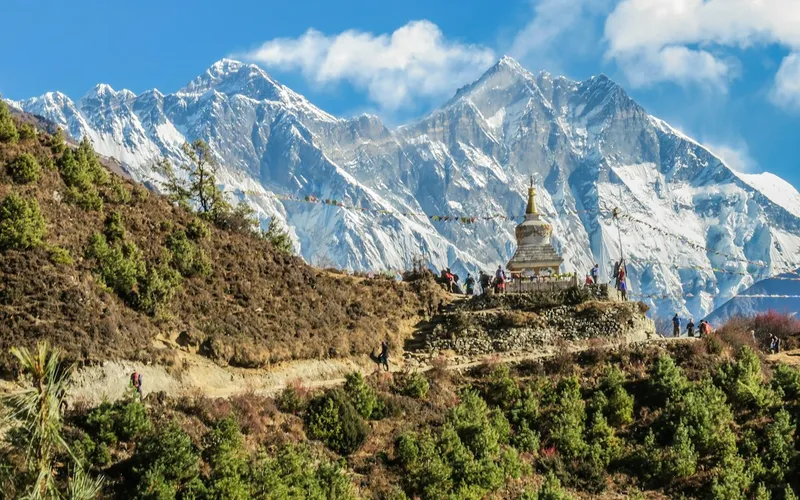


K2
K2, at 8,611 meters (28,251 ft), is the second-highest mountain on Earth and widely regarded as the most technically demanding and lethal 8,000-meter peak. Located in the heart of the Karakoram on the border between Pakistan and China, K2 is characterized by sheer relief, severe weather anomalies, and persistent objective hazards including the notorious Bottleneck couloir.
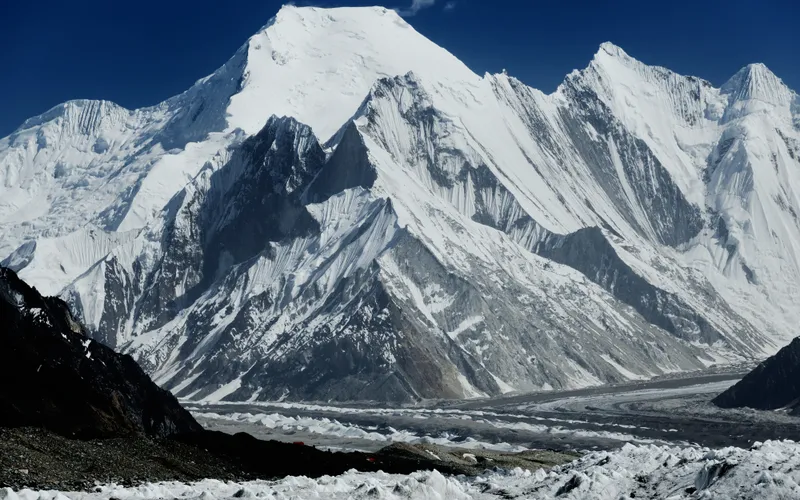
Chogolisa
Chogolisa, standing at 7,665 meters (25,148 ft) in the Karakoram range of Pakistan, is renowned as Bride Peak for its broad, graceful snow-draped profile. Located south of Concordia and the Baltoro Glacier, it features two prominent summits connected by a sweeping knife-edge snow ridge. In 1909, the Duke of the Abruzzi set a world altitude record on its slopes, and in 1957, it became the site of alpine pioneer Hermann Buhl's fatal cornice fall.
Documented Sources & Archival Citations
- Karakoram and Western Himalaya 1909: An Account of the Expedition of H.R.H. Prince Luigi Amedeo of Savoy(Dr. Filippo De Filippi and Vittorio Sella / Edward Arnold)
Supporting claim: Comprehensive official expedition record, cartographic surveys, and detailed climbing logs
Accessed/Documented: 1912 - Summit: Vittorio Sella - Pioneer Mountain Photographer 1879–1912(Aperture Foundation)
Supporting claim: Historical analysis of Sella's 1909 large-format glass plates and alpine expeditions
Accessed/Documented: 1999 - The Alpine Journal: The Duke of the Abruzzi's Karakoram Expedition(The Alpine Club UK)
Supporting claim: Contemporary verification of the 7,498m altitude record on Chogolisa and K2 route scouting
Accessed/Documented: 1910