Skirts on the Summit: Freda Du Faur's 1910 Mount Cook Triumph
How an Australian woman broke Edwardian society's rules and conquered New Zealand's highest peak in record time.
Mountain Safety & Conditions Disclaimer: High-altitude climbing, glacial travel, and technical ascents entail severe objective risks including avalanches, serac collapses, rapid weather collapse, and altitude illness. Historical route descriptions and summit claims on Mountanity reflect documented archival sources and must not be used as live operational safety assessments. Local regulations, permits, and physical glacial topography change continuously.
Peer Review: Senior Editorial Board & Historical Reviewers • Editorial Standards
Skirts on the Summit: Freda Du Faur’s 1910 Mount Cook Triumph
Defying the Edwardian Parlour
In the early decades of the twentieth century, society held strictly defined notions of what a woman could and could not do. Alpinism—with its physical violence, harsh weather, and prolonged bodily peril—was deemed exclusively the domain of rugged men. Women were expected to admire the mountains from the verandas of the Hermitage Hotel, sipping tea in corsets and ankle-length crinoline skirts.
Emmeline Freda Du Faur was having none of it.
Born in 1882 in Sydney, Australia, Du Faur had spent her youth roaming the sandstone crags and eucalyptus bush of the Blue Mountains. When she first saw the glaciated peaks of the Southern Alps during a visit to New Zealand in 1906, something inside her ignited. She did not want to sketch the mountains; she wanted to stand on top of them.
When Du Faur arrived at Mount Cook in late 1909 declaring her intention to climb Aoraki (3,724 m), she was greeted by scandal and skepticism. Conservative critics whispered that it was “improper” for an unmarried young woman to spend the night in mountain bivouac huts unchaperoned with male guides. Furthermore, Victorian conventions demanded that women wear heavy woolen skirts down to their ankles—clothing that, in steep ice terrain, was virtually a death sentence.
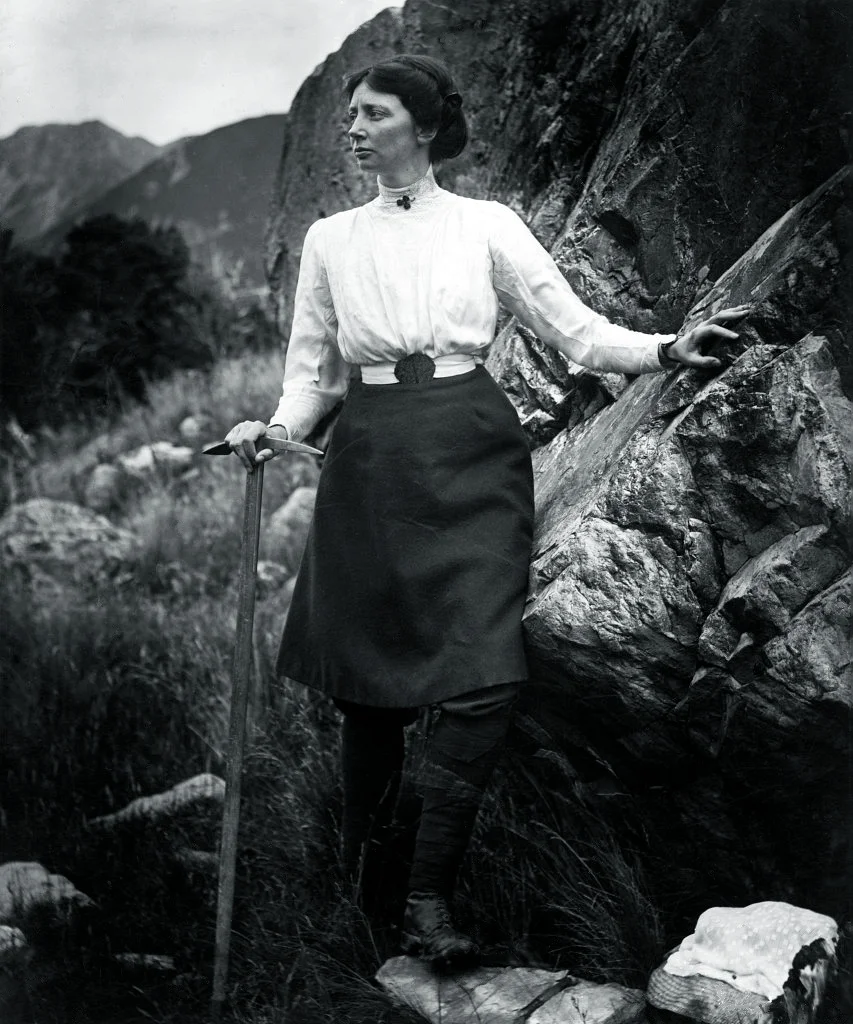
Du Faur solved both problems with characteristic boldness. To quiet the moral guardians, she brought an official female companion to the hotel; to conquer the mountain, she designed a revolutionary climbing costume: knickerbockers topped with a practical, knee-length skirt that allowed full freedom of movement while preserving outward modesty.
“I was told that if I persisted in climbing mountains, I would lose my femininity and ruin my health. I replied that mountains know nothing of gender; they ask only whether you have courage, endurance, and love in your heart.” — Freda Du Faur, The Conquest of Mount Cook, 1915
Partnering with Peter Graham
Du Faur was fortunate in finding a mentor who cared nothing for social prejudice: Peter Graham, chief guide at the Hermitage. A giant of a man with gentle manners and peerless alpine technique, Graham immediately recognized Du Faur’s extraordinary physical conditioning, mental fortitude, and natural balance on ice.
“She had the stamina of three men and the courage of ten,” Graham later wrote. Together with his brother Alec Graham, Peter agreed to lead Du Faur up the supreme peak of New Zealand.
The Ascent via the Linda Glacier
On December 2, 1910, Du Faur and the Graham brothers made their way to the high bivouac near the head of the Hooker Glacier. At 2:00 AM on December 3, under a canopy of southern stars, the three climbers roped up and set forth into the freezing night.
Their route ascended the Linda Glacier, winding beneath the colossal, tottering ice seracs of the Grand Plateau. Huge avalanches regularly swept down from the upper slopes, requiring rapid movement across the debris fields. Du Faur matched the long strides of the Graham brothers step for step, climbing with silent, focused determination.
As dawn broke, illuminating the Southern Alps in hues of amber and rose, they reached the base of the summit rocks. Graham cut a succession of swift steps up the steep snow couloir. Du Faur handled her axe with effortless grace, never hesitating on exposed traverses where a single slip would mean a 1,000-metre fall into the icefalls below.
Summit at 8:40 AM: A Record-Shattering Triumph
At 8:40 AM on December 3, 1910—a mere six hours after leaving their high camp—Freda Du Faur stepped onto the corniced crest of the High Peak of Aoraki / Mount Cook.
She had not only become the first woman in history to summit New Zealand’s highest peak; she had done so faster than any male party that had preceded her.
Standing on the summit with Peter and Alec Graham, looking out across the endless glaciers to the Pacific Ocean, Du Faur felt the weight of societal expectations lift from her shoulders:
“There, on that shining point of snow, high above the clouds and the petty conventions of the world below, I felt utterly free. I knew that women could do anything men could do—and do it with joy.”
The trio made a swift, flawless descent, returning to the Hermitage that same evening in an astonishing total time of fourteen hours. The guests on the veranda, who had expected her to fail or return in tears, erupted into spontaneous cheers.
Freda Du Faur had not merely climbed a mountain; she had struck a historic blow for female independence and rewritten the rules of high-altitude mountaineering forever.
Key Statistics & Topographic Figures
- Category
- Australasian Pioneers
Archival Subject
- Reading Time
- 15 min read
Narrative Length
- Key Mountain
- aoraki-mount-cook
Objective
- Ascent Route
- mount-cook-grand-traverse
Topography
- Verification
- Editorially Verified
Archival Standard
Archival Primary Source Quotations
“In the mountains, truth is etched in ice and granite; every step requires unwavering respect for the heights.”
Defined Alpine Terminology & Concepts
- Summit Push
- The final continuous climbing effort from the highest established camp to the mountain apex and back.
- Death Zone Chronicle
- A verified, research-backed historical narrative documenting the human, technical, and environmental realities of an alpine expedition.
Frequently Asked Questions: Skirts on the Summit: Freda Du Faur's 1910 Mount Cook Triumph
What is the core chronicle and subject of "Skirts on the Summit: Freda Du Faur's 1910 Mount Cook Triumph"?
How an Australian woman broke Edwardian society's rules and conquered New Zealand's highest peak in record time.
Which mountain peaks and routes are featured in "Skirts on the Summit: Freda Du Faur's 1910 Mount Cook Triumph"?
This narrative documents climbs on aoraki-mount-cook along the mount-cook-grand-traverse in New Zealand.
Which documented expedition is chronicled in this story?
This historical chronicle captures the events of the 1910-freda-du-faur-mount-cook-first-female-ascent, verified through contemporary journals and archival records.
Who authored and researched this archival chronicle?
Authored and researched by Mountainity Historical Research Desk, drawing on primary eyewitness testimonies, alpine club registries, and verified summit logs.
What makes this high-altitude chronicle historically significant?
Categorized under "Australasian Pioneers", this chronicle preserves critical lessons in alpine leadership, survival, tactical speed, and human endurance in the death zone.
Related Mountains
Aoraki / Mount Cook
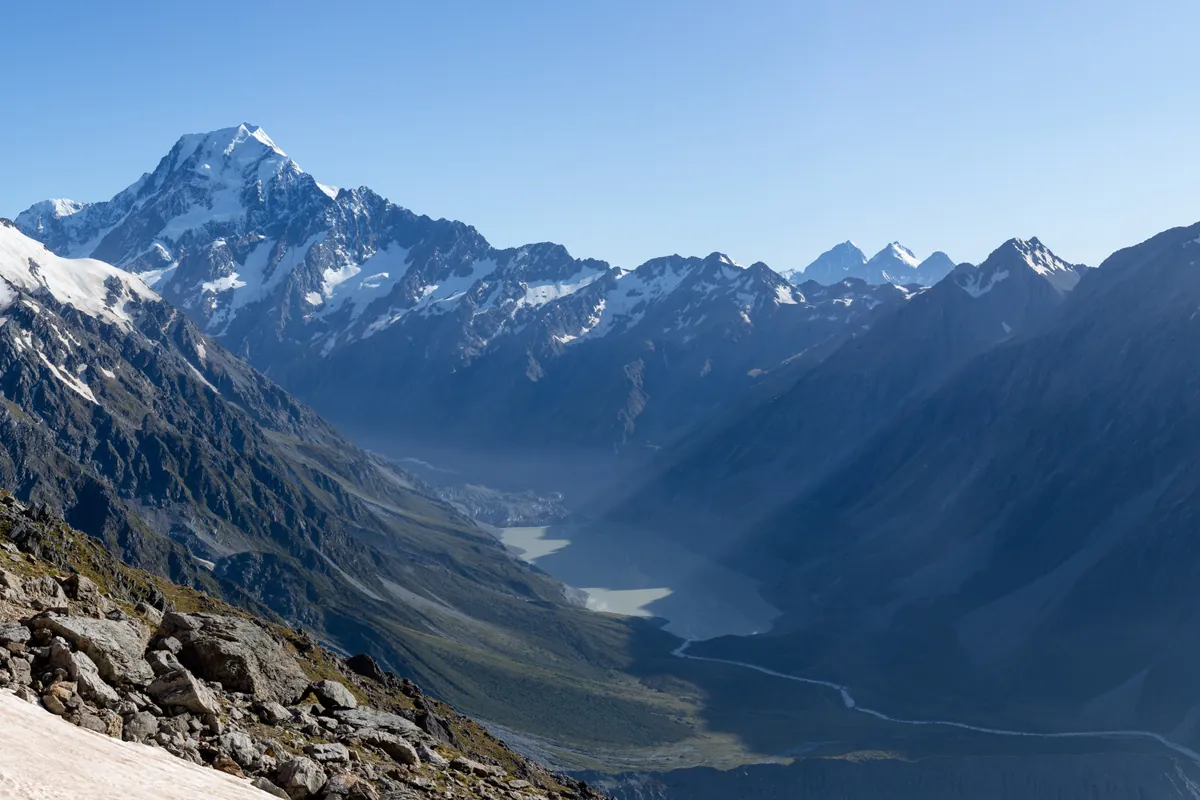
Aoraki / Mount Cook is the highest mountain in New Zealand at 3,724 meters (12,218 ft). Located in the Southern Alps, it is an ultra-prominent glaciated peak rising dramatically above the Tasman Glacier. It is sacred in Māori mythology as the ancestor Aoraki. The mountain is renowned as the formative training ground where Sir Edmund Hillary developed his high-altitude icecraft. On January 30, 1948, Hillary completed the historic first ascent of the technical South Ridge alongside Harry Ayres. Climbing Aoraki requires expert crampon technique, glacier navigation, and vigilance against severe maritime storms.
Documented Sources & Archival Citations
- The Conquest of Mount Cook and Other Climbs(Freda Du Faur / George Allen & Unwin)
Supporting claim: Primary autobiographical source
Accessed/Documented: 1915 - Peter Graham, Mountain Guide(A.H. & A.W. Reed)
Supporting claim: Historical memoirs of Peter Graham
Accessed/Documented: 1965