The Purity of the Solo: Paul Preuss and the Birth of Clean Climbing Ethics
On July 28, 1911, Austrian mountaineer Dr. Paul Preuss completed the ropeless free-solo first ascent of the East Face of Campanile Basso, establishing clean climbing principles.
Mountain Safety & Conditions Disclaimer: High-altitude climbing, glacial travel, and technical ascents entail severe objective risks including avalanches, serac collapses, rapid weather collapse, and altitude illness. Historical route descriptions and summit claims on Mountanity reflect documented archival sources and must not be used as live operational safety assessments. Local regulations, permits, and physical glacial topography change continuously.
Peer Review: Senior Editorial Board & Historical Reviewers • Editorial Standards
At the turn of the twentieth century, European mountaineering found itself standing at a philosophical crossroads. In the Eastern Alps and Dolomites, climbers were increasingly turning to heavy iron pitons, expansion hammers, and rope tension to force their way up sheer vertical rock walls. To some, this was progress; to a brilliant young Austrian plant physiologist named Paul Preuss, it was spiritual sacrilege.
Born in Styria in 1886 and educated at the University of Munich, Dr. Paul Preuss possessed both an analytical scientific intellect and a poetic devotion to mountains. In a famous 1911 essay published in the German and Austrian Alpine Club journal, Preuss laid down his revolutionary “Six Axioms of Pure Mountaineering.” His doctrine was simple, radical, and unforgiving: a climber must never use artificial aids to overcome rock difficulty, the piton should only be an emergency anchor, and above all, a mountaineer should never climb up a pitch that they could not safely down-climb without a rope.
The Challenge of the Brenta Spire
Many older contemporaries dismissed Preuss as an impractical theorist. They argued that the sheer limestone monoliths of the Dolomites were physically impossible to ascend without hammer and iron. Determined to prove that human physical skill, mental equilibrium, and clean climbing ethics could triumph over the most terrifying precipices, Preuss traveled to the Brenta Dolomites in late July 1911.
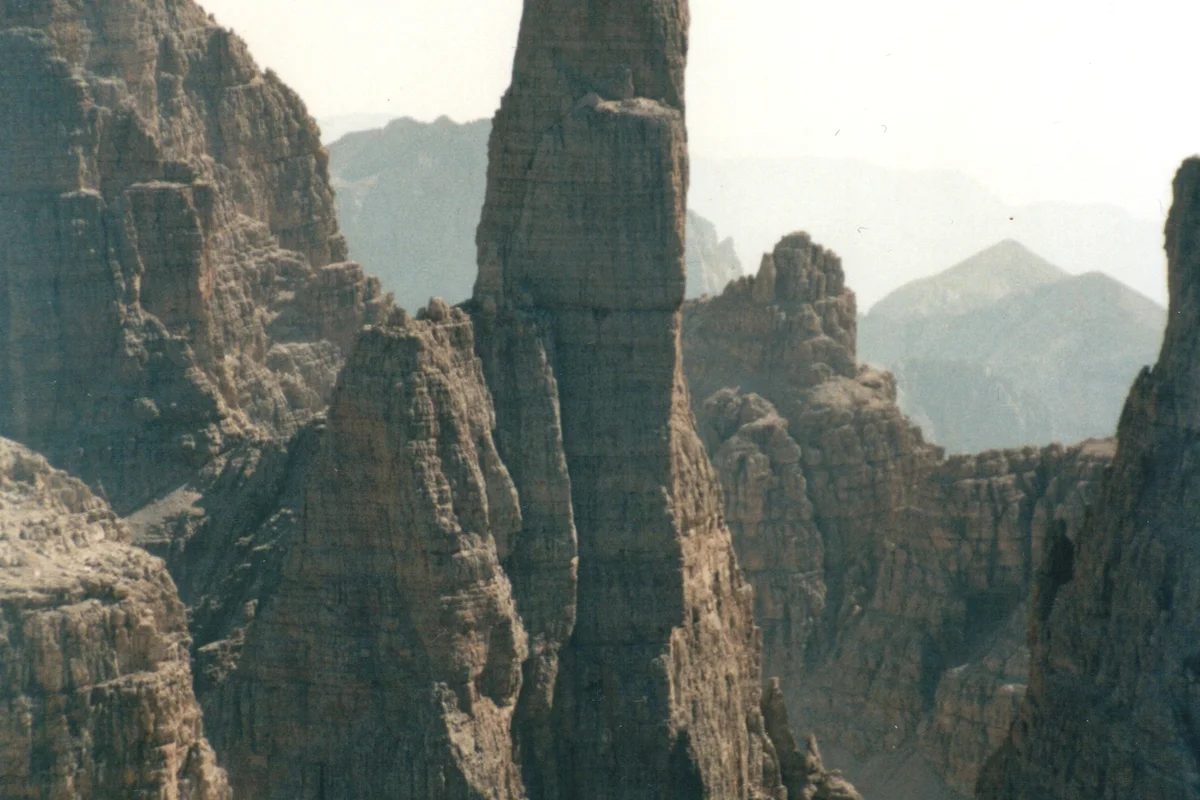
His objective was the Campanile Basso (Guglia di Brenta)—a four-hundred-meter vertical needle of yellow, gray, and black limestone that rises like a gothic cathedral spire into the clouds. The East Face of the tower was completely unclimbed and regarded as sheer and unprotectable.
Soloing into the Abyss
On the morning of July 28, 1911, Preuss stood at the base of the East Face. He wore simple canvas climbing slippers and tweed trousers. He carried no rope, no carabiners, no pitons, and no hammer. He had no climbing partner. Reaching up with chalk-free hands, he gripped the first limestone pocket and pulled himself off the scree.
What followed was one of the most sublime displays of calm athletic perfection in mountaineering history. Moving smoothly and deliberately up vertical cracks, exposed chimneys, and delicate friction slabs up to Grade V, Preuss appeared almost weightless. Where a fall meant instant death on the boulder fields hundreds of meters below, Preuss experienced complete mental clarity. In just two hours of continuous climbing, he pulled himself over the summit crest and stood atop the narrow, table-sized apex of the Campanile Basso.
The Reversal of Destiny
Most climbers who reach a summit are relieved to rappel down ropes. But Preuss had committed himself to his ultimate axiom: “A climber should never climb up a pitch they cannot safely down-climb.” Leaving no fixed anchors, Preuss turned his back to the abyss and began down-climbing the vertical face ropeless.
Reversing difficult fifth-grade moves down vertical rock without being able to see one’s footholds requires superhuman calm and spatial awareness. Preuss down-climbed every single pitch of the four-hundred-meter face with effortless poise, stepping back onto the scree at the base without a scratch. His solo first ascent and ropeless down-climb of the Campanile Basso remains celebrated as the foundational birth of pure free soloing and clean climbing ethics in world mountaineering.
Key Statistics & Topographic Figures
- Category
- Alpine Style Masterpieces
Archival Subject
- Reading Time
- 13 min read
Narrative Length
- Key Mountain
- matterhorn
Objective
- Ascent Route
- matterhorn-hornli-ridge
Topography
- Verification
- Editorially Verified
Archival Standard
Archival Primary Source Quotations
“In the mountains, truth is etched in ice and granite; every step requires unwavering respect for the heights.”
Defined Alpine Terminology & Concepts
- Summit Push
- The final continuous climbing effort from the highest established camp to the mountain apex and back.
- Death Zone Chronicle
- A verified, research-backed historical narrative documenting the human, technical, and environmental realities of an alpine expedition.
Frequently Asked Questions: The Purity of the Solo: Paul Preuss and the Birth of Clean Climbing Ethics
What is the core chronicle and subject of "The Purity of the Solo: Paul Preuss and the Birth of Clean Climbing Ethics"?
On July 28, 1911, Austrian mountaineer Dr. Paul Preuss completed the ropeless free-solo first ascent of the East Face of Campanile Basso, establishing clean climbing principles.
Which mountain peaks and routes are featured in "The Purity of the Solo: Paul Preuss and the Birth of Clean Climbing Ethics"?
This narrative documents climbs on matterhorn along the matterhorn-hornli-ridge in Italy / Austria.
Which documented expedition is chronicled in this story?
This historical chronicle captures the events of the 1911-paul-preuss-campanile-basso-free-solo, verified through contemporary journals and archival records.
Who authored and researched this archival chronicle?
Authored and researched by Mountainity Historical Research Desk, drawing on primary eyewitness testimonies, alpine club registries, and verified summit logs.
What makes this high-altitude chronicle historically significant?
Categorized under "Alpine Style Masterpieces", this chronicle preserves critical lessons in alpine leadership, survival, tactical speed, and human endurance in the death zone.
Related Mountains



Matterhorn
The Matterhorn (Monte Cervino), at 4,478 meters (14,692 ft), is one of the most recognizable and dramatic pyramidal peaks in the world. Straddling the border between Zermatt, Switzerland, and Breuil-Cervinia, Italy, its four triangular faces match the cardinal points of the compass. Its historic first ascent by Edward Whymper on July 14, 1865, and the tragic fall of four teammates on the descent marked the end of the Golden Age of Alpinism.
Documented Sources & Archival Citations
- Paul Preuss: Lord of the Abyss(David Smart / Rocky Mountain Books)
Supporting claim: Detailed historical verification of the July 28, 1911 free-solo first ascent of Campanile Basso East Face
Accessed/Documented: 2019 - Mitteilungen des DuÖAV: The Free Solo Ascents of Paul Preuss(Deutscher und Österreichischer Alpenverein)
Supporting claim: Contemporary report and Preuss's essay on clean climbing ethics without pitons
Accessed/Documented: 1912