Across the Razor's Edge: The 1913 Mount Cook Grand Traverse
Twenty continuous hours on the knife-edge crest of New Zealand: Freda Du Faur and Peter Graham conquer the triple peaks of Aoraki.
Mountain Safety & Conditions Disclaimer: High-altitude climbing, glacial travel, and technical ascents entail severe objective risks including avalanches, serac collapses, rapid weather collapse, and altitude illness. Historical route descriptions and summit claims on Mountanity reflect documented archival sources and must not be used as live operational safety assessments. Local regulations, permits, and physical glacial topography change continuously.
Peer Review: Senior Editorial Board & Historical Reviewers • Editorial Standards
Across the Razor’s Edge: The 1913 Mount Cook Grand Traverse
The Supreme Prize of the Southern Alps
By the summer of 1913, Freda Du Faur was no longer merely a promising climber; she was widely regarded as the most formidable mountaineer in Australasia. She had summited Mount Cook, claimed first ascents of Mount Dampier and Mount Sefton, and navigated dozens of uncharted passes.
Yet there was one dream that kept her awake at night in the Hermitage: the Grand Traverse of Mount Cook.
Aoraki is not a single isolated horn. It is a massive, multi-crested ridge crowned by three distinct summits: the Low Peak (3,593 m), the Middle Peak (3,717 m), and the crowning High Peak (3,724 m). Between these summits runs a narrow, undulating knife-edge arête of shattered greywacke and wind-sculpted snow cornices that overhang sheer vertical precipices for thousands of feet.
No climber—man or woman—had ever traversed all three peaks in a single continuous expedition. The challenge was regarded as one of the most dangerous endurance routes in world mountaineering. If a westerly squall from the Tasman Sea hit while a party was balanced on the ridge, retreat was impossible.
Together with her trusted chief guide Peter Graham and assistant guide David Thomson, Du Faur resolved to attempt the traverse in the opening days of 1913.
“The Grand Traverse was the dream of our lives. It called for everything an alpinist could possess: speed, iron nerves, boundless endurance, and absolute faith in one’s rope companions.” — Freda Du Faur, The Conquest of Mount Cook, 1915
Dawn on the Low Peak
On the afternoon of January 2, 1913, Du Faur, Graham, and Thomson established a Spartan bivouac at the Empress Shelter, perched high on the rocks above the Hooker Glacier. At 2:45 AM on January 3, they set out into the freezing night.
Climbing by candlelight and starlight up the frozen slopes of the Sheila Glacier, they gained the jagged notch of the South Ridge. As the first rays of sunrise turned the glaciers below into sheets of molten gold, Peter Graham stepped onto the Low Peak at 3,593 metres. Du Faur and Thomson followed, tying into their hemp rope for the endless ridge ahead.
Balanced Over the Abyss
Now began the most harrowing traverse ever undertaken in the Southern Hemisphere.
Between the Low Peak and the Middle Peak, the ridge narrowed to a razor’s edge barely two feet wide. To the right plunged the monstrous Caroline Face—a 2,000-metre wall of vertical hanging seracs and tumbling avalanches. To the left dropped the sheer western cliffs above the Hooker Glacier.
Walking this crest required supernatural concentration. Large wind cornices hung out over the eastern void like frozen waves; a climber who stepped too close to the edge would cause the cornice to shear away and plunge into the abyss.
With Graham in the lead, Du Faur in the centre, and Thomson anchoring the rear, the three moved with synchronized rhythm. Where the ridge was solid ice, Graham hacked shallow steps. Where broken rock towers blocked the way, they clung to shattered greywacke ledges with their fingertips, their boot toes finding precarious friction on frozen holds.
By 9:00 AM, they surmounted the Middle Peak (3,717 m). Looking ahead, the final connecting arête to the High Peak rose before them in a series of jagged, ice-glazed gendarmes. The wind was rising from the Tasman, whipping freezing spindrift across the ridge.
There could be no turning back. Forward was the only way off the mountain.
Victory on the High Peak
At 1:30 PM, after eleven continuous hours of unrelenting exposure, Peter Graham cut the final steps onto the summit snows of the High Peak (3,724 m).
Freda Du Faur pulled herself onto the dome, collapsing onto her knees in joyous exhaustion. David Thomson followed. They had done what many of the world’s finest alpine experts had declared impossible: they had completed the first-ever traverse across the entire triple crown of Aoraki.
They stood together on the highest point in New Zealand, having traversed over three kilometres of knife-edge ridge at extreme altitude without a single misstep.
The Descent of the Linda
The triumph was only half complete: they still had to descend safely through the labyrinth of the Linda Glacier. The afternoon heat had turned the snow bridges into treacherous slush, and hanging ice seracs threatened the lower couloirs.
Navigating crevasses in the gathering dusk, the party finally staggered off the ice and onto the moraine. It was after 10:00 PM when they reached the Hermitage—twenty continuous hours after departing their high camp.
The 1913 Grand Traverse stunned the international climbing world. European journals that had previously dismissed colonial climbing now published admiring tributes to the Australian woman and her New Zealand guides who had accomplished one of the greatest ridge traverses in alpine history.
Key Statistics & Topographic Figures
- Category
- Australasian Pioneers
Archival Subject
- Reading Time
- 16 min read
Narrative Length
- Key Mountain
- aoraki-mount-cook
Objective
- Ascent Route
- mount-cook-grand-traverse
Topography
- Verification
- Editorially Verified
Archival Standard
Archival Primary Source Quotations
“In the mountains, truth is etched in ice and granite; every step requires unwavering respect for the heights.”
Defined Alpine Terminology & Concepts
- Summit Push
- The final continuous climbing effort from the highest established camp to the mountain apex and back.
- Death Zone Chronicle
- A verified, research-backed historical narrative documenting the human, technical, and environmental realities of an alpine expedition.
Frequently Asked Questions: Across the Razor's Edge: The 1913 Mount Cook Grand Traverse
What is the core chronicle and subject of "Across the Razor's Edge: The 1913 Mount Cook Grand Traverse"?
Twenty continuous hours on the knife-edge crest of New Zealand: Freda Du Faur and Peter Graham conquer the triple peaks of Aoraki.
Which mountain peaks and routes are featured in "Across the Razor's Edge: The 1913 Mount Cook Grand Traverse"?
This narrative documents climbs on aoraki-mount-cook along the mount-cook-grand-traverse in New Zealand.
Which documented expedition is chronicled in this story?
This historical chronicle captures the events of the 1913-du-faur-graham-mount-cook-grand-traverse, verified through contemporary journals and archival records.
Who authored and researched this archival chronicle?
Authored and researched by Mountainity Historical Research Desk, drawing on primary eyewitness testimonies, alpine club registries, and verified summit logs.
What makes this high-altitude chronicle historically significant?
Categorized under "Australasian Pioneers", this chronicle preserves critical lessons in alpine leadership, survival, tactical speed, and human endurance in the death zone.
Related Mountains
Aoraki / Mount Cook
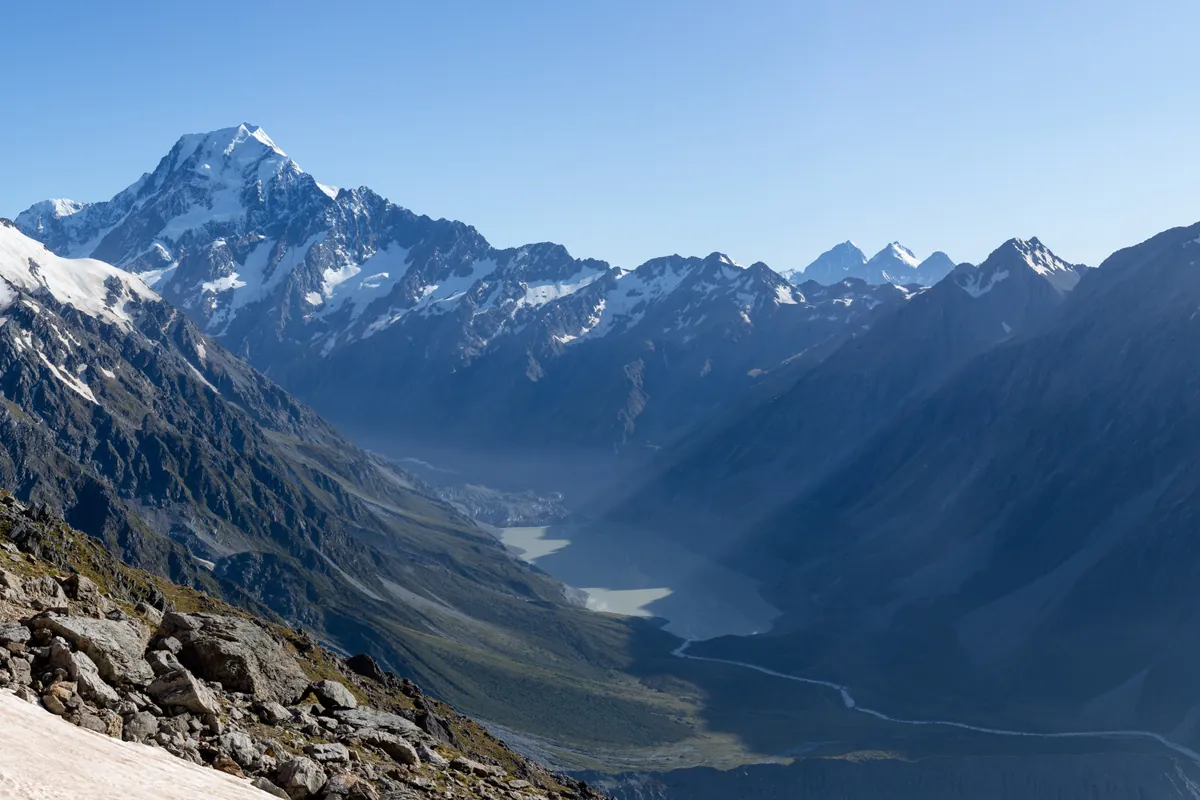
Aoraki / Mount Cook is the highest mountain in New Zealand at 3,724 meters (12,218 ft). Located in the Southern Alps, it is an ultra-prominent glaciated peak rising dramatically above the Tasman Glacier. It is sacred in Māori mythology as the ancestor Aoraki. The mountain is renowned as the formative training ground where Sir Edmund Hillary developed his high-altitude icecraft. On January 30, 1948, Hillary completed the historic first ascent of the technical South Ridge alongside Harry Ayres. Climbing Aoraki requires expert crampon technique, glacier navigation, and vigilance against severe maritime storms.
Documented Sources & Archival Citations
- The Conquest of Mount Cook and Other Climbs(Freda Du Faur / George Allen & Unwin)
Supporting claim: Primary historical source
Accessed/Documented: 1915 - New Zealand Alpine Journal(New Zealand Alpine Club)
Supporting claim: Official alpine commentary
Accessed/Documented: 1913