Buried Alive in the Ice: Augustine Courtauld's Five-Month Solitary Vigil
Trapped in darkness for five months beneath the Greenland Ice Sheet at -50°C, Augustine Courtauld survives one of the most harrowing solitary vigils in polar history.
Mountain Safety & Conditions Disclaimer: High-altitude climbing, glacial travel, and technical ascents entail severe objective risks including avalanches, serac collapses, rapid weather collapse, and altitude illness. Historical route descriptions and summit claims on Mountanity reflect documented archival sources and must not be used as live operational safety assessments. Local regulations, permits, and physical glacial topography change continuously.
Peer Review: Senior Editorial Board & Historical Reviewers • Editorial Standards
Buried Alive in the Ice: Augustine Courtauld’s Five-Month Solitary Vigil
The Lone Outpost on the Inland Ice
In the autumn of 1930, the British Arctic Air Route Expedition established Ice Cap Station—a solitary weather station positioned at 2,620 metres altitude, 225 kilometres inland on the featureless expanse of the Greenland ice sheet. Its purpose was vital: to record continuous barometric pressure, wind, and temperature data through the depth of the Arctic winter to determine whether commercial airplanes could safely cross the ice cap.
The station consisted of a small pyramid tent surrounded by a circular snow wall, connected to a snow-tunnel storehouse. Two meteorologists manned the station during autumn, but when a relief sledging party arrived on December 6, 1930, after battling ferocious blizzards, they discovered they had consumed most of their rations during the approach. There were only enough supplies to sustain one man for the winter.
Rather than abandon the meteorological station, 26-year-old Augustine Courtauld volunteered to stay alone until spring. He was well aware of the gravity of his choice: the Arctic winter was settling in, with perpetual darkness, temperatures plummeting past -50°C, and no possibility of relief until April.
Entombment
Courtauld settled into his solitary routine. Every three hours, he crawled through the narrow snow tunnel, stepped out into the howling, freezing gale, read the thermometers and anemometer, and logged the data.
By January 1931, the ferocious blizzards of the Inland Ice—the dreaded Piteraq storms—began to bury the station. Snow accumulated in colossal drifts until the tent was completely submerged beneath several feet of dense, wind-packed ice. Courtauld had to shovel his exit tunnel continuously.
In March, disaster struck. An immense blizzard battered the station for days. On March 22, the weight of the accumulated drift collapsed the entrance tunnel, sealing the opening under a solid slab of ice. Courtauld was entombed alive in his buried chamber beneath the Greenland ice sheet.
His only connection to the surface was a slender, two-inch brass ventilation pipe that poked through the snow above. Inside the pitch-black chamber, Courtauld’s kerosene for his Primus stove dwindled. He could only light a tiny wick for a few minutes each day to melt ice for drinking water. He lay inside his frozen sleeping bag in absolute sub-zero darkness, rationing dry pemmican biscuits, unable to stand, surrounded by the crushing silence of the ice cap.
“I was never frightened. I had complete faith that Gino Watkins and my companions would come for me. I spent my days thinking through books I had read, praying, and keeping my mind calm.” — Augustine Courtauld
The Rescue Across the Snow Desert
Down at coastal Base Camp, Watkins was deeply alarmed. A relief party sent in March had been forced back by blinding storms and frostbite. Public anxiety mounted in London; headlines across the world feared Courtauld was dead.
On April 21, 1931, Watkins took command of the relief mission himself, setting out with Spencer Chapman and Australian surveyor John Rymill. Armed with precision theodolite sextants, Watkins navigated across 225 kilometres of featureless, shifting white snow desert.
On May 5, 1931, after weeks of searching a vast expanse of snow, Chapman spotted an anomaly on the horizon: the frayed tip of a Union Jack flag attached to a surveyor’s pole, and nearby, the small brass ventilation pipe protruding six inches above the snow crust.
Digging furiously through the hard-packed ice, Watkins broke through the tent roof. Peering down into the dark cavern with a flashlight, Watkins called out: “Are you all right, August?”
From the gloom below, Courtauld calmly replied: “Yes, perfectly all right, thanks. Have you got any tobacco?”
Courtauld had survived 150 days on the Greenland ice sheet, including six weeks completely buried in darkness. His survival became one of the greatest legends in polar history, cementing his reputation as one of Britain’s most steadfast explorers.
Key Statistics & Topographic Figures
- Category
- Polar Pioneers
Archival Subject
- Reading Time
- 17 min read
Narrative Length
- Key Mountain
- gunnbjorn-fjeld
Objective
- Ascent Route
- gunnbjorn-south-ridge
Topography
- Verification
- Editorially Verified
Archival Standard
Archival Primary Source Quotations
“In the mountains, truth is etched in ice and granite; every step requires unwavering respect for the heights.”
Defined Alpine Terminology & Concepts
- Summit Push
- The final continuous climbing effort from the highest established camp to the mountain apex and back.
- Death Zone Chronicle
- A verified, research-backed historical narrative documenting the human, technical, and environmental realities of an alpine expedition.
Frequently Asked Questions: Buried Alive in the Ice: Augustine Courtauld's Five-Month Solitary Vigil
What is the core chronicle and subject of "Buried Alive in the Ice: Augustine Courtauld's Five-Month Solitary Vigil"?
Trapped in darkness for five months beneath the Greenland Ice Sheet at -50°C, Augustine Courtauld survives one of the most harrowing solitary vigils in polar history.
Which mountain peaks and routes are featured in "Buried Alive in the Ice: Augustine Courtauld's Five-Month Solitary Vigil"?
This narrative documents climbs on gunnbjorn-fjeld along the gunnbjorn-south-ridge in Greenland.
Which documented expedition is chronicled in this story?
This historical chronicle captures the events of the 1930-courtauld-greenland-ice-cap-vigil, verified through contemporary journals and archival records.
Who authored and researched this archival chronicle?
Authored and researched by Mountainity Historical Research Desk, drawing on primary eyewitness testimonies, alpine club registries, and verified summit logs.
What makes this high-altitude chronicle historically significant?
Categorized under "Polar Pioneers", this chronicle preserves critical lessons in alpine leadership, survival, tactical speed, and human endurance in the death zone.
Related Mountains

Gunnbjørn Fjeld
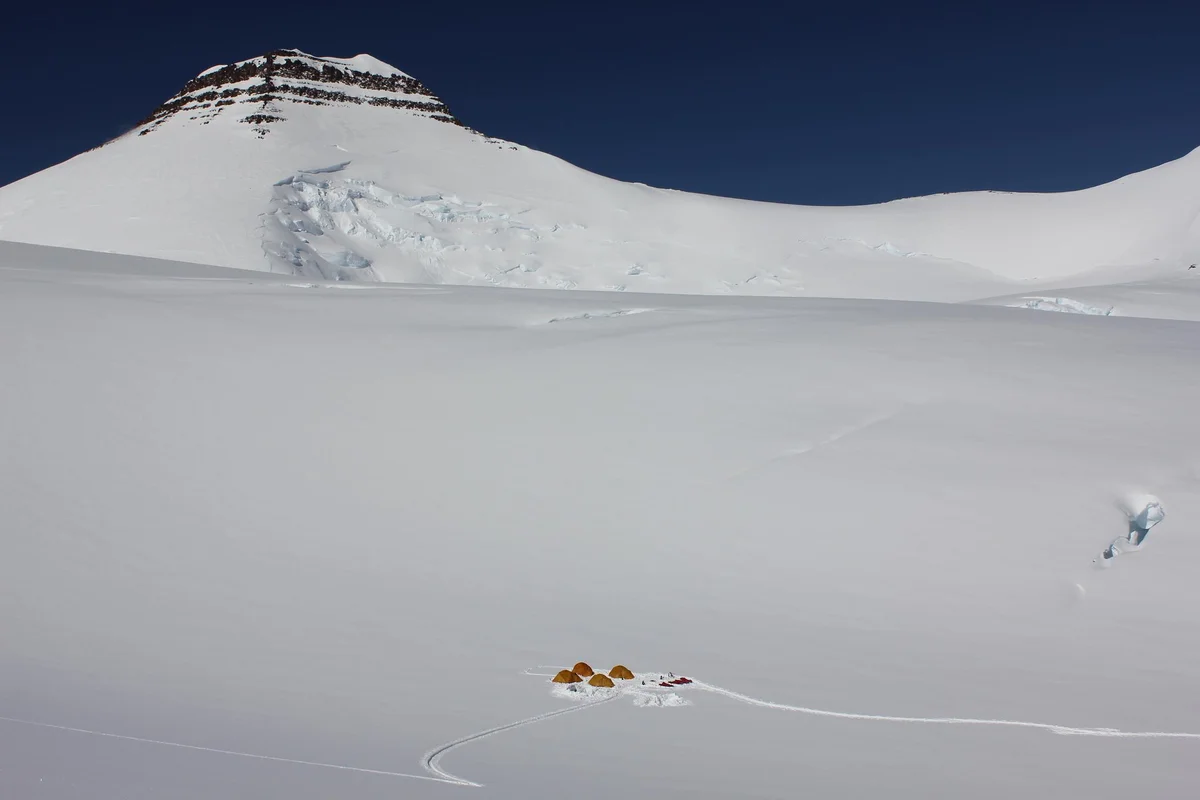
Gunnbjørn Fjeld is the highest mountain in Greenland and the highest peak north of the Arctic Circle at 3,694 metres (12,119 ft). Rising as an enormous basaltic nunatak above the glaciated plateau of the Watkins Range in East Greenland, it was first sighted from the air in 1930 by Gino Watkins and named after the 9th-century Norse explorer Gunnbjørn Ulfsson. The maiden first ascent was achieved on August 16, 1935, by Lawrence Wager, Ebbe Munck, Jack Longland, and Patrick Courtauld during an Anglo-Danish expedition. Climbing Gunnbjørn Fjeld involves moderate alpine glacier ascents, but requires complete self-reliance against extreme polar gales, severe windchill, and isolated Arctic conditions.
Documented Sources & Archival Citations
- Northern Lights(F. Spencer Chapman / Chatto & Windus)
Supporting claim: Primary eyewitness chronicle of Courtauld's relief
Accessed/Documented: 1932 - The Survival of Augustine Courtauld(The Polar Record / Scott Polar Research Institute)
Supporting claim: Retrospective analysis
Accessed/Documented: 1960