Nanda Devi 1936: Tilman, Odell, and the Conquest of the Blessed Goddess
On August 29, 1936, Bill Tilman and Noel Odell reached the 7,816-meter summit of Nanda Devi without bottled oxygen, conquering the highest mountain scaled on Earth until 1950.
Mountain Safety & Conditions Disclaimer: High-altitude climbing, glacial travel, and technical ascents entail severe objective risks including avalanches, serac collapses, rapid weather collapse, and altitude illness. Historical route descriptions and summit claims on Mountanity reflect documented archival sources and must not be used as live operational safety assessments. Local regulations, permits, and physical glacial topography change continuously.
Peer Review: Senior Editorial Board & Historical Reviewers • Editorial Standards
Rising in solemn, isolated majesty above the Garhwal Himalayas of northern India, Nanda Devi (7,816 meters / 25,643 ft) was revered for millennia by Hindu pilgrims as the physical manifestation of Parvati, the bliss-giving consort of Lord Shiva. Yet what truly distinguished Nanda Devi from every other mountain on Earth was its natural geography: it was entombed within an impregnable natural citadel known as the Nanda Devi Sanctuary.
For seventy continuous miles, a colossal, unbroken ring of jagged peaks exceeding 6,000 meters—including Dunagiri, Changabang, Trisul, and Nanda Ghunti—encircled the goddess like the ramparts of a fortress. The only drainage outlet from this glacial amphitheater was the Rishi Ganga, a raging torrent that plunged through a terrifying, near-vertical box canyon of polished granite. For fifty years, seasoned European explorers like W.W. Graham, Dr. Tom Longstaff, and Hugh Ruttledge had attempted to penetrate this gorge, only to be turned back by vertical precipices that dropped thousands of feet into boiling whitewater.
The 1934 Breakthrough on £287
The breakthrough came in the spring of 1934 through the sheer audacity of two British minimalist climbers: Eric Earle Shipton and Harold William “Bill” Tilman. Rejecting heavy military siege tactics and operating on a microscopic budget of £287, Shipton and Tilman took just three Sherpas—led by the incomparable Ang Tharkay—and attacked the sheer walls of the Rishi Ganga Gorge.
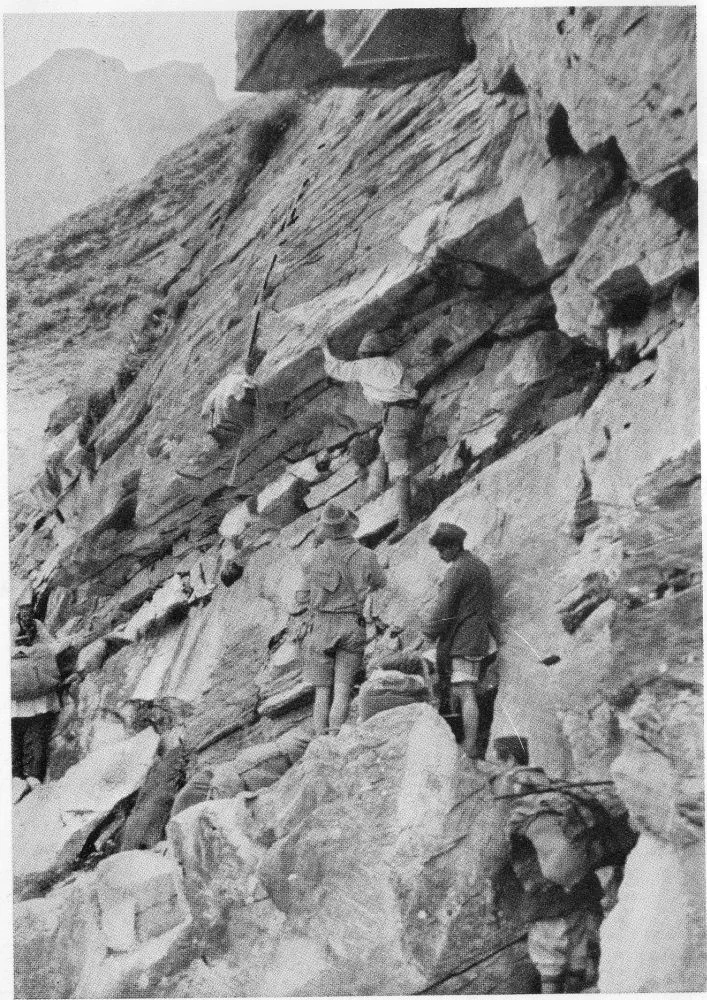
Crawling along crumbling rock ledges inches wide above the roaring abyss, chipping handholds into mossy granite, and wading waist-deep through icy glacial torrents, Shipton and Tilman accomplished what generations had deemed impossible: they forced the upper gorge. Stepping onto the verdant pastures of the inner Sanctuary, they gazed upon a virgin paradise where herds of blue sheep (bharal) grazed without fear of human hunters, and Nanda Devi rose directly from the valley floor in untouched splendor.
The 1936 Coalition: A Model of Brotherhood
Two years later, in the summer of 1936, Tilman returned to claim the summit. This time, he was accompanied by an informal partnership of four British climbers (Tilman, 1924 Everest veteran Noel Odell, T. Graham Brown, and Peter Lloyd) and four elite young American mountaineers (Charles Houston, Arthur Emmons, Adams Carter, and Warren Loomis).
Remarkably, the 1936 British-American Himalayan Expedition operated without a formal expedition leader, without nationalistic rivalry, and without a single cylinder of bottled oxygen. Carrying their own loads up the treacherous rock shelves of the Rishi Ganga, the eight men established Base Camp inside the Sanctuary in mid-July.
Operating in lightweight alpine style, they surveyed the southern ramparts of Nanda Devi, identifying a steep, razor-sharp rock spur known as the Coxcomb Ridge as their best line of attack. Methodically carrying supplies up the glaciated south face, they established Camp I (5,800m), Camp II (6,220m), and Camp III (6,460m) along the foot of the ridge.
Selflessness on the High Ridge
On August 25, young American physician Charles Houston and veteran British geologist Noel Odell carried loads to Camp IV (6,640m) on the upper crest of the Coxcomb. The initial assault plan called for Houston and Odell to make the first summit bid.
However, disaster struck that evening when Houston fell violently ill with acute food poisoning caused by a tainted tin of meat. Weakened by dehydration and intense vomiting in the thin air, Houston realized that forcing himself to climb would jeopardize the entire expedition. Demonstrating extraordinary sportsmanship, Houston voluntarily stepped aside, descending to lower camps and insisting that Bill Tilman take his place alongside Odell for the final summit push.
On August 28, Tilman and Odell climbed through a howling snowstorm to establish Camp V at 7,160 meters—a tiny, precarious tent platform hacked into an icy slope directly beneath the summit pyramid.
Summit Day: August 29, 1936
Dawn broke on Saturday, August 29, with cold, brilliant clarity. At 6:00 AM, Tilman and Odell strapped on their crampons, roped together, and began the final assault.
Climbing without supplemental oxygen, every step required immense physical discipline. As they negotiated the steep, friable rock bands of the upper pyramid, the snow was calf-deep and unstable. Yet 45-year-old Noel Odell, whose legendary lungs had carried him through the Death Zone of Everest in 1924, set a steady, rhythmic pace, while Tilman provided resolute physical power.
At 3:00 PM, after nine grueling hours of climbing, the slope abruptly leveled out. Tilman and Odell stepped onto the broad, snow-mantled summit crest of Nanda Devi at 7,816 meters (25,643 feet).
Surrounded by a breathtaking panorama stretching across the Tibetan plateau to the north and the plains of India to the south, the two men stood upon the highest piece of terra firma ever attained by human feet. Embracing in silence, Tilman famously broke the solemnity with characteristic British understatement:
“I believe we have knocked the bastard off.”
An Undefeated Altitude Benchmark
The conquest of Nanda Devi stood as the absolute world altitude summit record for fourteen years. It was not until June 3, 1950, when French alpinists Maurice Herzog and Louis Lachenal stood on the 8,091-meter summit of Annapurna I, that a higher mountain was climbed.
In the decades that followed, the Nanda Devi Sanctuary became a victim of its own fame. Excessive commercial trekking expeditions in the 1970s littered the fragile alpine pastures and deforested the birch groves of the Rishi gorge. Recognizing the sacred and ecological catastrophe, the Indian government made a visionary decision in 1982: the entire Nanda Devi Sanctuary was declared a strict National Park and permanently closed to all mountaineering, trekking, and human entry. In 1988, UNESCO designated it a World Heritage Site.
Today, Nanda Devi rests in solitary majesty, her pristine glaciers protected from the footprints of man—a sanctuary forever preserved in the memory of the eight brothers who unlocked her secrets in 1936.
Key Statistics & Topographic Figures
- Category
- Historic Expeditions
Archival Subject
- Reading Time
- 14 min read
Narrative Length
- Key Mountain
- nanda-devi
Objective
- Ascent Route
- nanda-devi-south-ridge
Topography
- Verification
- Editorially Verified
Archival Standard
Archival Primary Source Quotations
“In the mountains, truth is etched in ice and granite; every step requires unwavering respect for the heights.”
Defined Alpine Terminology & Concepts
- Summit Push
- The final continuous climbing effort from the highest established camp to the mountain apex and back.
- Death Zone Chronicle
- A verified, research-backed historical narrative documenting the human, technical, and environmental realities of an alpine expedition.
Frequently Asked Questions: Nanda Devi 1936: Tilman, Odell, and the Conquest of the Blessed Goddess
What is the core chronicle and subject of "Nanda Devi 1936: Tilman, Odell, and the Conquest of the Blessed Goddess"?
On August 29, 1936, Bill Tilman and Noel Odell reached the 7,816-meter summit of Nanda Devi without bottled oxygen, conquering the highest mountain scaled on Earth until 1950.
Which mountain peaks and routes are featured in "Nanda Devi 1936: Tilman, Odell, and the Conquest of the Blessed Goddess"?
This narrative documents climbs on nanda-devi along the nanda-devi-south-ridge in India.
Which documented expedition is chronicled in this story?
This historical chronicle captures the events of the 1936-anglo-american-nanda-devi, verified through contemporary journals and archival records.
Who authored and researched this archival chronicle?
Authored and researched by Mountainity Historical Research Desk, drawing on primary eyewitness testimonies, alpine club registries, and verified summit logs.
What makes this high-altitude chronicle historically significant?
Categorized under "Historic Expeditions", this chronicle preserves critical lessons in alpine leadership, survival, tactical speed, and human endurance in the death zone.
Related Mountains

Nanda Devi
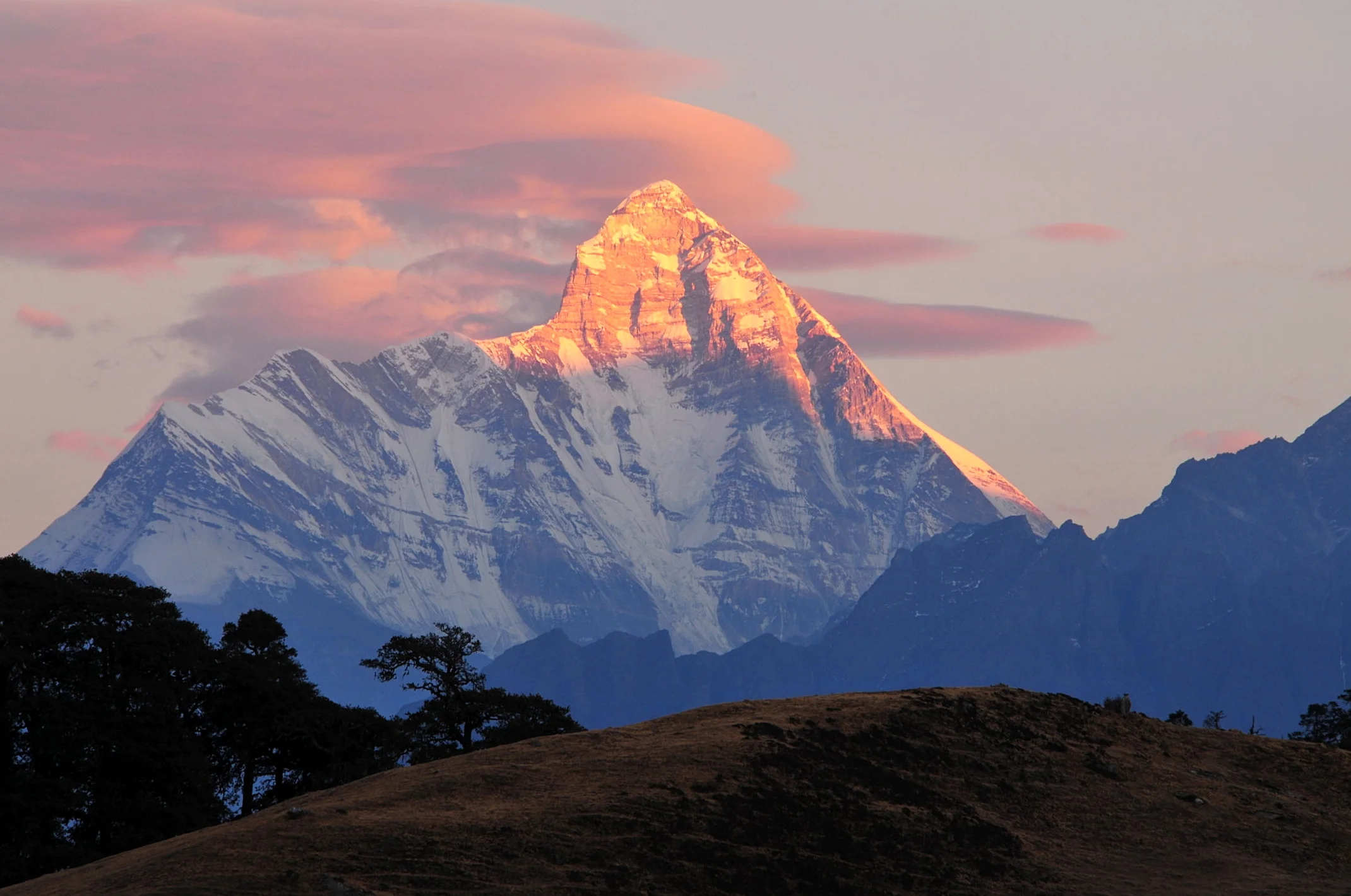
Nanda Devi, standing at 7,816 meters (25,643 ft), is the second-highest mountain in India and the highest peak situated entirely within Indian territory. Revered as a sacred manifestation of the patron goddess of Uttarakhand, the mountain rises within a formidable natural fortress—the Nanda Devi Sanctuary—ringed by seventy miles of razor-sharp peaks exceeding 6,000 meters. Its historic first ascent on August 29, 1936, by Bill Tilman and Noel Odell remained the highest summit ever achieved by human beings until the conquest of Annapurna in 1950.
Documented Sources & Archival Citations
- The Ascent of Nanda Devi(H.W. Tilman / Cambridge University Press)
Supporting claim: Primary expedition record describing the Rishi Ganga gorge approach, camps, and August 29 summit victory
Accessed/Documented: 1937 - Nanda Devi: Exploration of the Garhwal Himalaya(Eric Shipton / Hodder & Stoughton)
Supporting claim: Topographical account of the pioneering 1934 breach of the outer Sanctuary barrier
Accessed/Documented: 1936 - American Alpine Journal: The 1936 British-American Himalayan Expedition(Charles Houston & H. Adams Carter / American Alpine Club)
Supporting claim: Official American expedition report detailing logistics, health, and alpine teamwork
Accessed/Documented: 1937