Kangchenjunga 1955: The Sacred Summit and the Human Fly
On May 25, 1955, Joe Brown and George Band achieved the first ascent of Kangchenjunga (8,586m), overcoming a vertical rock wall at 8,500 meters while keeping their promise to leave the sacred summit crest untrodden.
Mountain Safety & Conditions Disclaimer: High-altitude climbing, glacial travel, and technical ascents entail severe objective risks including avalanches, serac collapses, rapid weather collapse, and altitude illness. Historical route descriptions and summit claims on Mountanity reflect documented archival sources and must not be used as live operational safety assessments. Local regulations, permits, and physical glacial topography change continuously.
Peer Review: Senior Editorial Board & Historical Reviewers • Editorial Standards
Among the fourteen eight-thousanders of the Earth, Kangchenjunga (8,586m)—the “Five Treasures of the Great Snow”—held a fearsome, almost mythical aura in the early 1950s. While Everest had finally surrendered in 1953 and K2 had fallen in 1954, Kangchenjunga remained defiant. Rising on the wild borderlands between eastern Nepal and Sikkim, it had swallowed five international expeditions and claimed dozens of lives. Veteran climbers considered it far more hazardous and technically difficult than Everest: its massive hanging glaciers dropped cataclysmic avalanches without warning, and its upper pyramid demanded sustained, severe rock climbing at elevations where human lungs starve for oxygen.
When the Alpine Club and the Royal Geographical Society decided to launch an expedition in the spring of 1955, they appointed Dr. Charles Evans as leader. Evans, a brain surgeon and veteran of the 1953 Everest expedition (who had climbed to the South Summit with Tom Bourdillon before their oxygen apparatus failed), brought an entirely new vision to the team. Rather than relying solely on the old Oxbridge establishment, Evans recruited a 24-year-old Manchester plumber who had taken the British rock-climbing world by storm: Joe Brown.
The Working-Class Master and the Sacred Covenant
Joe Brown was an unlikely candidate for imperial Himalayan expeditions. Born into poverty in industrial Manchester, Brown had left school at fourteen and spent his weekends hitchhiking to the Peak District and North Wales, establishing radical rock climbs in woolen sweaters and flat caps. His astonishing grip, lightning reflexes, and fearless ability to climb blank rock faces earned him the nickname “The Human Fly.” Alongside Cambridge geology graduate George Band—the youngest climber on the 1953 Everest expedition—Evans had assembled a summit pair that combined raw rock mastery with refined high-altitude technique.
Before the expedition could set foot on the mountain, however, a profound diplomatic hurdle had to be crossed. To the Lepcha and Sikkimese people, Kangchenjunga was not an arena for sporting triumph; it was the sacred physical manifestation of their guardian deity, Dzö-nga. The Chogyal (King) of Sikkim granted permission only after Dr. Charles Evans signed a formal treaty promising that the climbers would halt their ascent short of the actual summit crest, ensuring that the divine sanctuary would remain forever untrodden by human feet.
Forging the Southwest Face and the Great Shelf
In April 1955, the expedition established Base Camp at 5,475 meters on the moraine of the Yalung Glacier in eastern Nepal. Above them loomed an intimidating amphitheater of granite walls, hanging seracs, and ice towers.
Over five grueling weeks, the climbers and their Sherpa sirdar, Dawa Tenzing, forced a route up the Southwest Face. They negotiated the chaotic Yalung icefall, fixed ropes across steep ice couloirs, and hauled heavy oxygen canisters onto the mountain’s middle tier: a gigantic, hanging snow terrace known as The Great Shelf at 7,200 meters.
By mid-May, the lead assault team had established Camp VI at 8,200 meters—a tiny, precarious two-man tent clinging to a snow ledge directly below the sheer rock walls of the upper pyramid.
May 25, 1955: Confronting the 8,500-Meter Crux
At 8:00 AM on May 25, 1955, Joe Brown and George Band strapped on their open-circuit oxygen masks, roped together, and began climbing into the Death Zone. The route led up the Sickle Couloir, a steep ribbon of hard, blue 55-degree ice that funnelled rocks and spindrift down upon them.
Near 8,500 meters, their path was abruptly blocked by the mountain’s ultimate defense: an almost vertical, overhanging rock wall of shattered Himalayan granite. To the left lay smooth, impassable slabs; to the right was a dizzying drop into the thousands of feet of space above the Yalung Glacier.
Straight ahead, Brown spotted a narrow vertical fissure splitting the rock wall. In normal conditions in the British mountains, such a pitch would be graded a severe VS or HVS (Hard Very Severe)—a challenge for an unencumbered climber on a warm summer day. Here, at 28,000 feet, in sub-zero hurricane winds, wearing bulky down suits, crampons, and heavy oxygen cylinders, it was nearly unthinkable.
Joe Brown did not hesitate. Handing his ice axe to Band, Brown pulled off his bulky outer mittens. In thin silk and wool inner gloves, he jammed his fingers into the icy granite crack. Finding small edges for the front points of his crampons, he pulled his body upward, fighting against the crushing drag of his oxygen pack. The exertion at that extreme altitude was agonizing; every pull consumed all available oxygen in his muscles, forcing him to pause mid-move, head hanging between his arms, gasping through his rubber mask.
With a final, desperate heave of upper-body strength, Brown crested the overhanging lip and found a secure belay ledge. He had just climbed the most technically difficult rock pitch ever conquered at high altitude in mountaineering history.
The Untrodden Summit
Band followed up the crack, and together they navigated a final winding snow gully that brought them onto the final summit ridge. Ahead lay a gentle, rising crest of pristine white snow gleaming in the brilliant afternoon sun. At the top of the rise, thirty yards away, sat the ultimate pinnacle of Kangchenjunga: the highest point of the world’s third-greatest mountain.
It was 3:00 PM on May 25, 1955.
Remembering their solemn promise to the Chogyal of Sikkim, Joe Brown and George Band walked up the snow slope and came to a deliberate halt five feet below the crest. They stood in silence, looking over the ridge across the vast plains of India and into the jagged peaks of Tibet. They did not touch the sacred peak. They took photographs of the untrodden snow, buried a small talisman in the snow beneath their boots, and smiled at each other through iced-over oxygen masks.
Twenty-four hours later, on May 26, the second assault team—New Zealand engineer Norman Hardie and Captain Tony Streather—repeated the ascent, climbing the same route and similarly halting five feet short of the apex.
An Enduring Standard of Alpine Respect
The 1955 British first ascent of Kangchenjunga stands as one of the most remarkable and harmonious achievements in mountaineering history:
- Flawless Execution: Four climbers reached the summit ridge across two consecutive days without a single fatality or serious injury.
- Technical Mastery: Joe Brown’s ascent of the 8,500-meter rock crux proved that extreme rock climbing was possible even at the limits of the Death Zone.
- Cultural Honor: Unlike many early colonial expeditions that treated indigenous beliefs with indifference, Evans’s team treated local culture with profound reverence. To this day, responsible expeditions to Kangchenjunga honor the sacred pact and stop short of the actual summit crest.
When George Band returned home, he reflected on that afternoon in words that defined the spirit of the Golden Age: “We had climbed Kangchenjunga, but the mountain remained intact, pure, and unconquered in the eyes of those who loved it.”
Key Statistics & Topographic Figures
- Category
- Historic Expeditions
Archival Subject
- Reading Time
- 12 min read
Narrative Length
- Key Mountain
- kangchenjunga
Objective
- Ascent Route
- kangchenjunga-southwest-face
Topography
- Verification
- Editorially Verified
Archival Standard
Archival Primary Source Quotations
“In the mountains, truth is etched in ice and granite; every step requires unwavering respect for the heights.”
Defined Alpine Terminology & Concepts
- Summit Push
- The final continuous climbing effort from the highest established camp to the mountain apex and back.
- Death Zone Chronicle
- A verified, research-backed historical narrative documenting the human, technical, and environmental realities of an alpine expedition.
Frequently Asked Questions: Kangchenjunga 1955: The Sacred Summit and the Human Fly
What is the core chronicle and subject of "Kangchenjunga 1955: The Sacred Summit and the Human Fly"?
On May 25, 1955, Joe Brown and George Band achieved the first ascent of Kangchenjunga (8,586m), overcoming a vertical rock wall at 8,500 meters while keeping their promise to leave the sacred summit crest untrodden.
Which mountain peaks and routes are featured in "Kangchenjunga 1955: The Sacred Summit and the Human Fly"?
This narrative documents climbs on kangchenjunga along the kangchenjunga-southwest-face in Nepal.
Which documented expedition is chronicled in this story?
This historical chronicle captures the events of the 1955-british-kangchenjunga, verified through contemporary journals and archival records.
Who authored and researched this archival chronicle?
Authored and researched by Mountainity Historical Research Desk, drawing on primary eyewitness testimonies, alpine club registries, and verified summit logs.
What makes this high-altitude chronicle historically significant?
Categorized under "Historic Expeditions", this chronicle preserves critical lessons in alpine leadership, survival, tactical speed, and human endurance in the death zone.
Related Mountains


Kangchenjunga
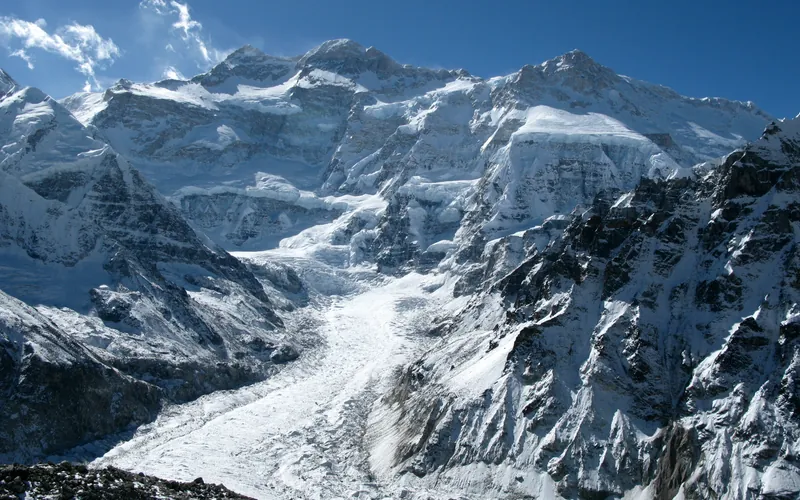
Kangchenjunga, at 8,586 meters (28,169 ft), is the third-highest mountain on Earth, rising on the border between Nepal and Sikkim, India. Honored as sacred by locals, early ascent teams respected local beliefs by stopping short of the actual highest crest. It features immense vertical relief and notorious storm cycles.
Documented Sources & Archival Citations
- Kangchenjunga: The Untrodden Peak(Charles Evans / Hodder & Stoughton)
Supporting claim: Expedition leader's narrative detailing route strategy, summit push, and the sacred summit pact
Accessed/Documented: 1956 - The Hard Years: An Autobiography(Joe Brown / Victor Gollancz)
Supporting claim: Eyewitness account by summit climber Joe Brown of the 8,500m rock crux pitch
Accessed/Documented: 1967 - Road to Kangchenjunga(George Band / Travel Book Club)
Supporting claim: Personal chronicle of high-altitude logistics, oxygen systems, and the summit ridge
Accessed/Documented: 1956 - The Himalayan Database: Spring 1955 Kangchenjunga Records(Elizabeth Hawley Archive)
Supporting claim: Official expedition records, ascent dates, and summit rosters
Accessed/Documented: 2026