1957 Chogolisa: Hermann Buhl's Final Alpine Frontier
The poignant chronicle of Hermann Buhl and Kurt Diemberger's lightweight alpine attempt on Chogolisa and the tragic summit cornice fall.
Mountain Safety & Conditions Disclaimer: High-altitude climbing, glacial travel, and technical ascents entail severe objective risks including avalanches, serac collapses, rapid weather collapse, and altitude illness. Historical route descriptions and summit claims on Mountanity reflect documented archival sources and must not be used as live operational safety assessments. Local regulations, permits, and physical glacial topography change continuously.
Peer Review: Senior Editorial Board & Historical Reviewers • Editorial Standards
A Restless Spirit in the Karakoram
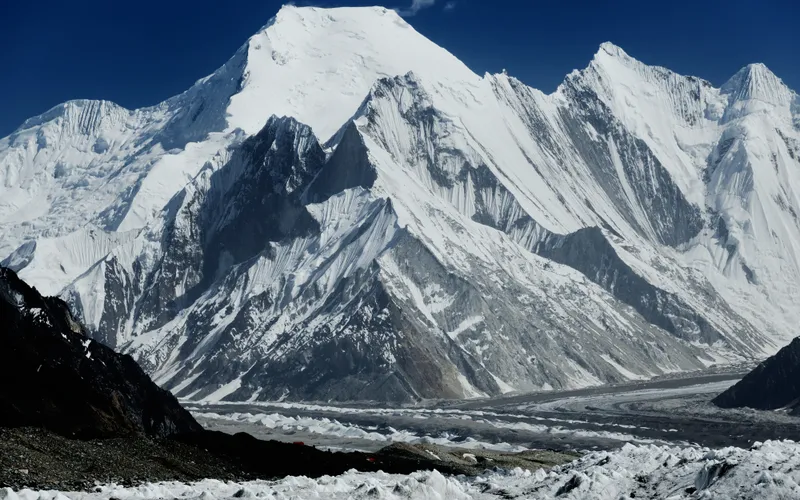
Immediately after achieving the historic first ascent of Broad Peak on June 9, 1957—the first 8,000-meter peak climbed in lightweight alpine style without high-altitude porters or oxygen—Austrian alpine legend Hermann Buhl remained hungry for further exploration. While teammates rested, Buhl and Kurt Diemberger looked south across the Baltoro toward the elegant, snow-domed silhouette of Chogolisa (7,665m), historically known as Bride Peak.
Operating without base camp support or high-altitude staff, Buhl and Diemberger carried their own tents, food, and ropes up the glaciated Chogolisa icefall in late June 1957.
Ascending the Southeast Ridge
Climbing with astonishing speed and economy of movement, Buhl and Diemberger established Camp 1 at 6,700m on the Southeast Ridge. On June 27, 1957, in clear morning skies, they launched their summit bid.
By midday, having surpassed 7,300 meters, a violent Karakoram blizzard engulfed the mountain. Hurricane-force winds whipped up heavy spindrift, obliterating visibility into a terrifying whiteout. Recognizing that pushing for the summit was suicidal, Buhl and Diemberger turned around to retreat along the razor-sharp knife-edge corniced ridge.
The Fatal Step
Diemberger led the descent, following their faint crampon tracks in the snow. Buhl followed ten to fifteen paces behind. Suddenly, Diemberger felt a dull vibration in the ice beneath his feet.
Turning around, Diemberger looked into an empty expanse of gray fog. The massive overhanging snow cornice upon which Buhl was treading had sheared away under his weight, plunging 1,000 meters down the sheer north face into the abyss. Despite frantic search efforts, Buhl’s body was never recovered. His resting place remains forever sealed within the ice of the Karakoram, marking the end of one of mountaineering’s most audacious and visionary solo pioneers.
Key Statistics & Topographic Figures
- Category
- Alpine Tragedy
Archival Subject
- Reading Time
- 8 min read
Narrative Length
- Key Mountain
- chogolisa
Objective
- Ascent Route
- chogolisa-southeast-ridge
Topography
- Verification
- Editorially Verified
Archival Standard
Archival Primary Source Quotations
“In the mountains, truth is etched in ice and granite; every step requires unwavering respect for the heights.”
Defined Alpine Terminology & Concepts
- Summit Push
- The final continuous climbing effort from the highest established camp to the mountain apex and back.
- Death Zone Chronicle
- A verified, research-backed historical narrative documenting the human, technical, and environmental realities of an alpine expedition.
Frequently Asked Questions: 1957 Chogolisa: Hermann Buhl's Final Alpine Frontier
What is the core chronicle and subject of "1957 Chogolisa: Hermann Buhl's Final Alpine Frontier"?
The poignant chronicle of Hermann Buhl and Kurt Diemberger's lightweight alpine attempt on Chogolisa and the tragic summit cornice fall.
Which mountain peaks and routes are featured in "1957 Chogolisa: Hermann Buhl's Final Alpine Frontier"?
This narrative documents climbs on chogolisa along the chogolisa-southeast-ridge in Pakistan.
Which documented expedition is chronicled in this story?
This historical chronicle captures the events of the 1957-chogolisa-attempt, verified through contemporary journals and archival records.
Who authored and researched this archival chronicle?
Authored and researched by Mountanity Research Desk, drawing on primary eyewitness testimonies, alpine club registries, and verified summit logs.
What makes this high-altitude chronicle historically significant?
Categorized under "Alpine Tragedy", this chronicle preserves critical lessons in alpine leadership, survival, tactical speed, and human endurance in the death zone.
Related Mountains

Chogolisa
Chogolisa, standing at 7,665 meters (25,148 ft) in the Karakoram range of Pakistan, is renowned as Bride Peak for its broad, graceful snow-draped profile. Located south of Concordia and the Baltoro Glacier, it features two prominent summits connected by a sweeping knife-edge snow ridge. In 1909, the Duke of the Abruzzi set a world altitude record on its slopes, and in 1957, it became the site of alpine pioneer Hermann Buhl's fatal cornice fall.