Antarctica's Hardest Peak: The 1967 First Ascent of Mount Tyree
Twenty-two continuous hours on a 2,000-metre frozen rock wall: Barry Corbet and John Evans conquer Mount Tyree in pure alpine style.
Mountain Safety & Conditions Disclaimer: High-altitude climbing, glacial travel, and technical ascents entail severe objective risks including avalanches, serac collapses, rapid weather collapse, and altitude illness. Historical route descriptions and summit claims on Mountanity reflect documented archival sources and must not be used as live operational safety assessments. Local regulations, permits, and physical glacial topography change continuously.
Peer Review: Senior Editorial Board & Historical Reviewers • Editorial Standards
Antarctica’s Hardest Peak: The 1967 First Ascent of Mount Tyree
The Menacing Sister of Vinson
When the American Antarctic Mountaineering Expedition stood atop Mount Vinson in December 1966, they looked eight miles to the northwest and saw a sight that made the most seasoned alpinists shiver.
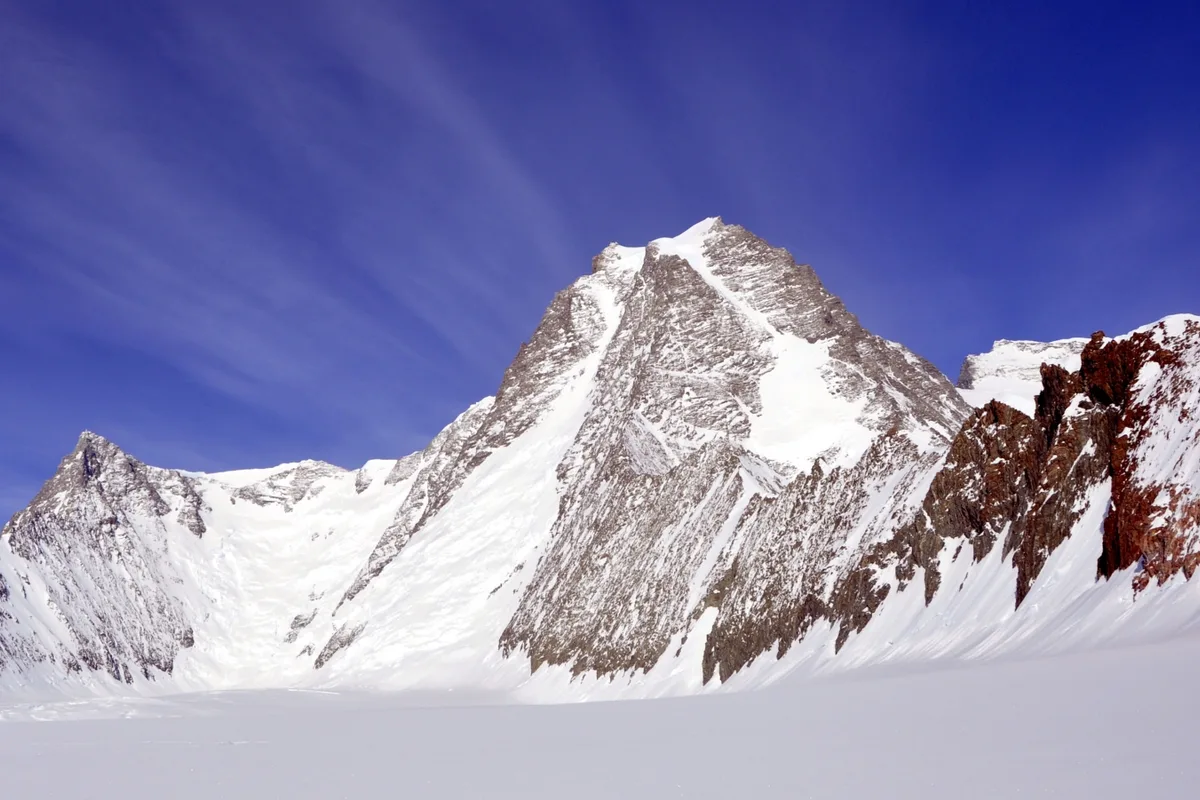
Rising like a gigantic, black gothic needle out of the polar ice sheet was Mount Tyree (4,852 m). While Mount Vinson was a sprawling, rounded massif whose normal route was a gentle glacier slog, Tyree was pure terror: a sheer, 2,000-metre wall of shattered dark granite and blue ice flutings soaring straight out of the Patton Glacier. At just forty metres lower than Vinson, it was the second-highest peak in Antarctica—and unquestionably the most formidable mountain on the continent.
To two members of the expedition, Tyree was irresistible. Barry Corbet, the powerhouse Jackson Hole guide and veteran of the 1963 Everest West Ridge climb, and John Evans, a brilliant granite rock specialist from Minnesota, resolved that Tyree must be climbed before their Navy plane arrived to take them home.
“Vinson was a glorious polar walk; Tyree was an assassin. It was steep, shattered, and brutally cold. We knew we had to climb it in one single, desperate push or not at all.” — Barry Corbet, American Alpine Journal, 1967
The 22-Hour Single Push
On January 4, 1967, Corbet and Evans skied across the glaciers separating Vinson from Tyree, hauling a tiny bivouac tent and basic climbing gear to the foot of Tyree’s monstrous Northwest Face.
Studying the 2,000-metre precipice with binoculars, Corbet and Evans realized that heavy siege tactics would fail. In temperatures hovering between -30°C and -40°C, establishing intermediate camps on small rock ledges would mean fatal frostbite. Their only chance of survival was pure alpine style: climbing fast, carrying only food, ropes, and a small rack of pitons, and refusing to stop until they reached the top and returned.
At 2:00 AM on January 6, 1967, under the eerie pale glare of the midnight sun, Corbet and Evans set forth. To move with maximum velocity, they ascended the lower 1,000 metres of the narrow, 50-degree ice couloir unroped, kicking their steel crampon points into the hard blue ice with rhythmic precision.
The Frozen Rock Crux
By 8:00 AM, the ice couloir dead-ended against vertical, frost-shattered granite walls at 3,800 metres. Roping together with a single goldline climbing rope, Evans took the lead.
Now began climbing of extreme technical difficulty. High-angle granite rock (5.8) that would be demanding in the sunny warmth of Yosemite had to be climbed here in temperatures of -35°C, wearing heavy insulated boots, windpants, and leather gloves. Evans searched for thin seams in the rock, clearing away rime ice with his axe pick before hammering thin chromoly pitons into the frozen granite.
Every breath seared their lungs like liquid fire. Above the rock ribs, Corbet took the lead up a succession of 55-degree blue ice gullies, hacking small footholds and driving ice screws into bulletproof glacial ice.
At 1:30 PM, after eleven and a half hours of uninterrupted vertical movement, Corbet pulled himself over the knife-edge corniced crest. Evans joined him. They stood atop the sharp pinnacle of Mount Tyree: 4,852 metres above sea level.
The Long Descent into Safety
Standing on the airy summit, looking down 2,000 metres on either flank to the vast glaciers of West Antarctica, they had achieved what many considered the finest pure alpine climb ever executed in the polar regions.
Yet the battle was only half won: they still had to get down. The descent was a harrowing ordeal of twenty continuous rappels off frozen rock horns and piton anchors, followed by delicate down-climbing through gathering polar fog.
It was midnight—twenty-two continuous hours after leaving their tent—when Corbet and Evans finally collapsed into their sleeping bags on the Patton Glacier. They had conquered the hardest giant in Antarctica, establishing a legendary route that would not see a second ascent for nearly two decades.
Key Statistics & Topographic Figures
- Category
- Polar Pioneers
Archival Subject
- Reading Time
- 14 min read
Narrative Length
- Key Mountain
- mount-tyree
Objective
- Ascent Route
- mount-tyree-northwest-face
Topography
- Verification
- Editorially Verified
Archival Standard
Archival Primary Source Quotations
“In the mountains, truth is etched in ice and granite; every step requires unwavering respect for the heights.”
Defined Alpine Terminology & Concepts
- Summit Push
- The final continuous climbing effort from the highest established camp to the mountain apex and back.
- Death Zone Chronicle
- A verified, research-backed historical narrative documenting the human, technical, and environmental realities of an alpine expedition.
Frequently Asked Questions: Antarctica's Hardest Peak: The 1967 First Ascent of Mount Tyree
What is the core chronicle and subject of "Antarctica's Hardest Peak: The 1967 First Ascent of Mount Tyree"?
Twenty-two continuous hours on a 2,000-metre frozen rock wall: Barry Corbet and John Evans conquer Mount Tyree in pure alpine style.
Which mountain peaks and routes are featured in "Antarctica's Hardest Peak: The 1967 First Ascent of Mount Tyree"?
This narrative documents climbs on mount-tyree along the mount-tyree-northwest-face in Antarctica.
Which documented expedition is chronicled in this story?
This historical chronicle captures the events of the 1967-corbet-evans-mount-tyree-first-ascent, verified through contemporary journals and archival records.
Who authored and researched this archival chronicle?
Authored and researched by Mountainity Historical Research Desk, drawing on primary eyewitness testimonies, alpine club registries, and verified summit logs.
What makes this high-altitude chronicle historically significant?
Categorized under "Polar Pioneers", this chronicle preserves critical lessons in alpine leadership, survival, tactical speed, and human endurance in the death zone.
Related Mountains

Mount Tyree
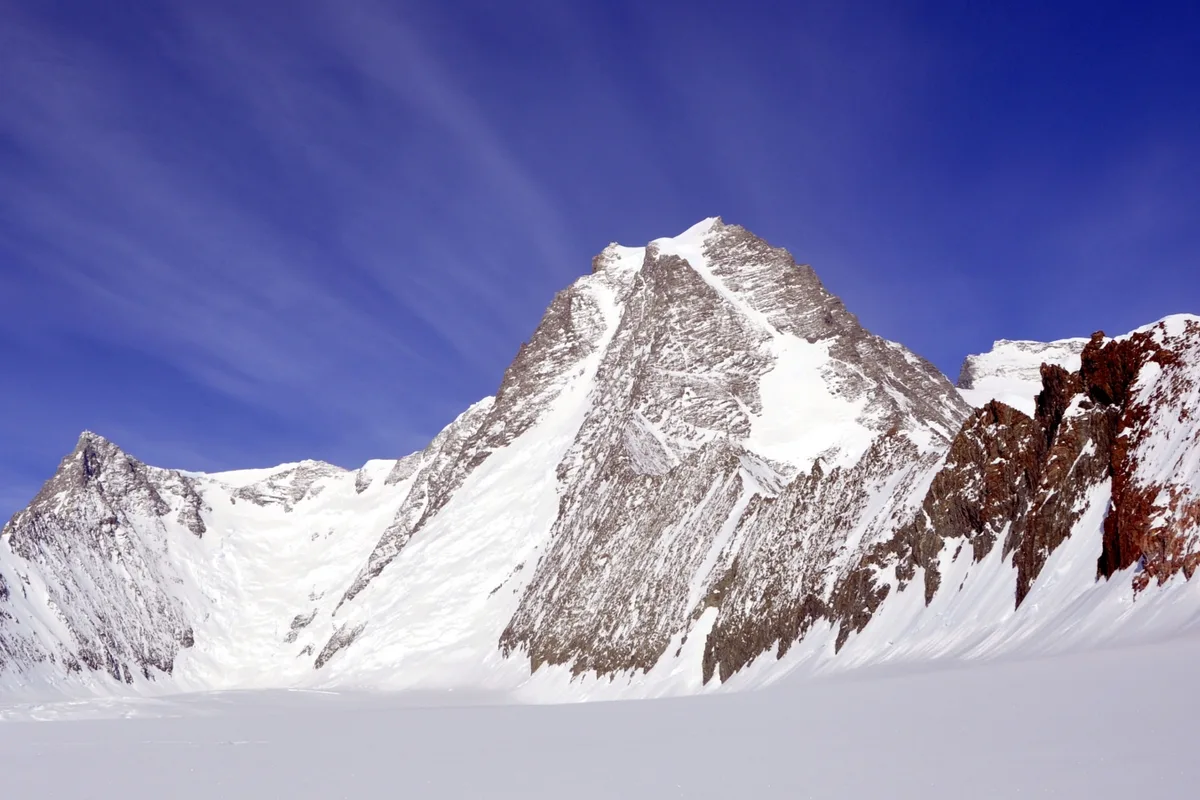
Mount Tyree is the second-highest mountain in Antarctica at 4,852 metres (15,919 ft), located just 13 kilometres northwest of Mount Vinson in the Sentinel Range. In stark contrast to the rounded, glaciated ramps of Mount Vinson, Mount Tyree is a terrifying, sheer horn of dark metamorphic rock and steep blue ice, rising over 2,000 metres directly from its surrounding glaciers. First ascended on January 6, 1967, by Barry Corbet and John Evans via the Northwest Face, it is widely acknowledged as the most technically demanding and formidable high peak in all of Antarctica, having seen fewer than twenty ascents in mountaineering history.
Documented Sources & Archival Citations
- The First Ascent of Mount Tyree(Barry Corbet / American Alpine Journal)
Supporting claim: Primary technical report
Accessed/Documented: 1967 - Mount Tyree: Antarctica's Toughest Summit(Alpine Journal)
Supporting claim: Historical documentation
Accessed/Documented: 2012