The Colossus of Chijllani: Mesili on Illimani's South Face
In August 1972, Alain Mesili conquered the 2,000-metre South Face of Nevado Illimani (6,438 m), solving the ultimate big-wall ice challenge in Bolivia.
Mountain Safety & Conditions Disclaimer: High-altitude climbing, glacial travel, and technical ascents entail severe objective risks including avalanches, serac collapses, rapid weather collapse, and altitude illness. Historical route descriptions and summit claims on Mountanity reflect documented archival sources and must not be used as live operational safety assessments. Local regulations, permits, and physical glacial topography change continuously.
Peer Review: Senior Editorial Board & Historical Reviewers • Editorial Standards
The Colossus of Chijllani: Mesili on Illimani’s South Face
Above the gorge of the Rio Chijllani, on the southern flank of Nevado Illimani, rises one of the most terrifying precipices in the Americas: the 2,000-metre (6,600-foot) South Face.
While Conway’s 1898 normal route ascended the gentle western ridge from Nido de Cóndores, the South Face was an amphitheatre of sheer vertical ice, hanging glaciers, and granite headwalls that dropped straight into the abyss. Constant rockfall and massive serac avalanches swept the face, leading generations of climbers to consider it entirely suicidal.
Mesili’s Grand Vision
Fresh from his triumph on the West Face of Huayna Potosí in 1970, French-Bolivian pioneer Alain Mesili turned his eyes to Illimani’s southern wall. Mesili realized that traditional siege tactics were impossible on such a face; the only way to survive was speed—a lightweight alpine-style blitz that minimized exposure to falling ice.
In August 1972, during a spell of crystalline winter weather, Mesili assembled his elite team, supported by young Bolivian climbers including future mountaineering researcher Erick Monasterio. Carrying only single ropes, technical ice axes, pitons, and bivouac hammocks, the climbers hiked into the isolated Chijllani valley.
Night Ascent through the Bowling Alley
To survive the lower ice apron—notoriously dubbed “The Bowling Alley” due to rockfall peeling off the upper face under the afternoon sun—the climbers crossed the bergschrund at 2:00 a.m.
Moving rapidly under the light of headlamps, Mesili led the rope team up steep 60-degree firn ramps. The cold was searing, freezing their breath against their wool balaclavas, but the frost glued the loose rock to the face, giving them a safe passage through the lower couloirs.
By midday, they reached the central ice barrier at 5,600 metres: an imposing, 70-degree wall of blue glacial ice flanked by fractured granite buttresses. Here, the climbing became intensely technical. Mesili led pitch after pitch on front points, driving tubular ice pitons to protect the exposed moves.
The Hanging Bivouac at 5,800 Metres
As night fell, unable to find any flat ledge, the climbers had no choice but to hack out a tiny standing platform on a 60-degree ice shelf at 5,800 metres. Anchored to three pitons driven into the ice, they spent the night suspended over two kilometres of empty vertical void, watching the stars wheel across the Southern Cross.
At dawn on August 8, 1972, stiff with cold and exhausted from hypoxia, they tackled the final 600 metres. The route surmounted delicate ice flutings and tunneled through an overhanging snow mushroom to emerge on the corniced summit crest of Pico Sur at 6,438 metres.
Standing on the summit in brilliant sunlight, with the clouds of the Amazon basin churning below like an endless white sea, Mesili and his companions realized they had accomplished the greatest big-wall ice climb in the history of the Bolivian Andes. It stood as an immortal monument to alpine courage, visionary route-finding, and the golden age of South American exploration.
Key Statistics & Topographic Figures
- Category
- Andean Pioneers
Archival Subject
- Reading Time
- 16 min read
Narrative Length
- Key Mountain
- illimani
Objective
- Ascent Route
- illimani-south-ridge
Topography
- Verification
- Editorially Verified
Archival Standard
Archival Primary Source Quotations
“In the mountains, truth is etched in ice and granite; every step requires unwavering respect for the heights.”
Defined Alpine Terminology & Concepts
- Summit Push
- The final continuous climbing effort from the highest established camp to the mountain apex and back.
- Death Zone Chronicle
- A verified, research-backed historical narrative documenting the human, technical, and environmental realities of an alpine expedition.
Frequently Asked Questions: The Colossus of Chijllani: Mesili on Illimani's South Face
What is the core chronicle and subject of "The Colossus of Chijllani: Mesili on Illimani's South Face"?
In August 1972, Alain Mesili conquered the 2,000-metre South Face of Nevado Illimani (6,438 m), solving the ultimate big-wall ice challenge in Bolivia.
Which mountain peaks and routes are featured in "The Colossus of Chijllani: Mesili on Illimani's South Face"?
This narrative documents climbs on illimani along the illimani-south-ridge in Bolivia.
Which documented expedition is chronicled in this story?
This historical chronicle captures the events of the 1972-mesili-illimani-south-face, verified through contemporary journals and archival records.
Who authored and researched this archival chronicle?
Authored and researched by Mountainity Historical Research Desk, drawing on primary eyewitness testimonies, alpine club registries, and verified summit logs.
What makes this high-altitude chronicle historically significant?
Categorized under "Andean Pioneers", this chronicle preserves critical lessons in alpine leadership, survival, tactical speed, and human endurance in the death zone.
Related Mountains
Illimani
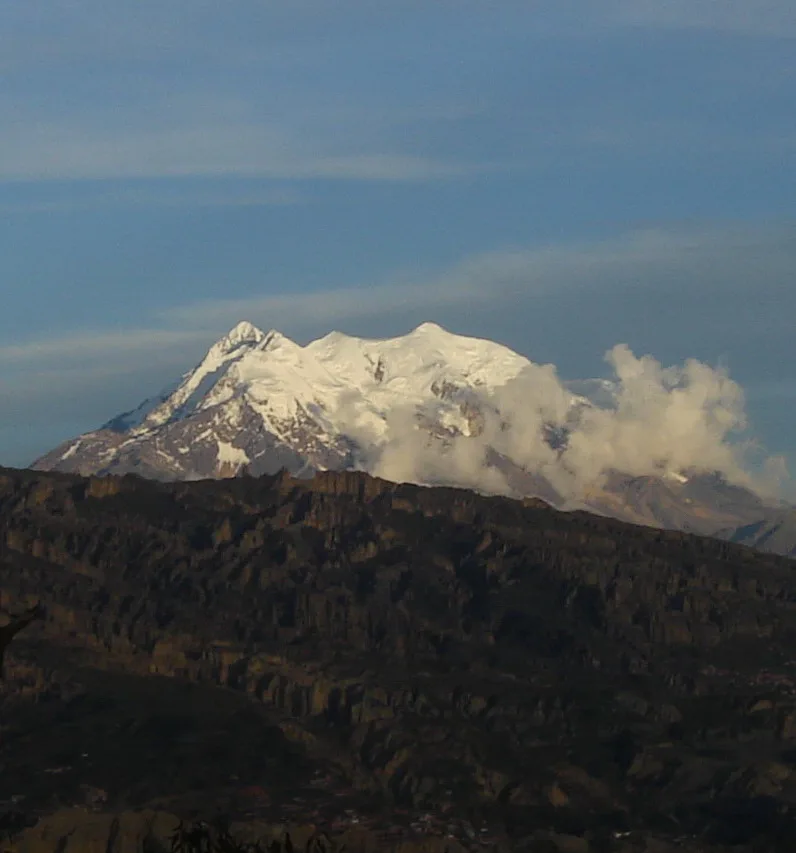
Nevado Illimani is the iconic 6,438-metre monarch of the Cordillera Real, towering dramatically over the city of La Paz and the Bolivian Altiplano. First climbed in September 1898 by British explorer Sir William Martin Conway alongside Swiss guides Antoine Maquignaz and Jean-Antoine Pellissier, the mountain features four distinct summits linked by knife-edge glaciated ridges. Its immense southern and eastern faces drop precipitously toward the Amazon basin.
Documented Sources & Archival Citations
- The Bolivian Andes: Cordillera Real Climbing Guide(Alain Mesili / Los Amigos del Libro)
Supporting claim: Firsthand technical topo and retrospective of the 2,000 m South Face first ascent on Illimani
Accessed/Documented: 1980 - American Alpine Journal: Illimani South Face Direct(American Alpine Club)
Supporting claim: Detailed review of route difficulties, bivouacs, and technical gear on the 1972 ascent
Accessed/Documented: 1973