Gasherbrum IV 1985: Kurtyka and Schauer's Climb of the Century
In July 1985, Wojciech Kurtyka and Robert Schauer completed the first alpine-style ascent of Gasherbrum IV's 2,500-meter West Face, enduring a 48-hour storm bivouac without food in an ascent hailed as the greatest big-wall climb of the 20th century.
Mountain Safety & Conditions Disclaimer: High-altitude climbing, glacial travel, and technical ascents entail severe objective risks including avalanches, serac collapses, rapid weather collapse, and altitude illness. Historical route descriptions and summit claims on Mountanity reflect documented archival sources and must not be used as live operational safety assessments. Local regulations, permits, and physical glacial topography change continuously.
Peer Review: Senior Editorial Board & Historical Reviewers • Editorial Standards
In the grand amphitheater of the Karakoram, where the Baltoro and Godwin-Austen glaciers converge at Concordia, one mountain commands the horizon not by sheer elevation, but by terrifying architectural perfection: Gasherbrum IV (7,925m / 26,001 ft).
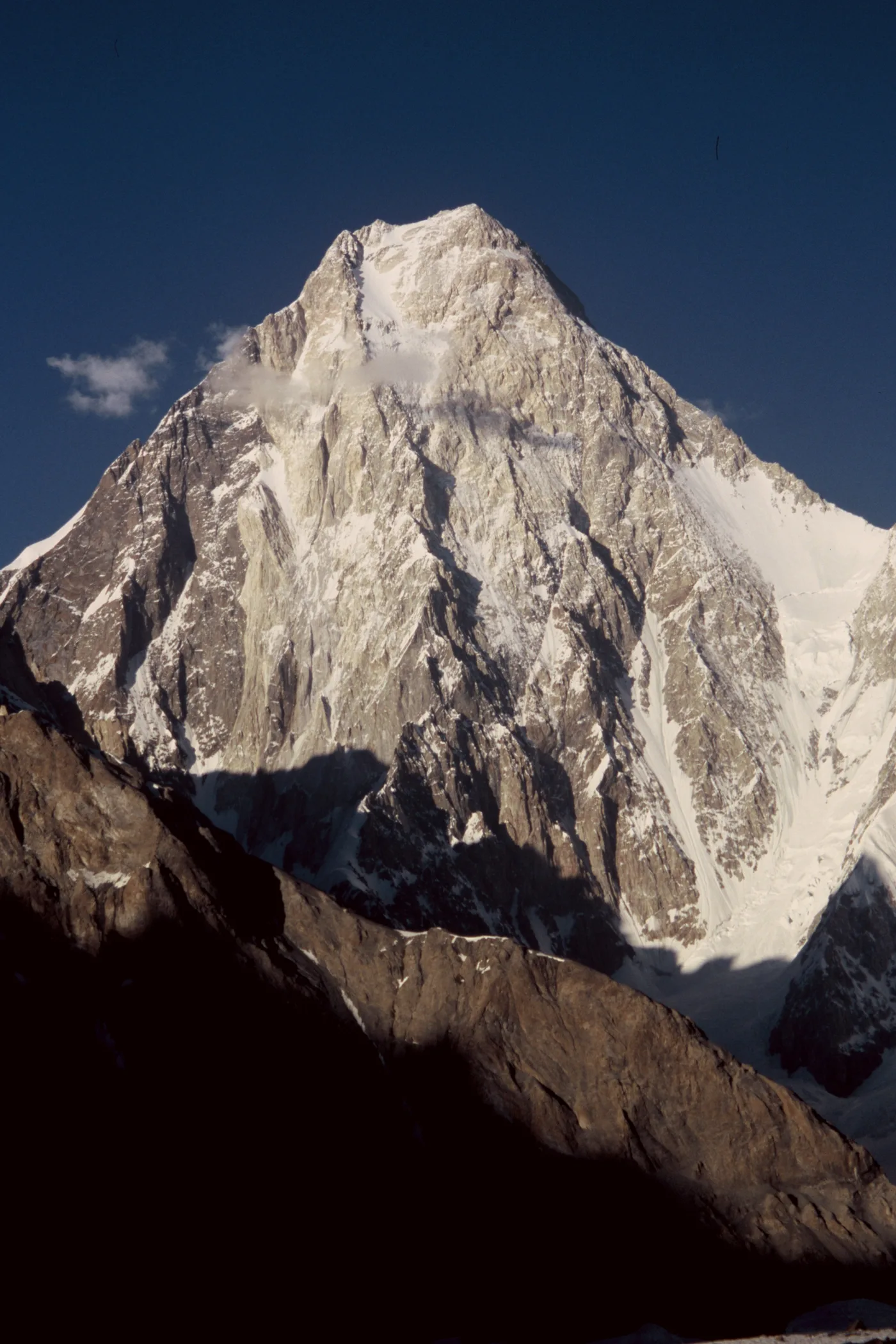
While slightly lower than its 8,000-meter neighbors, Gasherbrum IV is technically far more formidable than K2. Its Western Face—a colossal, vertical shield rising 2,500 meters (over 8,200 vertical feet) in bands of golden limestone, fractured yellow marble, and glazed ice couloirs—is affectionately and fearfully known as The Shining Wall. For decades, the wall was considered an absolute impossibility. Even Walter Bonatti, who completed the mountain’s first ascent via the Northeast Ridge in 1958, gazed upon the West Face with awe, describing it as a vertical precipice beyond human capability.
In the summer of 1985, two men arrived at the base of the wall with an audacious philosophy: they would attempt the entire 2,500-meter face in pure, lightweight alpine style. The pair were Polish visionary Wojciech ‘Voytek’ Kurtyka and Austrian maestro Robert Schauer.
The Purity of the Alpine Style
To attempt a high-altitude big wall of this magnitude without supplemental oxygen, without high-altitude porters, without fixed ropes, and without establishing pre-stocked camps was seen by traditional mountaineers as madness. Kurtyka and Schauer packed only what could fit on their backs: a single, ultralight two-man tent, two 8mm ropes, a lightweight rack of pitons and Friends, a single gas stove, and food rations for barely five days.
Once their boots crossed the bergschrund at the base of the wall, there would be no retreat. In true alpine style, the only way off the mountain was over the top.
On July 13, 1985, Kurtyka and Schauer crossed the glacier and stepped onto the lower ice apron. Moving with fluid grace, they simul-climbed steep 60-degree ice ramps under a clear sky. But as they climbed higher into the vertical marble constriction, the wall unleashed its defense.
Technical Mastery on Fractured Marble
The climbing was savagely difficult. Kurtyka, on the sharp end of the rope, was forced to remove his heavy outer gloves at over 7,000 meters to crimp tiny, downward-sloping edges of friable yellow marble. Pitons hammered into the rotten rock rang with hollow, terrifying notes. The face was completely vertical, with sections of overhanging rock glazed with a thin layer of verglas that offered no purchase for ice axes.
Worse, the summer sun turned the couloirs into natural funnels for cascading spindrift avalanches. While belaying on tiny standing ledges hacked out of 70-degree ice, Schauer was repeatedly engulfed in roaring powder avalanches that threatened to rip him from his anchors and snap their thin ropes.
By July 18, after five grueling days of continuous climbing, they breached the Great Marble Band at 7,600 meters. But their food had run out, and the Karakoram sky suddenly blackened with ominous storm clouds.
The 48-Hour Survival Bivouac at 7,800 Meters
On the afternoon of July 19, just below the summit crest at 7,800 meters, a catastrophic high-altitude hurricane enveloped the mountain. With winds exceeding 80 miles per hour and temperatures plunging far below freezing, further progress was impossible.
Desperately hacking into a steep snow slope with their ice axes, Kurtyka and Schauer excavated a cramped snow trench barely large enough to sit side by side. For the next forty-eight continuous hours, trapped in the Death Zone without food, without water (their stove fuel had run out), and in a state of severe hypothermia, the two men clung to life.
Hallucinations set in from extreme cerebral hypoxia. Kurtyka later described hearing phantom voices whispered by the wind and feeling an invisible presence sitting beside them in the ice cave. They dared not sleep, knowing that falling into unconsciousness meant death. To stay alive, they rubbed each other’s frostbitten hands and performed isometric contractions through the night.
The Summit Crest and the Desperate Descent
On the morning of July 21, the blizzard finally subsided, leaving behind waist-deep powder and a frozen landscape. Emaciated, severely dehydrated, and frostbitten, Kurtyka and Schauer crawled out of their snow hole. With monumental effort, they kicked steps up the final steep cornice and scrambled onto the north summit ridge of Gasherbrum IV.
Standing on the crest at approximately 7,915 meters, the primary south summit (7,925m) was visible across a corniced knife-edge ridge. But their physical resources were completely exhausted. To attempt the traverse across unstable wind slabs would have guaranteed fatal falls. Making a mature, life-saving decision, they focused entirely on survival: they had climbed the entire 2,500-meter West Face; now they had to get down.
Their descent via the unclimbed North Ridge was an epic in itself. For three days, moving like ghosts, they navigated crumbling rock towers and steep ice slopes, making dozens of rappels off single pitons or rock horns. On July 23, ten days after leaving their base, Kurtyka and Schauer stumbled off the glacier and collapsed into the arms of waiting friends at Base Camp.
Legacy: The Climb of the Century
The 1985 ascent of Gasherbrum IV’s Shining Wall sent shockwaves through international climbing circles. It was universally hailed by peers—including Reinhold Messner and Doug Scott—as the finest big-wall alpine climb of the twentieth century.
Kurtyka and Schauer demonstrated that the highest standards of technical rock and ice climbing could be merged with extreme high-altitude endurance in pure, lightweight style. Kurtyka’s masterpiece on Gasherbrum IV remains an immortal testament to the triumph of the human spirit over the impossible.
Key Statistics & Topographic Figures
- Category
- Alpine Style Epics
Archival Subject
- Reading Time
- 16 min read
Narrative Length
- Key Mountain
- gasherbrum-4
Objective
- Ascent Route
- gasherbrum-4-west-face
Topography
- Verification
- Editorially Verified
Archival Standard
Archival Primary Source Quotations
“In the mountains, truth is etched in ice and granite; every step requires unwavering respect for the heights.”
Defined Alpine Terminology & Concepts
- Summit Push
- The final continuous climbing effort from the highest established camp to the mountain apex and back.
- Death Zone Chronicle
- A verified, research-backed historical narrative documenting the human, technical, and environmental realities of an alpine expedition.
Frequently Asked Questions: Gasherbrum IV 1985: Kurtyka and Schauer's Climb of the Century
What is the core chronicle and subject of "Gasherbrum IV 1985: Kurtyka and Schauer's Climb of the Century"?
In July 1985, Wojciech Kurtyka and Robert Schauer completed the first alpine-style ascent of Gasherbrum IV's 2,500-meter West Face, enduring a 48-hour storm bivouac without food in an ascent hailed as the greatest big-wall climb of the 20th century.
Which mountain peaks and routes are featured in "Gasherbrum IV 1985: Kurtyka and Schauer's Climb of the Century"?
This narrative documents climbs on gasherbrum-4 along the gasherbrum-4-west-face in Pakistan.
Which documented expedition is chronicled in this story?
This historical chronicle captures the events of the 1985-gasherbrum-4-shining-wall, verified through contemporary journals and archival records.
Who authored and researched this archival chronicle?
Authored and researched by Mountainity Historical Research Desk, drawing on primary eyewitness testimonies, alpine club registries, and verified summit logs.
What makes this high-altitude chronicle historically significant?
Categorized under "Alpine Style Epics", this chronicle preserves critical lessons in alpine leadership, survival, tactical speed, and human endurance in the death zone.
Related Mountains

Gasherbrum IV
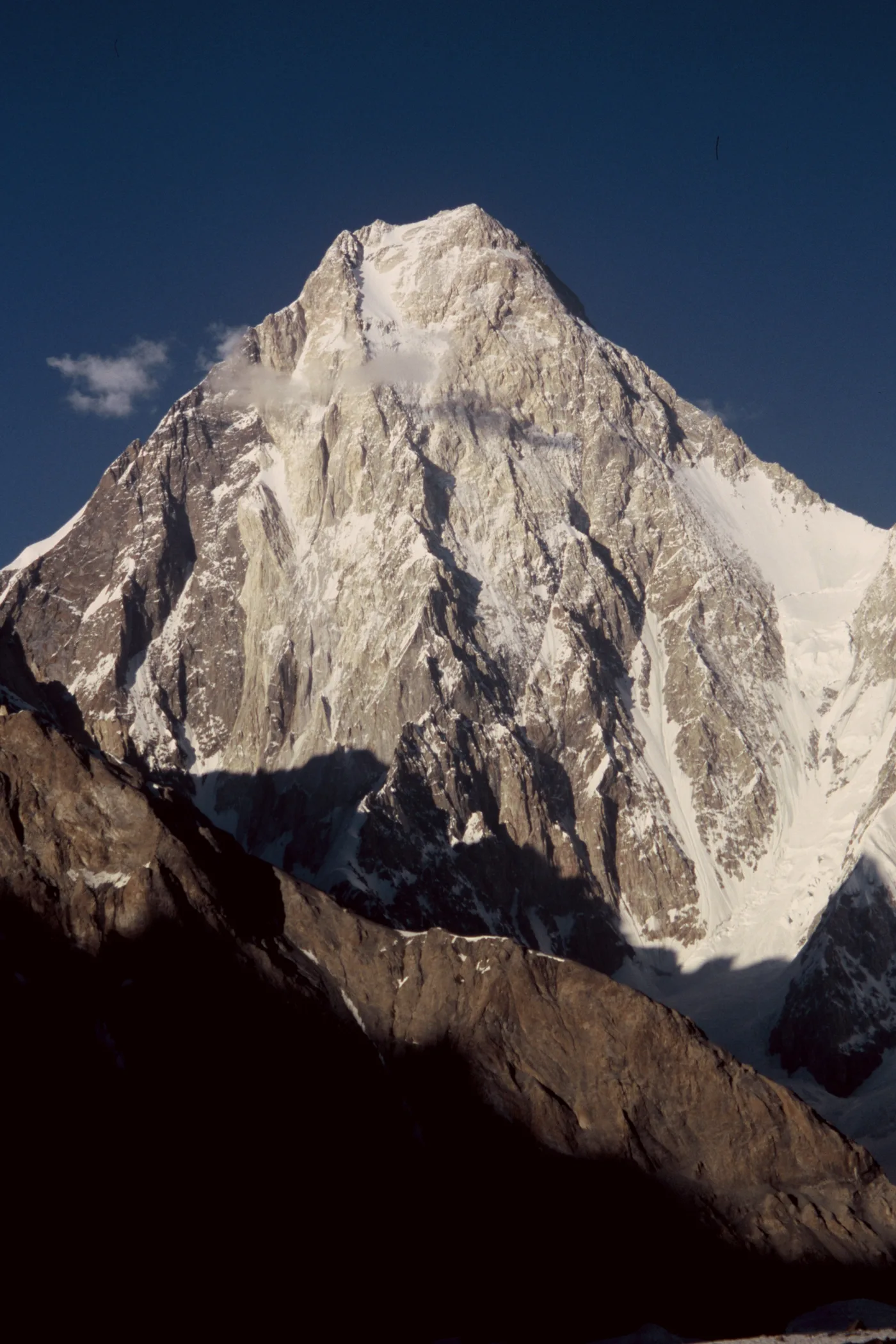
Gasherbrum IV, at 7,925 meters (26,001 ft), is the 17th highest mountain on Earth and the 6th highest in Pakistan. Rising dramatically at the head of the Baltoro Glacier, its breathtaking 2,500-meter West Face of sheer limestone and marble—termed 'The Shining Wall'—is regarded as one of the ultimate technical mountaineering challenges on the planet. First climbed in 1958 by Walter Bonatti and Carlo Mauri via the Northeast Ridge, it later saw the legendary 1985 alpine-style ascent of its West Face by Wojciech Kurtyka and Robert Schauer, widely called the 'Climb of the Century'.
Documented Sources & Archival Citations
- The Shining Wall: Gasherbrum IV(Wojciech Kurtyka / American Alpine Journal)
Supporting claim: Authoritative firsthand expedition journal describing every technical pitch and the 48-hour storm survival
Accessed/Documented: 1986 - Art of Freedom: The Life and Climbs of Voytek Kurtyka(Bernadette McDonald / Mountaineers Books)
Supporting claim: Definitive biography detailing Kurtyka's philosophical approach and the 1985 Gasherbrum IV ascent
Accessed/Documented: 2017