The Golden Pillar of Spantik: Mick Fowler and Victor Saunders' Karakoram Epic
In August 1987, British climbers Mick Fowler and Victor Saunders conquered the sheer 2,000-metre Golden Pillar of Spantik (7,027m) in an eight-day pure alpine-style epic.
Mountain Safety & Conditions Disclaimer: High-altitude climbing, glacial travel, and technical ascents entail severe objective risks including avalanches, serac collapses, rapid weather collapse, and altitude illness. Historical route descriptions and summit claims on Mountanity reflect documented archival sources and must not be used as live operational safety assessments. Local regulations, permits, and physical glacial topography change continuously.
Peer Review: Senior Editorial Board & Historical Reviewers • Editorial Standards
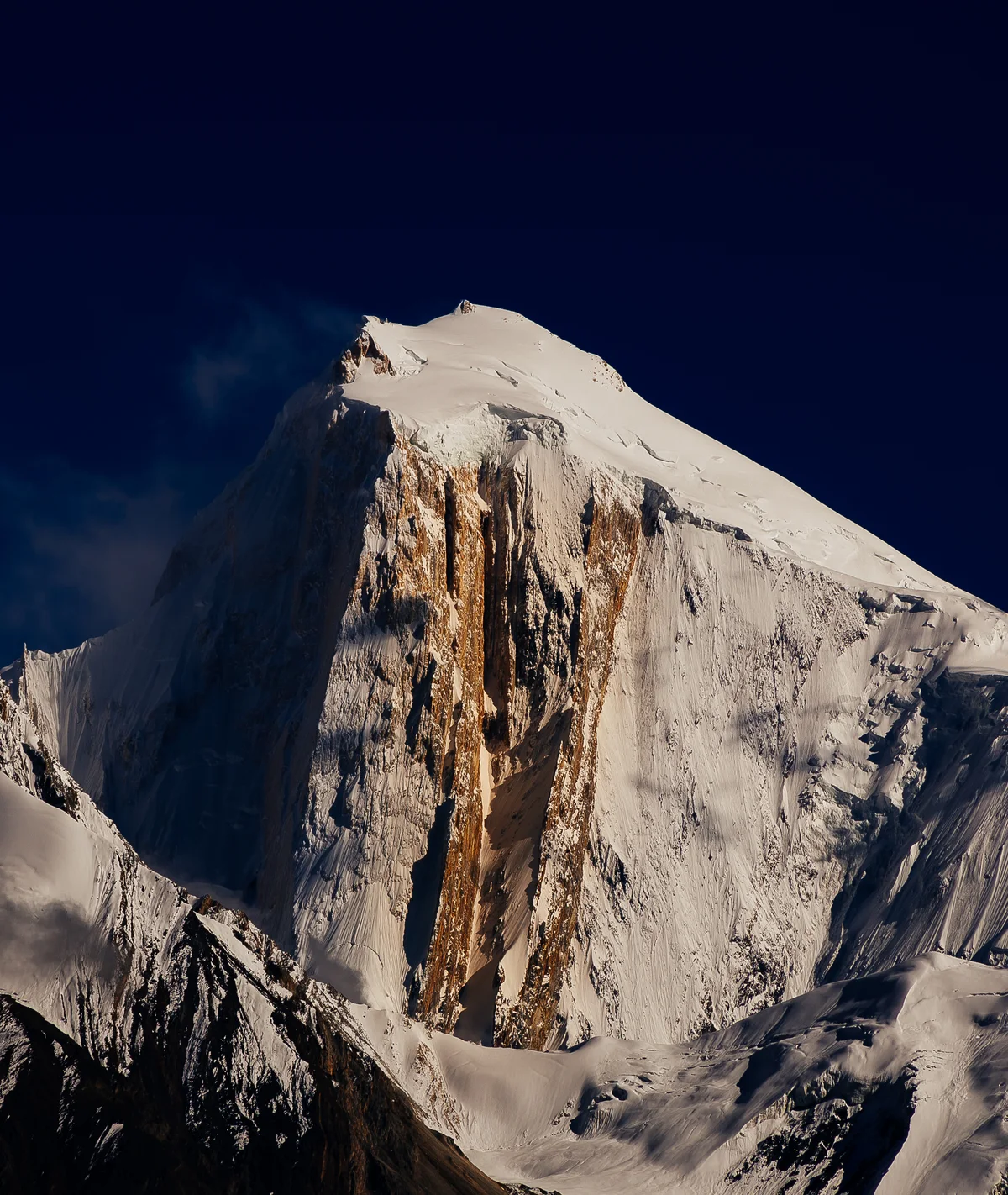
In the remote heart of the Karakoram range, rising above the fractured icefalls of the Chogolungma Glacier, stands one of the most stunning geologic monuments on Earth: the Northwest Face of Spantik (7,027m). Unlike the rolling snow slopes of the mountain’s southern approaches, this sheer two-thousand-metre precipice is forged from smooth bands of tiered golden granite capped by friable strata of crystalline red and white marble. When bathed in the evening sun, the pillar glows with an otherworldly luminescence that inspired British climbers to christen it the Golden Pillar.
In the summer of 1987, two British climbers arrived beneath the wall: Mick Fowler, an executive tax officer in London who used his thirty days of annual leave to pursue high-standard exploratory climbing, and Victor Saunders, a practicing London architect. In an era when Himalayan big walls were commonly besieged with thousands of meters of nylon fixed ropes, steel winches, and multiple high camps, Fowler and Saunders stood as unapologetic purists. They carried no fixed ropes, no supplemental oxygen, and no support team. Their entire world was compressed into two thirty-pound rucksacks, six days of lightweight rations, two ropes, a miniature single-skin bivy tent, and a modest rack of rock and ice pitons.
The Committing Leap onto the Marble Shield
On August 5, 1987, Fowler and Saunders crossed the gaping bergschrund and stepped onto the face. The lower section demanded delicate ice climbing on sixty-degree runnels of bullet-hard water ice, quickly giving way to vertical granite cracks choked with frozen rubble.
By Day Three, they had reached the base of the central granite buttress at 5,800 metres. The climbing was brutally technical: vertical cracks graded British E2 (5.10 rock) and aid pitches requiring precarious peg placements in expanding flakes. Because the wall was so relentlessly vertical, they could find no level platforms to pitch their tent. Each evening, Fowler and Saunders spent hours hacking small sitting ledges into the frozen slopes, sitting shoulder-to-shoulder tied into piton anchors with their legs dangling over the precipitous drop to the glacier miles below.
The Storm and the Crux Marble Band
On the fourth afternoon, the sky turned a sinister bruised violet. A massive Karakoram storm swept over the Spantik massif, engulfing the two men in hurricane-force gusts and blinding spindrift. Trapped on a tiny ice ledge at 6,200 metres, they pulled their bivy tent over their heads like an improvised bivouac sack. For thirty-six hours, they endured continuous avalanches of powdered snow that threatened to tear them from the face, using their cooking stove intermittently to melt handfuls of ice to stave off debilitating dehydration.
When the tempest finally subsided on Day Six, they faced the ultimate crux of the climb: the great Red Band. This colossal overhang of loose, crumbly crystalline marble offered almost no solid gear placements. Saunders led with meticulous patience, gently tapping pitons into hairline seams while chunks of yellow marble broke away under his boots. Fowler followed with the heavy haul-pack, jumaring through vertical space as the Karakoram landscape swung beneath his feet.
Cresting the Pillar to the Summit
By August 10, their food was completely exhausted, their stove fuel was down to its final dregs, and their fingertips were blackened from frostbite and rope friction. Yet their spirits remained unshakeable. Breaking through the upper ice cornice at 6,850 metres, Fowler and Saunders emerged from the shadow of the vertical pillar onto the rolling, wind-scoured summit plateau of Spantik.
On August 11, 1987, beneath a crystalline blue sky, Mick Fowler and Victor Saunders reached the 7,027-metre summit. Before them stretched an endless sea of Karakoram giants: K2, Broad Peak, Baintha Brakk (The Ogre), and the sharp granite towers of the Trango group.
Their safe descent down the mountain’s Southwest Ridge over the next twenty-four hours concluded an eight-day epic that was immediately recognized as a masterpiece of modern lightweight alpinism. By demonstrating that a two-thousand-metre technical big wall at seven thousand metres could be conquered cleanly, quickly, and in pure fair-means alpine style, Mick Fowler and Victor Saunders etched their names into the golden ledger of mountaineering history.
Key Statistics & Topographic Figures
- Category
- Alpine Style Masterpieces
Archival Subject
- Reading Time
- 13 min read
Narrative Length
- Key Mountain
- spantik
Objective
- Ascent Route
- spantik-golden-pillar
Topography
- Verification
- Editorially Verified
Archival Standard
Archival Primary Source Quotations
“In the mountains, truth is etched in ice and granite; every step requires unwavering respect for the heights.”
Defined Alpine Terminology & Concepts
- Summit Push
- The final continuous climbing effort from the highest established camp to the mountain apex and back.
- Death Zone Chronicle
- A verified, research-backed historical narrative documenting the human, technical, and environmental realities of an alpine expedition.
Frequently Asked Questions: The Golden Pillar of Spantik: Mick Fowler and Victor Saunders' Karakoram Epic
What is the core chronicle and subject of "The Golden Pillar of Spantik: Mick Fowler and Victor Saunders' Karakoram Epic"?
In August 1987, British climbers Mick Fowler and Victor Saunders conquered the sheer 2,000-metre Golden Pillar of Spantik (7,027m) in an eight-day pure alpine-style epic.
Which mountain peaks and routes are featured in "The Golden Pillar of Spantik: Mick Fowler and Victor Saunders' Karakoram Epic"?
This narrative documents climbs on spantik along the spantik-golden-pillar in Pakistan.
Which documented expedition is chronicled in this story?
This historical chronicle captures the events of the 1987-fowler-saunders-spantik-golden-pillar, verified through contemporary journals and archival records.
Who authored and researched this archival chronicle?
Authored and researched by Mountainity Historical Research Desk, drawing on primary eyewitness testimonies, alpine club registries, and verified summit logs.
What makes this high-altitude chronicle historically significant?
Categorized under "Alpine Style Masterpieces", this chronicle preserves critical lessons in alpine leadership, survival, tactical speed, and human endurance in the death zone.
Related Mountains

Spantik
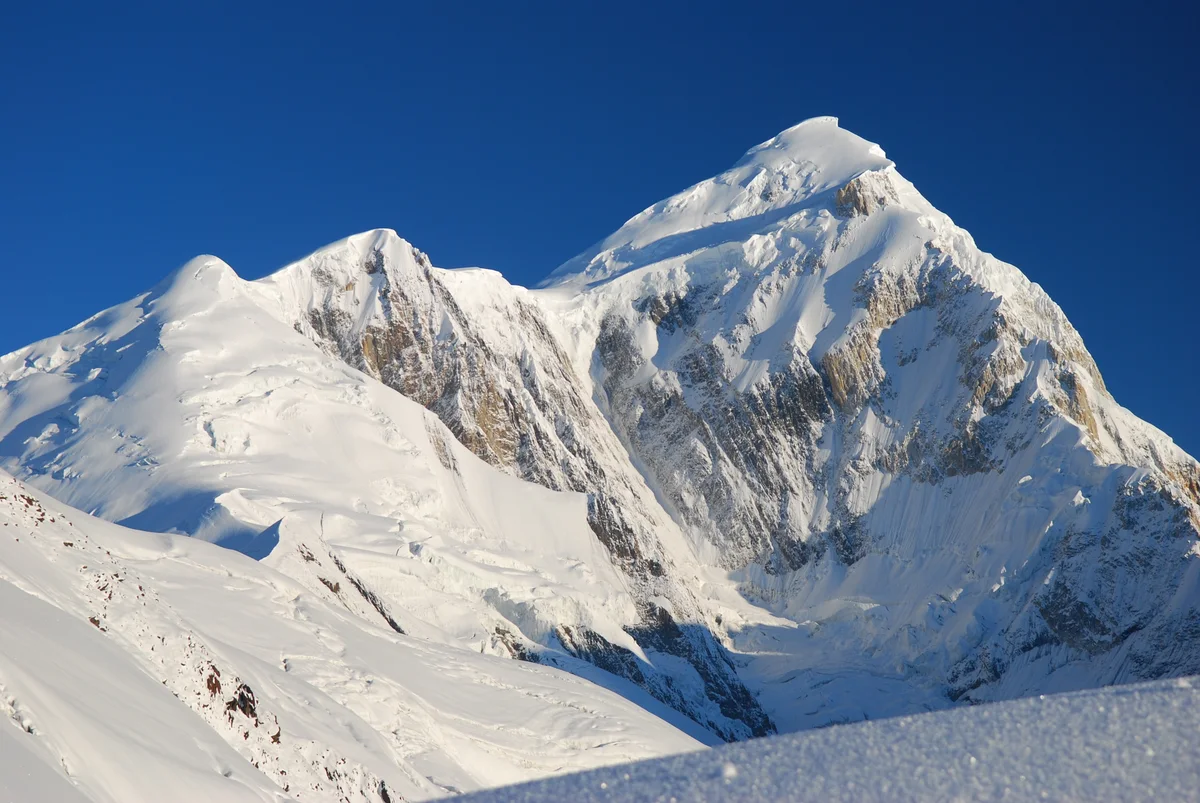
Spantik, also known worldwide as Golden Peak or Ghenish Chhish, is a striking 7,027-meter (23,054 ft) peak in the Spantik-Sosbun subrange of the Karakoram in Gilgit-Baltistan, Pakistan. While its Southeast Ridge is a popular high-altitude objective, its colossal Northwest Face—the Golden Pillar—is a 2,000-meter vertical wall of tiered red marble and golden granite that ranks among the most coveted and difficult big-wall alpine routes on Earth. First ascended via the Southeast Ridge in 1955 by Karl Kramer's German expedition, Spantik achieved legendary status in modern technical alpinism in August 1987 when British climbers Mick Fowler and Victor Saunders made the historic first ascent of the Golden Pillar in pure alpine style.
Documented Sources & Archival Citations
- The Golden Pillar: Spantik(The Alpine Journal / Mick Fowler)
Supporting claim: Detailed firsthand account of the eight-day alpine first ascent of Spantik's Northwest Pillar
Accessed/Documented: 1988 - Elusive Summits: Four Expeditions in the Karakoram(Victor Saunders / Hodder & Stoughton)
Supporting claim: Boardman Tasker winning chronicle of the climb, technical pitches, and bivy experiences
Accessed/Documented: 1990