1978 First Oxygenless Mount Everest Expedition
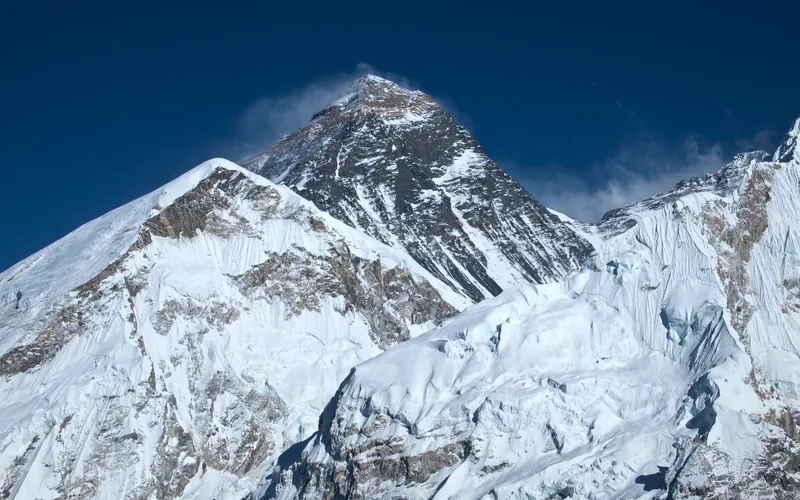
The landmark 1978 Austrian expedition where Reinhold Messner and Peter Habeler shattered medical dogma by summiting Mount Everest (8,848.86m) without supplemental oxygen.
Mountain Safety & Conditions Disclaimer: High-altitude climbing, glacial travel, and technical ascents entail severe objective risks including avalanches, serac collapses, rapid weather collapse, and altitude illness. Historical route descriptions and summit claims on Mountanity reflect documented archival sources and must not be used as live operational safety assessments. Local regulations, permits, and physical glacial topography change continuously.
Peer Review: Senior Editorial Board & Historical Reviewers • Editorial Standards
Official Expedition Narrative & Archival Record
In early 1978, prominent medical authorities warned that climbing above 8,000 meters without supplemental oxygen would cause irreversible brain damage or rapid death. Disregarding these theoretical limits, Reinhold Messner and Peter Habeler joined an Austrian expedition led by Wolfgang Nairz to test the true physiological boundaries of human endurance. Operating from the South Col (7,925m), the duo launched their final summit push on May 8, 1978. In bitter sub-zero temperatures and buffeting winds, they ascended past the Balcony and the Hillary Step, taking dozens of deep gasps for every step forward. At 1:15 PM, Messner and Habeler stood on the highest point on Earth, proving that the human body could sustain itself at 8,848 meters without artificial life support.
Documented Team Composition
- Wolfgang Nairz (Expedition Leader)
- Reinhold Messner (Summit Climber)
- Peter Habeler (Summit Climber)
- Oswald Oelz (Expedition Doctor)
- Reinhard Karl
- Horst Bergmann
Key Statistics & Topographic Figures
- Summit Timestamp
- 1:15 PM, May 8, 1978
First Oxygenless Everest Ascent
- Summit Climbers
- Reinhold Messner & Peter Habeler
Two-Man Lightweight Assault
- Oxygen Equipment
- 0 Liters / 0 Bottled Oxygen
Natural Human Respiration
- Expedition
- Austrian Alpine Club Expedition
Led by Wolfgang Nairz
Archival Primary Source Quotations
“I am nothing more than a single, narrow gasping lung, floating over the mists and summits.”
Defined Alpine Terminology & Concepts
- Hypoxia
- A medical condition in which the body or a region of the body is deprived of adequate oxygen supply at the tissue level, typical in the high alpine Death Zone.
- Fair Means
- An ethical climbing philosophy championed by Messner that rejects artificial aids like bottled oxygen, bolts, or massive porter teams in favor of human capability.
Frequently Asked Questions: 1978 First Oxygenless Mount Everest Expedition
Who was the first person to climb Mount Everest without supplemental oxygen?
Reinhold Messner of Italy and Peter Habeler of Austria made the historic first ascent of Mount Everest (8,848m) without supplemental bottled oxygen on May 8, 1978, climbing via the South Col route.
Did doctors believe climbing Everest without oxygen was impossible?
Yes. Prior to May 1978, leading high-altitude physiologists and medical experts asserted that atmospheric pressure at 8,848 meters was too low for human survival, predicting that anyone attempting it would suffer irreversible brain damage or fatal pulmonary edema.
How long did Messner and Habeler take from the South Col to the summit?
Leaving Camp IV at the South Col at 5:30 AM in deep cold, they battled intense hypoxia, taking several breaths for every single step. They reached the summit at 1:15 PM, taking less than eight hours to conquer the final 900 vertical meters.
Ascent Route & Topography
South Col & Southeast Ridge (Normal Route)
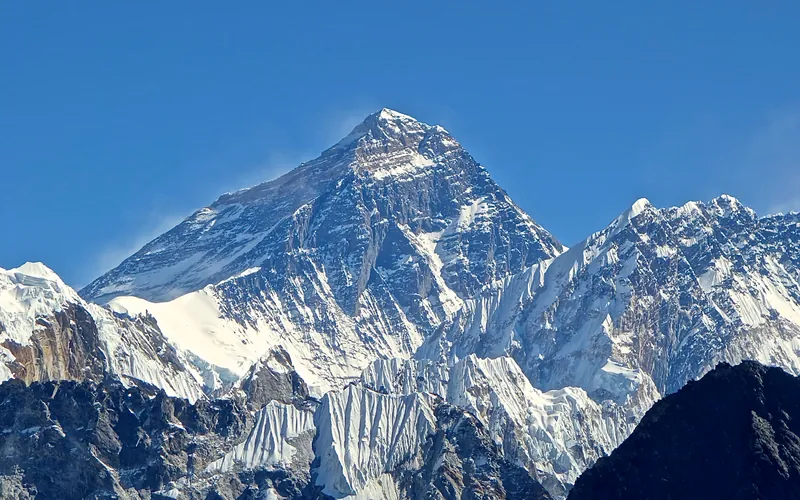
The South Col Route along the Southeast Ridge is the historic path of the 1953 first ascent and the most popular route on Mount Everest. Starting from Base Camp on the Khumbu Glacier in Nepal, climbers navigate the shifting seracs of the Khumbu Icefall into the Western Cwm. The route then scales the icy 45-degree slope of the Lhotse Face to the South Col at 7,925 meters, launching the final summit bid through the Balcony, South Summit, and Hillary Step to the summit of Earth at 8,848.86 meters.
Target Objective Peak


Mount Everest
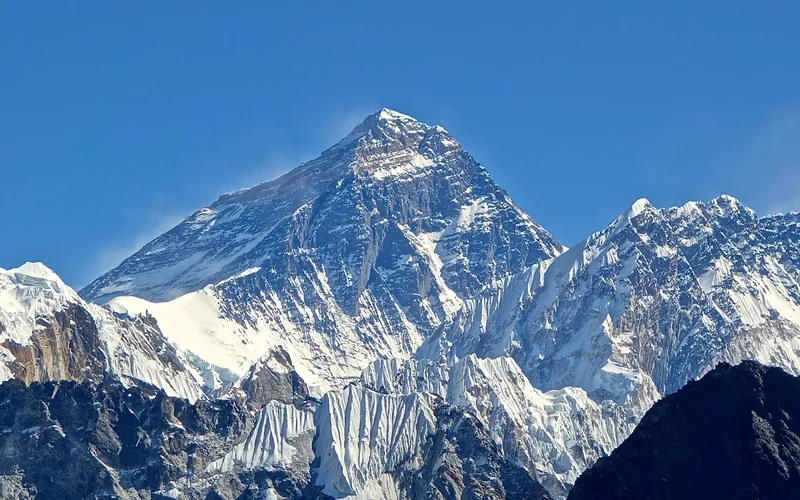
Mount Everest is the highest mountain above sea level on Earth, standing at an official elevation of 8,848.86 meters (29,031.7 ft). Straddling the international frontier between Nepal and China, it is known locally as Sagarmatha in Nepali ('Goddess of the Sky') and Chomolungma in Tibetan ('Mother Goddess of the World'). The peak rises into the extreme upper troposphere, where oxygen levels drop to barely one-third of sea-level pressure. Climbers face hurricane-force jet stream winds, severe frostbite conditions, shifting ice crevasses in the Khumbu Icefall, and the dangerous Death Zone above 8,000 meters.
Featured Expedition Climbers
Peter Habeler
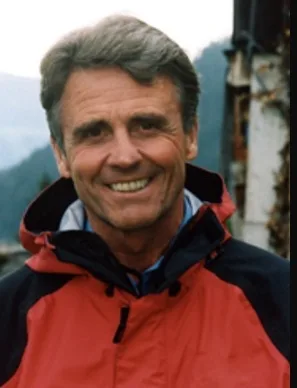
Peter Habeler was born on July 22, 1942, in Mayrhofen in the Zillertal valley of Tyrol, Austria. Growing up surrounded by the towering glaciated peaks of the Zillertal Alps, Habeler began climbing at age six. By his late teens, he had developed exceptional physical stamina, rapid footwork on steep mixed terrain, and a profound intuitive understanding of mountain weather, qualifying as a certified Austrian state ski instructor and UIAGM mountain guide at age twenty-one. In 1969, Habeler formed a legendary climbing partnership with South Tyrolean alpinist Reinhold Messner. Together, the duo pioneered extreme speed climbing in the Alps, discarding heavy bivouac equipment in favor of continuous, rapid movement. In 1974, Habeler and Messner stunned international climbing circles by climbing the fearsome 1,800-meter North Face of the Eiger (Heckmair Route) in an astonishing 10 hours—shattering the existing speed record by more than half and proving that speed and minimal gear dramatically reduced exposure to rockfall and objective hazards. In 1975, Habeler and Messner exported their lightweight alpine philosophy to the Karakoram. Over three days in August, they climbed the Northwest Face of Gasherbrum I (Hidden Peak, 8,080m) in pure alpine style—carrying only small backpacks, using no supplemental oxygen, fixing zero ropes, and establishing no permanent camps. It marked the first time an 8,000-meter peak was climbed in pure alpine style, permanently transforming the ethics of high-altitude mountaineering. Habeler's greatest historical breakthrough came in the spring of 1978 during the Austrian Everest Expedition led by Wolfgang Nairz. Disregarding universal medical warnings that climbing above 8,000 meters without supplemental oxygen would lead to fatal cerebral edema or irreversible neurological damage, Habeler and Messner pushed out from the South Col (7,980m) on May 8, 1978. Fighting extreme exhaustion, hyperventilating up to fifteen times per step, and battling gale-force winds, Habeler and Messner stood on the summit of Mount Everest (8,848.86m) at 1:15 PM. They had achieved what science considered physiologically impossible, opening the modern era of pure, unassisted high-altitude climbing. Following Everest, Habeler authored the bestselling book 'Der einsame Sieg' (The Lonely Victory) and continued climbing high-altitude giants without supplemental oxygen, including Cho Oyu (8,188m), Nanga Parbat (8,126m), and Kangchenjunga (8,586m). He founded the Peter Habeler Ski and Mountaineering School in Mayrhofen, dedicating his career to mountain education and mentorship. In 2017, at the age of 74, Habeler returned to the Eiger North Face alongside his former student, the late prodigy David Lama, successfully climbing the 1,800-meter wall forty-three years after his record-setting ascent. Habeler remains an enduring icon of athletic grace, alpine ethics, and human physiological potential.
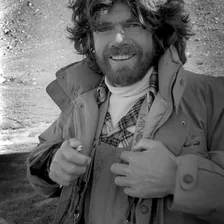
Reinhold Messner
Reinhold Messner was born on September 17, 1944, in Bressanone (Brixen), South Tyrol, Italy, and grew up in the rugged Villnöß valley beneath the towering limestone spires of the Geisler Peaks (Odle). Guided by his father Josef, Messner completed his first alpine ascent at age five. By his late teens, Reinhold and his younger brother Günther had evolved into one of the most prolific and technically daring climbing partnerships in European mountaineering history, establishing hundreds of first ascents across the Dolomites, Western Alps, and Central Europe. In 1968, Messner penned the seminal climbing essay 'The Murder of the Impossible' (Die Ermordung des Unmöglichen), launching a vehement ethical rebellion against the heavy siege tactics, expansion bolts, and mechanical apparatus dominating mid-century mountaineering. He argued passionately that technical artificial aids killed the genuine spiritual and physical challenge of climbing, advocating instead for strict self-reliance, minimal equipment, and clean alpine style. In 1970, Messner stepped onto the global stage during the Austro-German Expedition to Nanga Parbat (8,126m) led by Karl Maria Herrligkoffer. Alongside his brother Günther, Messner completed the audacious first ascent of the Rupal Face—the largest direct rock and ice wall on the planet, rising 4,500 vertical meters above the valley floor. After reaching the summit in fading light on June 27, Günther succumbed to severe altitude exhaustion, making a descent back down the terrifying Rupal Face impossible. In a desperate bid for survival, the brothers undertook the first complete traverse of an 8,000-meter mountain by descending the unexplored Diamir Face. Near the base of the mountain, Günther was swept away and killed by an ice avalanche. Reinhold, hallucinating and suffering catastrophic frostbite, stumbled into local pastures days later, subsequently undergoing surgical amputation of six toes and parts of his fingertips. Rather than ending his mountaineering career, the physical trauma accelerated Messner's transformation into the purest lightweight high-altitude climber of the modern era. In May 1978, Messner and Austrian partner Peter Habeler stunned medical researchers and high-altitude physiologists by summiting Mount Everest (8,848.86m) entirely without supplemental oxygen via the South Col. Prominent scientists had insisted that atmospheric pressure at 8,848 meters made oxygenless human survival impossible. Just three months later, in August 1978, Messner scored another historic milestone by soloing Nanga Parbat from base camp to summit via an unclimbed route on the Diamir Face—the first completely solo ascent of an 8,000-meter peak from base to summit. Messner pushed self-sufficiency to its historical absolute in August 1980 during a solo monsoon ascent of Mount Everest from the Tibetan north side. Operating without oxygen, porters, fixed camps, or two-way radio communication, he survived an 8-meter crevasse fall and battled deep monsoon snow to summit via the North Face and Great Couloir (Norton Couloir). In the summers that followed, he demonstrated the speed and agility of alpine style on giants like K2, Kangchenjunga, and Gasherbrum I and II. In 1982, teaming up with Pakistani climbers Nazir Sabir and Sher Khan, he completed a back-to-back traverse of Gasherbrum II and Broad Peak within nine days. On October 16, 1986, by standing on the summit of Lhotse (8,516m), Messner completed the ascent of all fourteen 8,000-meter peaks on Earth—the first human to achieve the Grand Slam of mountaineering, every single peak climbed without bottled oxygen. Having redefined high-altitude mountaineering, Messner turned his boundless endurance toward horizontal planetary wildernesses. Between 1989 and 1990, he and German polar explorer Arved Fuchs completed the first crossing of Antarctica on foot and skis via the South Pole without motor or dog assistance, covering 2,800 kilometers in 92 days. He subsequently crossed Greenland and traversed the 2,000-kilometer expanse of the Gobi Desert on foot. Messner served as a Member of the European Parliament for the Italian Green Party from 1999 to 2004, championing mountain conservation and Alpine culture. He established the Messner Mountain Museum (MMM)—a network of six architectural museums across South Tyrol and Belluno dedicated to human engagement with mountains, art, and high-altitude history. Messner remains the enduring benchmark for ethics, psychological fortitude, and alpine purity.
Associated Historical Chronicles & Stories
1978 Everest Without Oxygen: Shattering Medical Dogma
How Reinhold Messner and Peter Habeler proved humans could summit Everest without supplemental oxygen, overturning established physiology.
Documented Sources & Archival Citations
- Everest: Expedition to the Ultimate(Reinhold Messner / Kaye & Ward)
Supporting claim: Firsthand narrative of the 1978 oxygenless climb with Peter Habeler
Accessed/Documented: 1979 - The Lonely Victory: 8,848 Metres Without Oxygen(Peter Habeler / Macdonald and Jane's)
Supporting claim: Autobiographical account of the physical and psychological toll of the ascent
Accessed/Documented: 1979