Caucasus Mountains
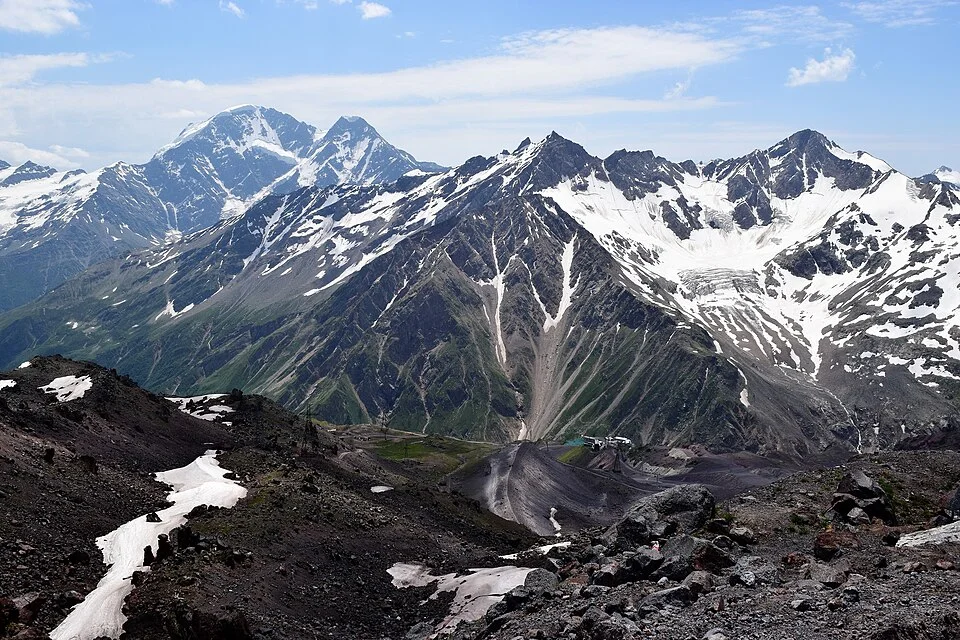
The formidable 1,200-kilometer mountain system bridging Europe and Asia between the Black Sea and the Caspian Sea. Home to Mount Elbrus (5,642 m), the continental high point of Europe, the terrifying twin granite spires of Ushba in Svaneti, and the ancient glaciated stratovolcano of Mount Kazbek.
Peer Review: Senior Editorial Board & Historical Reviewers • Editorial Standards
Key Statistics & Topographic Figures
- Archive Classification
- RANGES
Mountanity Knowledge Corpus
- Verification Status
- Editorially Verified
Archival Standards
- Citation Standard
- Primary Source Verified
Alpine Research Desk
Archival Primary Source Quotations
“Great things are done when men and mountains meet; this is not done by jostling in the street.”
Defined Alpine Terminology & Concepts
- Archival Integrity
- The standard of verifying historical mountain facts, summit claims, and altitudes using primary expeditions journals and geodetic measurements.
Frequently Asked Questions: Caucasus Mountains
What historical significance does this range hold?
Caucasus Mountains represents an essential chapter in global mountaineering heritage, verified through contemporary expedition journals and archival sources.
How are the facts and records for Caucasus Mountains verified?
All records are checked against peer-reviewed journals, national alpine clubs, geodetic surveys, and the Mountanity Archival Integrity Policy.
Documented Peaks in Caucasus Mountains
Mount Elbrus
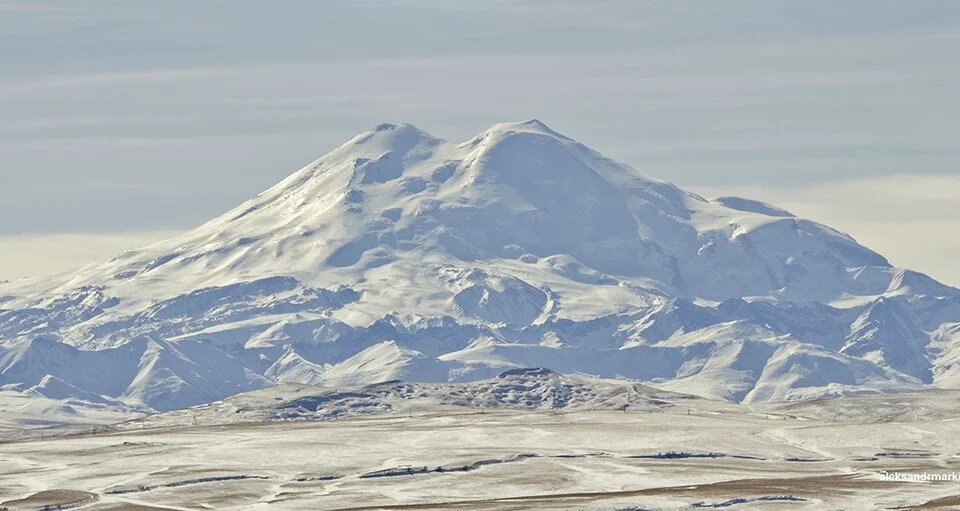
Mount Elbrus is the highest mountain in Russia and Europe, soaring to 5,642 metres as the tenth-most topographically prominent peak on Earth and one of the Seven Summits. Situated in the Russian Caucasus near the Georgian border, this colossal dormant stratovolcano features two ice-capped volcanic domes separated by a high saddle at 5,416 metres. The eastern summit (5,621 m) was first climbed in 1829 by Circassian scout Killar Khashirov, while the true continental high point on the western summit (5,642 m) was conquered in 1874 by Florence Craufurd Grove, Frederick Gardiner, Horace Walker, Peter Knubel, and Balkar guide Ahiya Sottaev.

Mount Kazbek
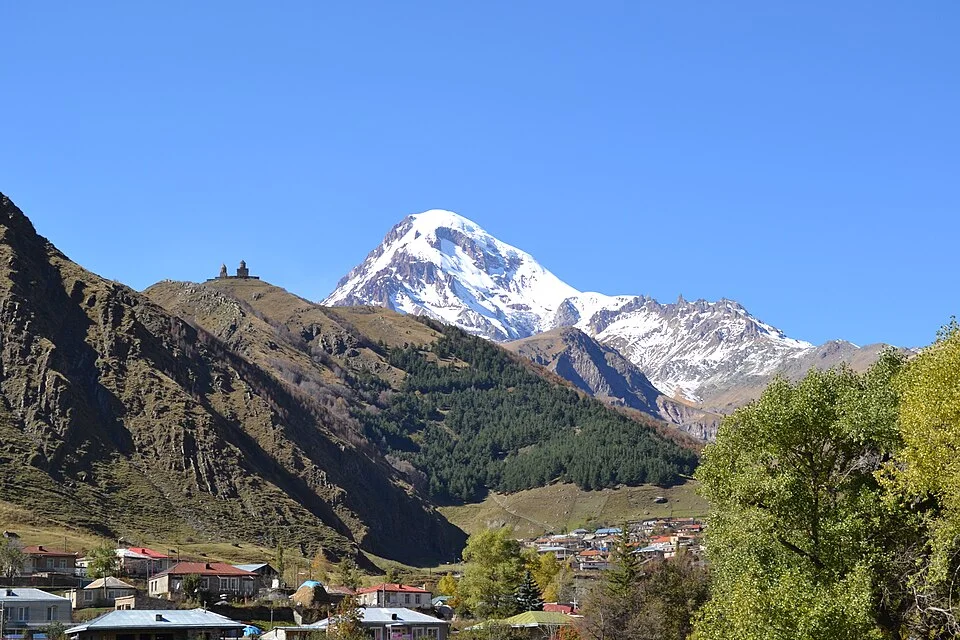
Mount Kazbek (known in Georgian as Mqinvartsveri, meaning 'Glacier Peak') is a magnificent 5,054-metre dormant stratovolcano situated in northeastern Georgia just south of the Russian border. The third-highest summit in Georgia and the second-highest volcanic cone in the Caucasus after Elbrus, Kazbek towers majestically above the town of Stepantsminda and the historic Georgian Military Highway. Rich in mythology as the legendary peak where the Titan Amirani (the Georgian Prometheus) was chained for gifting fire to mortals, Kazbek was first climbed in 1868 by Douglas Freshfield, Adolphus Moore, Charles Tucker, and Chamonix guide François Devouassoud.
Ushba
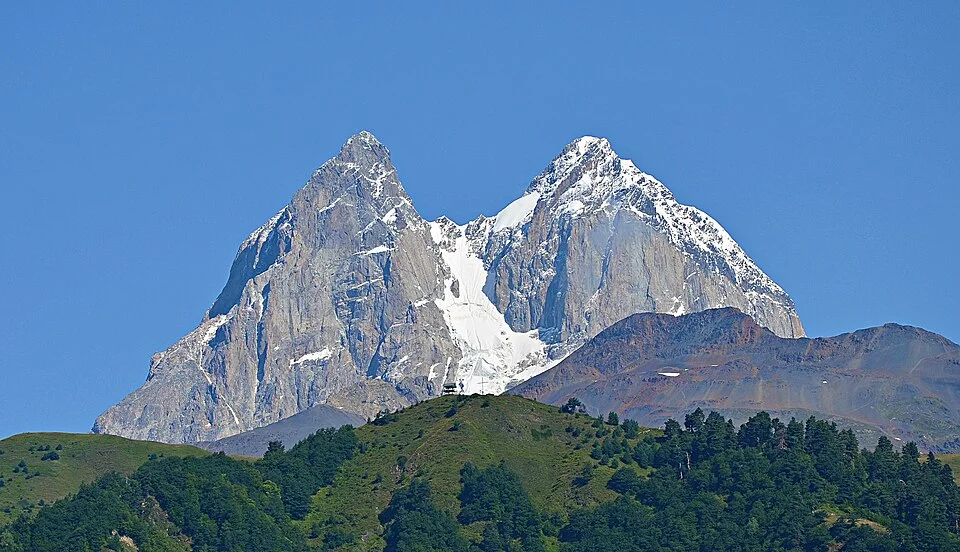
Ushba is a legendary double-peaked granite horn in the Svaneti region of Georgia, universally celebrated as the 'Matterhorn of the Caucasus' and widely regarded as the most difficult technical mountaineering objective in the entire Caucasus range. Rising with breathtaking vertical ferocity above the high valleys of Mestia, Ushba features a South Peak (4,710 m) and a North Peak (4,690 m) separated by a jagged, corniced saddle. The North Peak was first climbed in 1888 by English mountaineer John Garford Cockin and Swiss guide Ulrich Almer, while the South Peak was first conquered in 1903 by a daring German-Austrian team led by Adolf Schulze, Willi Rickmer Rickmers, and Cenzi von Ficker.
Documented Sources & Archival Citations
- The Exploration of the Caucasus(Douglas William Freshfield / Edward Arnold)Accessed/Documented: 1896
- The Frosty Caucasus(Florence Craufurd Grove / Longmans, Green, and Co.)Accessed/Documented: 1875