Kangchenjunga 1955: Sacred Summit and Alpine Respect
In May 1955, Joe Brown and George Band pioneered the first ascent of Kangchenjunga (8,586m), deliberately stopping short of the true summit to honor the religious beliefs of Sikkim.
Mountain Safety & Conditions Disclaimer: High-altitude climbing, glacial travel, and technical ascents entail severe objective risks including avalanches, serac collapses, rapid weather collapse, and altitude illness. Historical route descriptions and summit claims on Mountainity reflect documented archival sources and must not be used as live operational safety assessments. Local regulations, permits, and physical glacial topography change continuously.
Peer Review: Senior Editorial Board & Historical Reviewers • Editorial Standards
The Five Treasures of the Snow
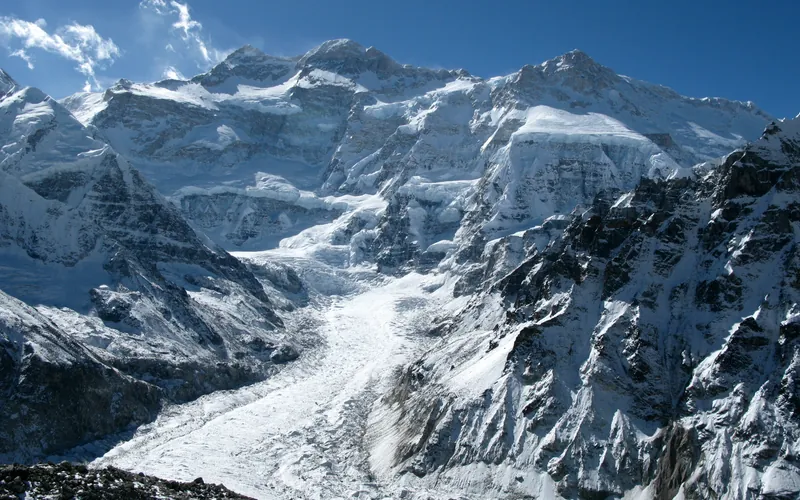
Kangchenjunga (8,586m)—the third highest peak on Earth—rears its immense mass of ridges and glaciers along the frontier of Nepal and Sikkim. To the Sikkimese people, the mountain is not merely an elevation of stone and ice, but the sacred abode of their guardian deities, ‘The Five Treasures of the Great Snow’. For decades, the Sikkimese royal government prohibited any expedition that would desecrate the summit by setting foot upon its crown.
When British mountaineer and surgeon Dr. Charles Evans organized an expedition in the spring of 1955, he signed a solemn covenant with the Chogyal of Sikkim: the climbers would ascend the mountain, but they promised that the highest crest of the peak would remain untrodden.
Assault on the Yalung Face
Approaching from the southwest through eastern Nepal, Evans’s team focused their assault on the imposing Yalung Face. The route required navigating colossal icefalls, traversing precarious avalanche slopes, and surmounting the Great Shelf at 7,500 meters. The climbing was intensely demanding, testing both veterans like Norman Hardie and young British rock-climbing prodigies Joe Brown and George Band.
Joe Brown, a working-class builder from Manchester renowned for pioneering the hardest rock climbs in Wales and the Peak District, adapted brilliantly to the thin air. Together with George Band, a Cambridge graduate, they forged the summit assault from Camp VI at 8,200 meters on May 25, 1955.
The Final Rock Pitch and Honored Promise
Above 8,400 meters, Brown and Band confronted the ultimate defense of Kangchenjunga: a sheer wall of brittle granite rock blocking the path to the ridge. Removing his bulky mittens and utilizing tiny finger jams in freezing winds, Joe Brown executed a brilliant piece of extreme rock climbing—later rated Grade V/VI—surmounting an outward-sloping overhang.
Emerging onto the gentle snow slope above, Brown and Band stood just below the crest. Only a few feet of snow separated them from the highest geographic point. Remembering their solemn promise to the people of Sikkim, they deliberately stopped short, respecting the sacred boundary. The following day, teammates Norman Hardie and Tony Streather repeated the ascent, also leaving the very top unmarred. Their historic climb stands as an eternal benchmark of mountaineering excellence united with cultural humility.
Key Statistics & Topographic Figures
- Category
- Historic Expeditions
Archival Subject
- Reading Time
- 11 min read
Narrative Length
- Key Mountain
- kangchenjunga
Objective
- Ascent Route
- the ascent route
Topography
- Verification
- Editorially Verified
Archival Standard
Defined Alpine Terminology & Concepts
- Summit Push
- The final continuous climbing effort from the highest established camp to the mountain apex and back.
- Death Zone Chronicle
- A verified, research-backed historical narrative documenting the human, technical, and environmental realities of an alpine expedition.
Frequently Asked Questions: Kangchenjunga 1955: Sacred Summit and Alpine Respect
What is the core chronicle and subject of "Kangchenjunga 1955: Sacred Summit and Alpine Respect"?
In May 1955, Joe Brown and George Band pioneered the first ascent of Kangchenjunga (8,586m), deliberately stopping short of the true summit to honor the religious beliefs of Sikkim.
Which mountain peaks and routes are featured in "Kangchenjunga 1955: Sacred Summit and Alpine Respect"?
This narrative documents climbs on kangchenjunga along the the ascent route in Nepal.
Which documented expedition is chronicled in this story?
This historical chronicle captures the events of the 1955-british-kangchenjunga, verified through contemporary journals and archival records.
Who authored and researched this archival chronicle?
Authored and researched by Mountainity Historical Research Desk, drawing on primary eyewitness testimonies, alpine club registries, and verified summit logs.
What makes this high-altitude chronicle historically significant?
Categorized under "Historic Expeditions", this chronicle preserves critical lessons in alpine leadership, survival, tactical speed, and human endurance in the death zone.
Related Mountains


Kangchenjunga
Kangchenjunga, at 8,586 meters (28,169 ft), is the third-highest mountain on Earth, rising on the border between Nepal and Sikkim, India. Honored as sacred by locals, early ascent teams respected local beliefs by stopping short of the actual highest crest. It features immense vertical relief and notorious storm cycles.
Featured Mountaineers & Pioneers (5)
Browse All Mountaineers →Charles Evans
Robert Charles Evans was a pioneering British mountaineer and neurosurgeon. In 1953, Evans served as deputy leader of the historic British Mount Everest Expedition led by John Hunt. On May 26, 1953, Evans and Tom...

Dawa Tensing Sherpa
Dawa Tensing Sherpa (recorded in the official Himalayan Club Tiger Badge roll as Dawa Tenzing, porter registration H/C No. 173) was one of the most respected high-altitude sirdars in the golden era of Himalayan...
George Band
George Christopher Band was born on February 2, 1929, in Taipei, Taiwan, where his parents were British missionary educators. Returning to England for his schooling at Eltham College, Band entered Queens' College,...
Joe Brown
Joseph 'Joe' Brown was born on September 26, 1930, in Ardwick, an impoverished working-class district of Manchester, England. The youngest of seven children, Brown left school at age fourteen to work as a plumber and...
Norman Hardie
Norman David Hardie was one of the most accomplished climbers in New Zealand’s golden age of mountaineering. Trained as a civil engineer, Hardie joined Sir Edmund Hillary on the 1954 Barun Valley Expedition, during...
Documented Expeditions (1)
View All Expeditions →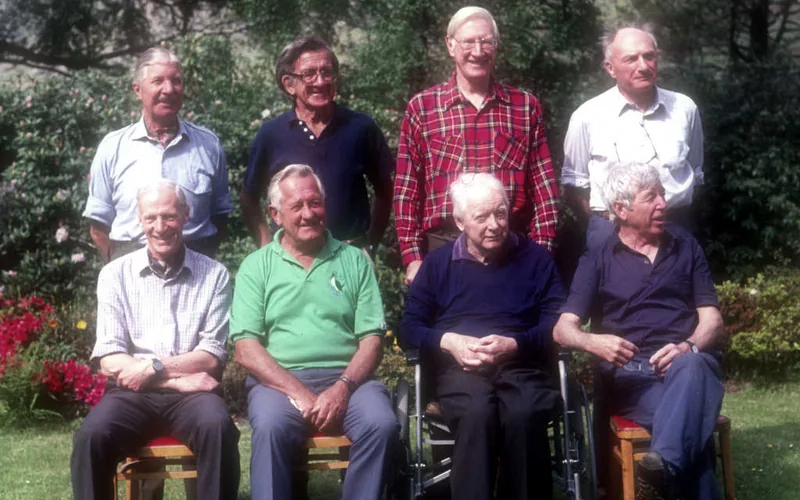
1955 British Kangchenjunga Expedition
Led by Dr. Charles Evans, this landmark British expedition achieved the first ascent of Kangchenjunga (8,586m) on May 25, 1955, when Joe Brown and George Band reached the summit ridge via the Southwest Face, followed the next day by Norman Hardie and Tony Streather.
Documented Sources & Archival Citations
- Kangchenjunga: The Untrodden Peak(Charles Evans / E. P. Dutton & Co. (New York))
Supporting claim: Authoritative account of the 1955 British expedition and the sacred summit agreement.
- Road to Kangchenjunga(George Band / The Alpine Journal (Vol. LX))
Supporting claim: Technical description of the Yalung Face and summit rock pitch.
Share Exploration
Global Mountain Intelligence
✓ Link copied to clipboard!