1957 Austrian Chogolisa Alpine Expedition
The lightweight two-man alpine-style push on Chogolisa (7,665m) by Hermann Buhl and Kurt Diemberger, ending in a severe blizzard retreat and Buhl's fatal cornice fall.
Mountain Safety & Conditions Disclaimer: High-altitude climbing, glacial travel, and technical ascents entail severe objective risks including avalanches, serac collapses, rapid weather collapse, and altitude illness. Historical route descriptions and summit claims on Mountanity reflect documented archival sources and must not be used as live operational safety assessments. Local regulations, permits, and physical glacial topography change continuously.
Peer Review: Senior Editorial Board & Historical Reviewers • Editorial Standards
Official Expedition Narrative & Archival Record
Following their historic first ascent of Broad Peak on June 9, 1957, Hermann Buhl and Kurt Diemberger made a spontaneous decision to attempt the virgin 7,665-meter summit of Chogolisa in pure alpine style. Operating completely independently without high-altitude porters or fixed ropes, the pair established a high camp on the upper glacier and launched their summit bid on June 27. Ascending along the narrow Southeast Ridge through deteriorating weather, they reached approximately 7,300 meters before fierce winds and heavy snow forced a turnaround. During the descent through dense whiteout conditions, Buhl walked a few meters behind Diemberger when a massive wind-sculpted snow cornice collapsed beneath his feet, plummeting him 900 meters down the sheer North Face. Despite frantic searching, Diemberger found only Buhl's broken tracks vanishing into the void.
Documented Team Composition
- Hermann Buhl
- Kurt Diemberger
Key Statistics & Topographic Figures
- Date of Tragedy
- June 27, 1957
Cornice Collapse on Descent
- High Point Reached
- ~7,300 meters
Southeast Ridge
- Climbing Pair
- Hermann Buhl & Kurt Diemberger
Two-Man Alpine Push
- Mountain Location
- Chogolisa (Bride Peak, 7,665m)
Karakoram, Pakistan
Archival Primary Source Quotations
“I looked back. There was no one. Just the tracks stopping at the edge of nothingness where the cornice had sheared away.”
Defined Alpine Terminology & Concepts
- Snow Cornice
- An overhanging edge of snow formed by wind blowing over the crest of a mountain ridge, which appears solid from above but has no support underneath.
- Whiteout
- A severe weather condition where snow, clouds, and blowing fog cause uniform light reflection, completely erasing the horizon and depth perception.
Frequently Asked Questions: 1957 Austrian Chogolisa Alpine Expedition
What happened to Hermann Buhl on Chogolisa in 1957?
On June 27, 1957, during their descent from 7,300 meters in a blinding blizzard, Hermann Buhl stepped on an overhanging snow cornice along the Southeast Ridge of Chogolisa. The cornice broke away, and Buhl plunged approximately 900 meters down the vertical North Face. His body was never found.
Who was climbing with Hermann Buhl when he died on Chogolisa?
Kurt Diemberger was climbing with Hermann Buhl. Diemberger was breaking trail a short distance ahead in the whiteout and suddenly heard an ominous cracking sound. Turning around, he saw only Buhl’s footprints ending abruptly in empty air.
How close were Buhl and Diemberger to summiting Chogolisa?
The pair had reached an altitude of approximately 7,300 meters, just a few hundred vertical meters below the 7,665-meter summit, when sudden gale-force winds and a complete loss of visibility forced them to turn back.
Ascent Route & Topography
Southeast Ridge (Standard Route)
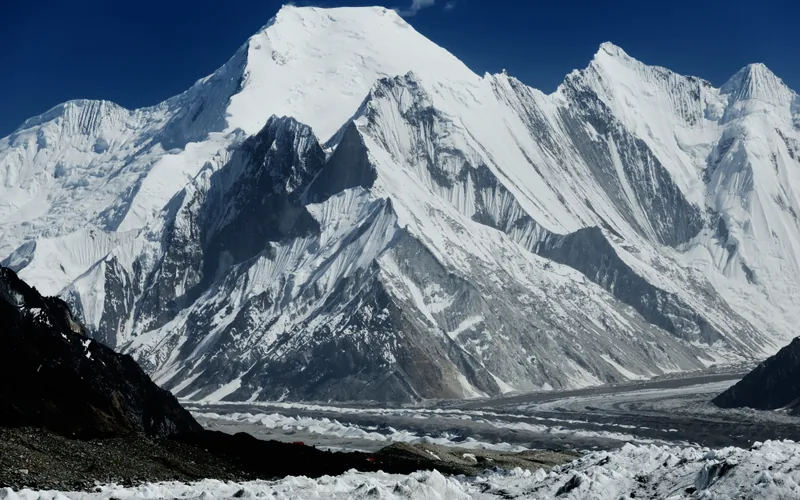
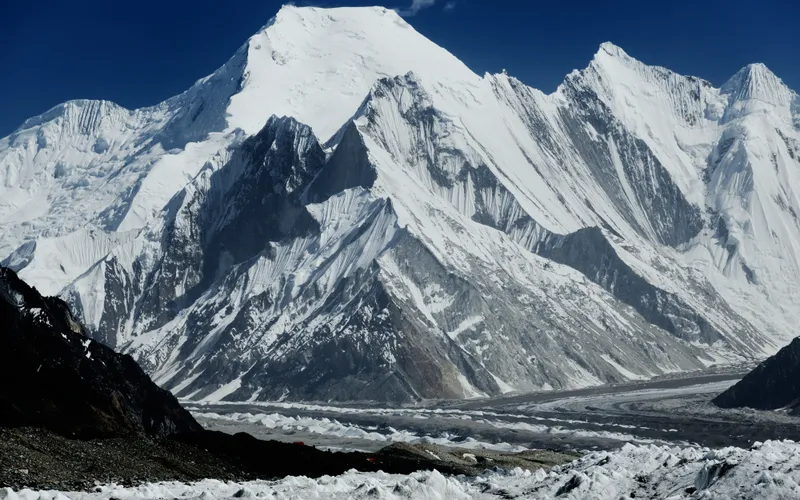
The Southeast Ridge of Chogolisa (7,665m) ascends from the upper Chogolisa Glacier, scaling steep ice couloirs to gain the elegant, wind-sculpted snow arête leading toward the summit. First explored in 1909 by the Duke of the Abruzzi to 7,498 meters, attempted in alpine style in 1957 by Hermann Buhl and Kurt Diemberger, and first summited on August 4, 1958, by Fred Pressl and Adolf Bräunlich.
Target Objective Peak

Chogolisa
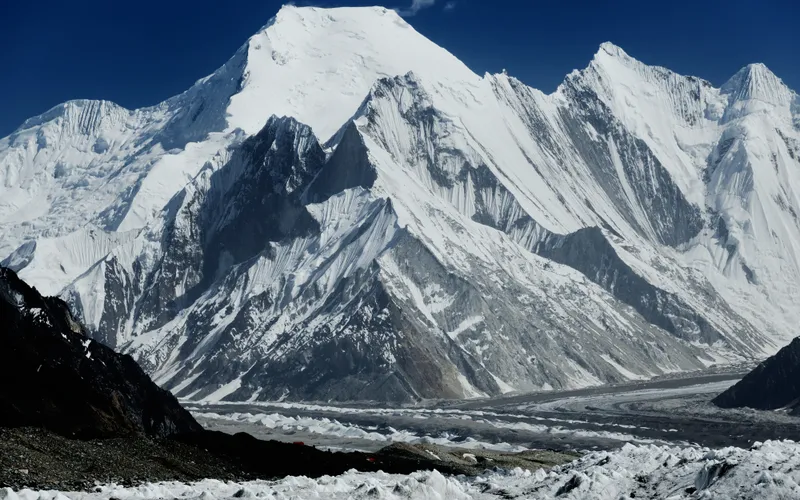
Chogolisa, standing at 7,665 meters (25,148 ft) in the Karakoram range of Pakistan, is renowned as Bride Peak for its broad, graceful snow-draped profile. Located south of Concordia and the Baltoro Glacier, it features two prominent summits connected by a sweeping knife-edge snow ridge. In 1909, the Duke of the Abruzzi set a world altitude record on its slopes, and in 1957, it became the site of alpine pioneer Hermann Buhl's fatal cornice fall.
Featured Expedition Climbers
Hermann Buhl
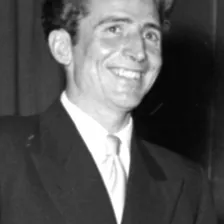
Hermann Buhl was born in Innsbruck, Austria, on September 21, 1924, the youngest of four children. After losing his mother at age four, he spent several formative years in an orphanage. Although plagued by sensitive health as a young boy, he built exceptional physical stamina and psychological grit scrambling across the limestone towers of the Karwendel and Wilder Kaiser ranges. He joined the Innsbruck branch of the Austrian Alpine Club in 1939 and completed rigorous mountain guide qualifications after World War II, establishing a reputation as the most skilled rock climber in the Eastern Alps. During the early 1950s, Buhl revolutionized European alpinism by introducing extreme speed, endurance, and solo ascents on technical routes previously considered multi-day team undertakings. In July 1952, he cycled 150 kilometers from Landeck to Promontogno in Switzerland, soloed the demanding 800-meter Northeast Face of Piz Badile in just 4.5 hours in wet and icy conditions, and then pedaled home on his bicycle to start work on Monday morning. Later that summer, he completed the notorious North Face of the Eiger (Eigerwand) during an unforgiving blizzard with Sepp Jöchler, Otto Maag, and Sepp Maag. In February 1953, Buhl pulled off the first winter solo ascent of the Watzmann East Face by night in deep snow. In the summer of 1953, Buhl joined the Austro-German Nanga Parbat Expedition organized by Dr. Karl Maria Herrligkoffer. Thirty-one climbers had previously died attempting Nanga Parbat (8,126m). On the night of July 2, high at Camp V (6,900m) on the Rakhiot Flank, his assigned climbing partner Otto Kempter suffered severe physical exhaustion. Undeterred, Buhl set out alone at 2:30 AM on July 3 without supplemental oxygen. Crossing the high Silbersattel (Silver Saddle) at 7,450 meters, the desolate upper plateau, and the Bazhin Gap, he reached the summit alone at 7:00 PM. On his descent, darkness trapped him at 8,000 meters after he lost a crampon on icy rock. Buhl survived an extraordinary open-air standing bivouac balanced on a tiny rock ledge, holding on with one hand through sub-zero temperatures. Hallucinating from dehydration and fatigue, he staggered back into Camp V forty-one hours after departure—completing the only solo first ascent of an 8,000-meter mountain in history. In the spring of 1957, Buhl returned to the Karakoram alongside Marcus Schmuck, Fritz Wintersteller, and Kurt Diemberger for an expedition to Broad Peak (8,051m). Rejecting the heavy military siege tactics of their era, the four Austrians carried all their own gear, pitched their own camps, hired no high-altitude porters, and used no supplemental oxygen. After an initial turnaround at the Forepeak on May 29, the team returned on June 9, 1957. Schmuck and Wintersteller reached the summit first, followed two hours later by Buhl and Diemberger. This historic ascent proved that four self-reliant climbers could master an eight-thousander cleanly and quickly. Buhl became the first human to make the first ascents of two 8,000-meter peaks. Just eighteen days after Broad Peak, Buhl and Kurt Diemberger launched a lightweight alpine-style assault on the nearby unclimbed summit of Chogolisa (7,665m). On June 27, 1957, after ascending past 7,300 meters along the Southeast Ridge, a sudden Karakoram storm forced them to turn back. Descending through a blinding whiteout, Buhl walked a short distance behind Diemberger when a massive snow cornice collapsed under his feet. He plunged 900 meters down the vertical North Face. His body was never recovered. Legendary mountaineer Reinhold Messner later declared Buhl at least fifty years ahead of his time, cementing his place as the founding father of modern lightweight alpinism.

Kurt Diemberger
Kurt Diemberger was born on March 16, 1932, in Villach, Austria. Educated in business and pedagogy in Vienna, Diemberger found his true calling on the towering limestone walls of the Alps. By the mid-1950s, he had established himself among Europe's elite extreme alpinists, mastering the treacherous Giant Arête on the Dent du Géant and completing major routes across the Mont Blanc massif and the Bernese Oberland. In 1957, Diemberger was invited to join Marcus Schmuck's revolutionary four-man Austrian Karakoram Expedition to Broad Peak (8,051m). Rejecting the cumbersome military siege tactics of the era, the small team operated without supplemental oxygen, without high-altitude porters, and without fixed camps established by support relays. On June 9, 1957, Diemberger reached the 8,051-meter summit alongside Marcus Schmuck and Fritz Wintersteller, and later joined the ailing Hermann Buhl on his delayed summit push, completing one of high-altitude mountaineering's most legendary alpine-style triumphs. Just days later, Diemberger accompanied Buhl on an attempt of nearby Chogolisa (7,654m), witnessing Buhl plunge to his death when a summit ridge cornice collapsed during a blinding blizzard. Undeterred by the tragedy, Diemberger returned to the Himalayas in 1960 as a key climbing member of the Swiss Dhaulagiri Expedition led by Max Eiselin. On May 13, 1960, Diemberger stepped onto the summit of Dhaulagiri I (8,167m) via the Northeast Ridge alongside Peter Diener, Ernst Forrer, Albin Schelbert, and Sherpas Nyima Dorje and Nawang Dorje. With this conquest, Diemberger cemented an unmatched milestone in mountaineering history: alongside Hermann Buhl, he became one of only two human beings to claim the maiden first ascents of two eight-thousanders. Over the following decades, Diemberger pioneered high-altitude cinematography, carrying heavy 16mm film cameras onto the summits of Everest and K2. In 1986, he and his climbing and filming partner Julie Tullis summited K2, only to be trapped by the catastrophic 1986 K2 disaster; while Tullis and four others perished in a five-day storm in Camp IV, Diemberger survived a harrowing descent with severe frostbite. An acclaimed author of classic memoirs including *Summits and Secrets* and *The Endless Knot*, Diemberger was awarded the Piolet d'Or Lifetime Achievement Award in 2013, revered as high-altitude climbing's ultimate living pioneer.
Associated Historical Chronicles & Stories
1957 Chogolisa: Hermann Buhl's Final Alpine Frontier
The poignant chronicle of Hermann Buhl and Kurt Diemberger's lightweight alpine attempt on Chogolisa and the tragic summit cornice fall.
Documented Sources & Archival Citations
- Summits and Secrets(Kurt Diemberger / Hodder & Stoughton)
Supporting claim: Detailed firsthand eyewitness record of the 1957 Chogolisa climb and cornice collapse
Accessed/Documented: 1971 - The Fall of Hermann Buhl: American Alpine Journal(American Alpine Club)
Supporting claim: Official expedition obituary and geographical report on the Baltoro accident
Accessed/Documented: 1958