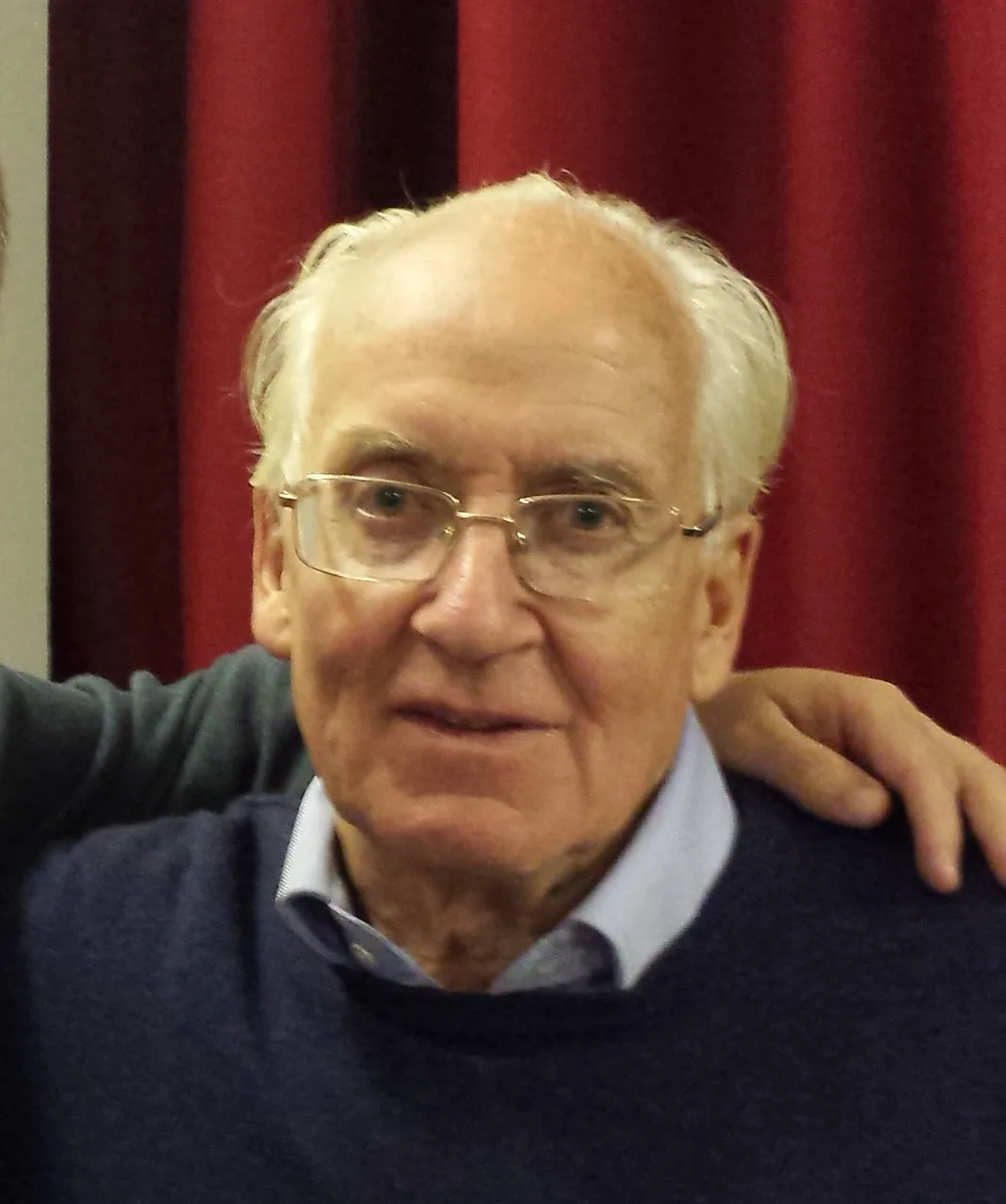
Doug Scott
Doug Scott CBE was a pioneering English mountaineer celebrated for bringing lightweight alpine ethics to the world's most formidable big walls. On September 24, 1975, he and Dougal Haston made the first ascent of Everest's Southwest Face, surviving a legendary open bivouac at 8,760 meters. In 1977, Scott made the first ascent of The Ogre (Baintha Brakk), surviving an epic eight-day crawl down the mountain with two broken legs.
Mountain Safety & Conditions Disclaimer: High-altitude climbing, glacial travel, and technical ascents entail severe objective risks including avalanches, serac collapses, rapid weather collapse, and altitude illness. Historical route descriptions and summit claims on Mountanity reflect documented archival sources and must not be used as live operational safety assessments. Local regulations, permits, and physical glacial topography change continuously.
Peer Review: Senior Editorial Board & Historical Reviewers • Editorial Standards
Biographical Record & Archival Chronicle
Douglas Keith Scott was born on May 29, 1941, in Nottingham, England. Introduced to climbing at age twelve in the gritstone outcrops of Derbyshire and the Black Rocks of Cromford, Scott trained as a geography and physical education teacher before dedicating his life to exploratory mountaineering. Tall, physically powerful, and philosophically drawn to Eastern mysticism and Buddhist concepts of mindfulness, Scott quickly distinguished himself on vertical granite big walls, making the first ascent of the Tarso Tiroko in Chad's Tibesti Mountains and scaling the South Face of Mount Asgard on Baffin Island in 1972.
In autumn 1975, Scott joined the British Mount Everest Southwest Face Expedition organized by Chris Bonington. The 2,300-meter face had defeated six previous international attempts due to the formidable, overhanging 300-meter yellow limestone 'Rock Band' at 8,200–8,500 meters. On September 24, 1975, Scott and Scottish climber Dougal Haston pushed out from Camp VI, breached the Rock Band gully, and surmounted the South Summit. Battling deep drifts in failing light, they reached the summit of Mount Everest at 6:00 PM, becoming the first Britons to conquer Everest. Descending in pitch darkness, they ran out of oxygen and were forced into an emergency bivouac at 8,760 meters—the highest bivouac in history at the time. Digging a shallow snow cave beneath the South Summit, they survived the sub-zero night without sleeping bags, stove, or frostbite through continuous muscular isometric movement and meditation.
In July 1977, Scott and Bonington made the first ascent of Baintha Brakk (The Ogre, 7,285m) in Pakistan's Karakoram. Standing atop the vertical summit tower on July 13, Scott prepared for the first abseil. In the twilight, he pendulum-swung across an icy granite corner, lost his footing, and slammed violently into the rock, snapping both fibulas and talus bones just above the ankles. Unfazed, Scott crawled on his hands and knees over jagged granite ledges, rappelled down vertical cliffs, and dragged himself across the Biafo Glacier for eight agonizing days through a blizzard. His survival and refusal to give up remains one of the greatest legends of self-rescue in mountaineering history.
Scott became one of the foremost advocates of pure alpine style on Himalayan giants. In 1979, he, Peter Boardman, and Joe Tasker climbed the unclimbed North Ridge of Kangchenjunga (8,586m) in lightweight style without supplemental oxygen. In 1982, Scott, Alex MacIntyre, and Roger Baxter-Jones scaled the 2,200-meter South Face of Shishapangma (8,027m) in a pure three-day alpine blitz. Over his career, Scott completed forty-five expeditions across the Himalaya, Karakoram, and Hindu Kush, summiting over forty peaks.
Deeply grateful to the Sherpa and indigenous mountain communities who supported his climbs, Scott founded Community Action Nepal (CAN) in 1991. Over three decades, CAN established and funded more than sixty schools, health posts, and porter rescue shelters across remote Nepalese mountain valleys. In 2011, Scott was awarded the Lifetime Achievement Piolet d'Or (Piolet d'Or Carrière). He passed away at his home in the Lake District on December 7, 2020, remembered as a giant of British adventure, compassionate humanitarianism, and uncompromising alpine ethics.
Notable Milestones & Ascents
- First British ascent of Mount Everest (8,848m) via the colossal Southwest Face with Dougal Haston on September 24, 1975
- Endured legendary unplanned open bivouac at 8,760m in a snow cave on Everest without oxygen or sleeping bags (1975)
- First ascent of Baintha Brakk (The Ogre, 7,285m) in 1977, crawling down for eight days with two broken legs
- First lightweight alpine-style ascent of Kangchenjunga via the North Ridge without supplemental oxygen (1979)
- First alpine-style ascent of the direct South Face of Shishapangma (8,027m) over three days (1982)
- First ascent of the East Pillar of Shivling (6,543m) in the Garhwal Himalayas (1981)
- Awarded the Lifetime Achievement Piolet d'Or (Piolet d'Or Carrière) in 2011
- Founder of Community Action Nepal (CAN), funding over 60 schools and health posts in the Himalayas
- Appointed Commander of the Order of the British Empire (CBE) in 1994
Key Statistics & Topographic Figures
- Lifespan
- 1941–2020 (Age 79)
Nottingham & Lake District
- First British Everest Summit
- September 24, 1975
Southwest Face
- Everest Survival Bivouac
- 8,760 meters (28,740 ft)
Highest Open Bivouac
- The Ogre Survival
- 8-Day Crawl (Both Legs Broken)
Self-Rescue Benchmark
Archival Primary Source Quotations
“Climbing is not about conquering mountains; it is about discovering who you are when all your usual securities are stripped away.”
Defined Alpine Terminology & Concepts
- Rock Band (Everest)
- The vertical 300-meter yellow limestone cliff on Everest’s Southwest Face at 8,300m, breached by Bonington’s team in 1975.
- Community Action Nepal (CAN)
- The non-profit humanitarian organization founded by Doug Scott in 1991 to support mountain communities in remote Nepal with healthcare and education.
Frequently Asked Questions: Doug Scott
Who was Doug Scott and what were his greatest climbs?
Doug Scott CBE (1941–2020) was a legendary English mountaineer famous for the 1975 first ascent of Everest Southwest Face and the 1977 first ascent of The Ogre.
Was Doug Scott the first British climber to summit Everest?
Yes. On September 24, 1975, Doug Scott and Dougal Haston became the first British climbers to stand on the summit of Mount Everest, climbing the formidable Southwest Face.
How did Doug Scott survive his 8,760m Everest bivouac?
Trapped after dark below the South Summit, Scott and Haston excavated a shallow snow cave and survived the sub-zero night without sleeping bags, stoves, or supplemental oxygen.
What happened to Doug Scott on The Ogre (Baintha Brakk) in 1977?
Scott snapped both legs just above the ankles during an abseil pendulum off the summit tower, then crawled on his hands and knees for eight days down the mountain to safety.
What charity did Doug Scott found in Nepal?
In 1991, Scott founded Community Action Nepal (CAN), a charitable trust that established and funded over 60 schools, health posts, and rescue shelters across remote Nepal.
What lifetime mountaineering honor was awarded to Doug Scott?
In 2011, Scott was awarded the prestigious Lifetime Achievement Piolet d’Or (Piolet d’Or Carrière) for his pioneering alpine-style ascents across the world.
What route did Doug Scott climb on Kangchenjunga?
In 1979, Scott, Peter Boardman, and Joe Tasker made the first lightweight alpine-style ascent of Kangchenjunga via the North Ridge without supplemental oxygen.
How many expeditions did Doug Scott lead to the high ranges of Asia?
Scott completed forty-five expeditions to the mountains of Asia, reaching the summits of over forty major peaks almost entirely via lightweight alpine style.
Associated Summits (5)
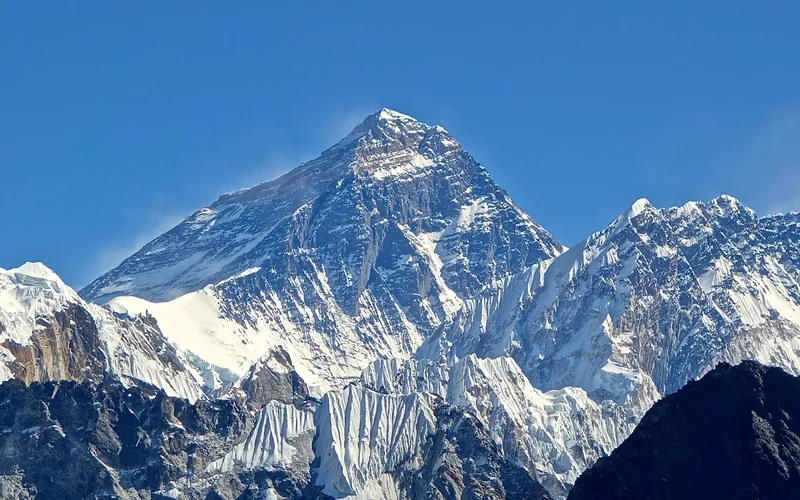


Mount Everest
Mount Everest is the highest mountain above sea level on Earth, standing at an official elevation of 8,848.86 meters (29,031.7 ft). Straddling the international frontier between Nepal and China, it is known locally as Sagarmatha in Nepali ('Goddess of the Sky') and Chomolungma in Tibetan ('Mother Goddess of the World'). The peak rises into the extreme upper troposphere, where oxygen levels drop to barely one-third of sea-level pressure. Climbers face hurricane-force jet stream winds, severe frostbite conditions, shifting ice crevasses in the Khumbu Icefall, and the dangerous Death Zone above 8,000 meters.
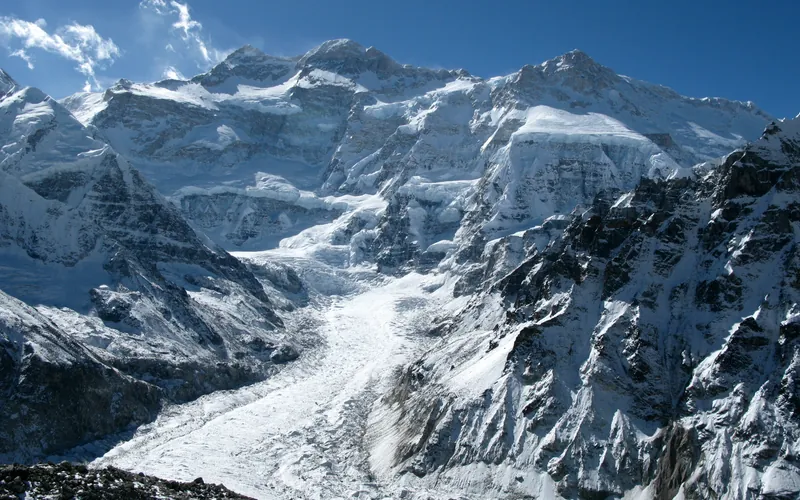
Kangchenjunga
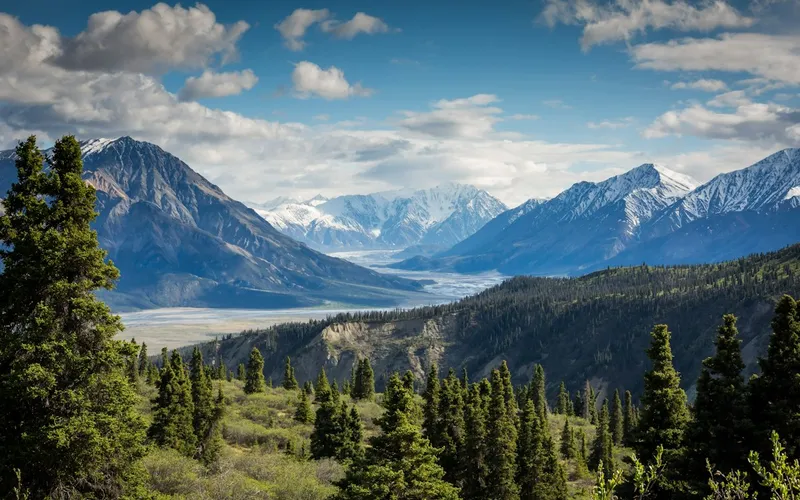
Kangchenjunga, at 8,586 meters (28,169 ft), is the third-highest mountain on Earth, rising on the border between Nepal and Sikkim, India. Honored as sacred by locals, early ascent teams respected local beliefs by stopping short of the actual highest crest. It features immense vertical relief and notorious storm cycles.

Broad Peak
Broad Peak, at 8,051 meters (26,414 ft), is the twelfth-highest mountain in the world. Located in the Karakoram directly across the Godwin-Austen Glacier from K2, it is famous for its 1.5-kilometre-long summit crest. First climbed in lightweight alpine style without supplemental oxygen or high-altitude porters in 1957 by an Austrian team.
Shishapangma
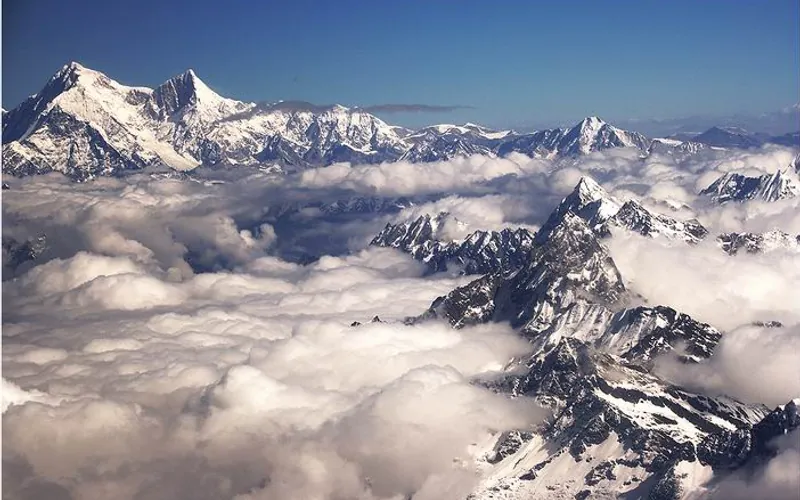
Shishapangma, at 8,027 meters (26,335 ft), is the fourteenth-highest mountain on Earth and the only 8,000-meter peak situated entirely within Tibetan/Chinese territory. Due to geopolitical restrictions, it was the final eight-thousander to be climbed, summited by a Chinese expedition on May 2, 1964.
Baintha Brakk
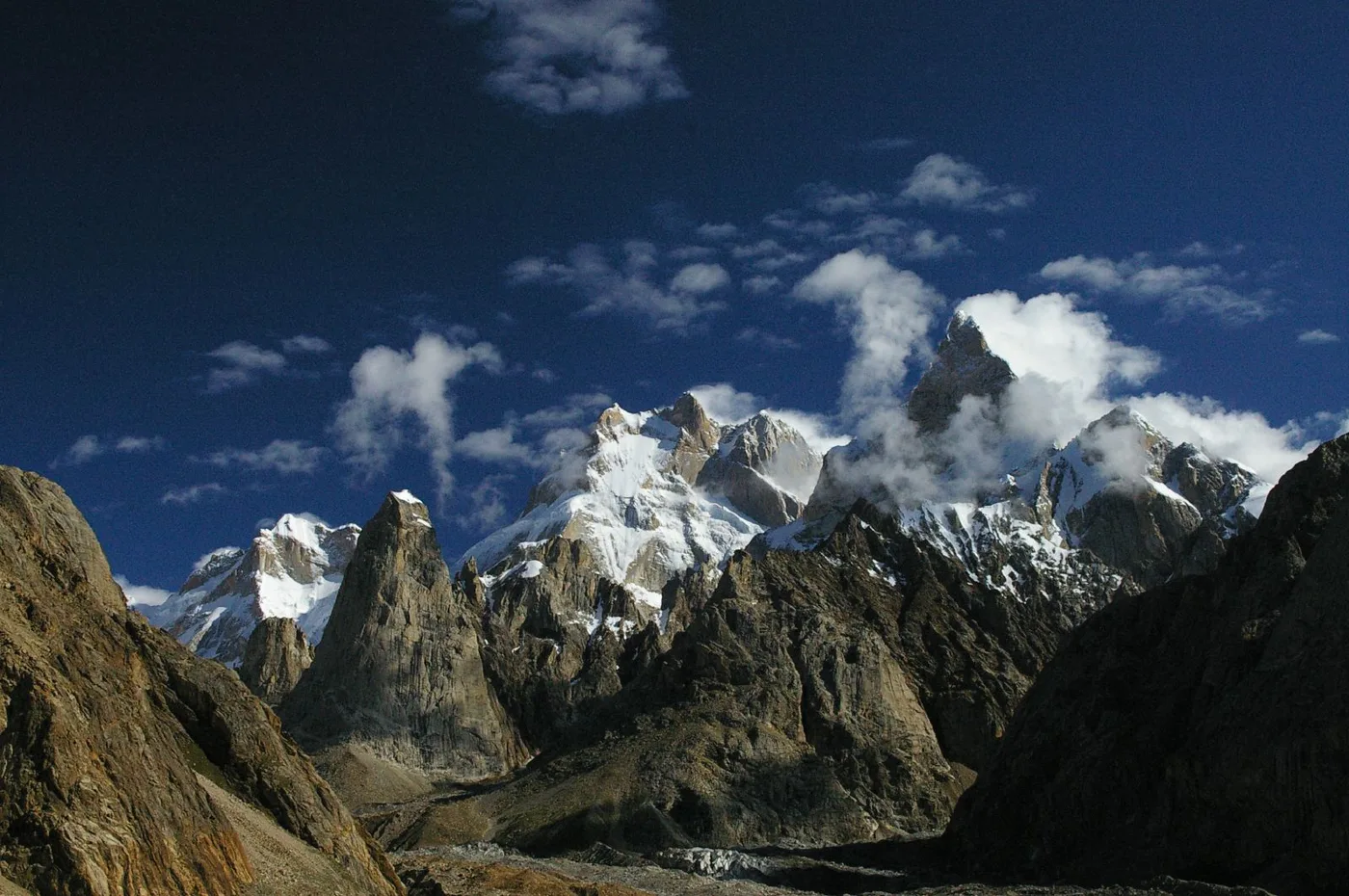
Baintha Brakk, famously known as 'The Ogre', is a colossal 7,285-meter (23,901 ft) granite mountain in the Panmah Muztagh subrange of the Karakoram. Widely regarded as one of the most perilous and technically difficult mountains in the world, its sheer vertical granite towers rise steeply above the Biafo Glacier. Following its epic 1977 first ascent by British climbers Doug Scott and Chris Bonington—during which Scott broke both legs and crawled for over a week down the mountain—The Ogre repelled more than twenty international expeditions over twenty-four years before seeing a second ascent in 2001.
Pioneered & Associated Routes (9)
The Ogre South Face & West Ridge (Original Route)
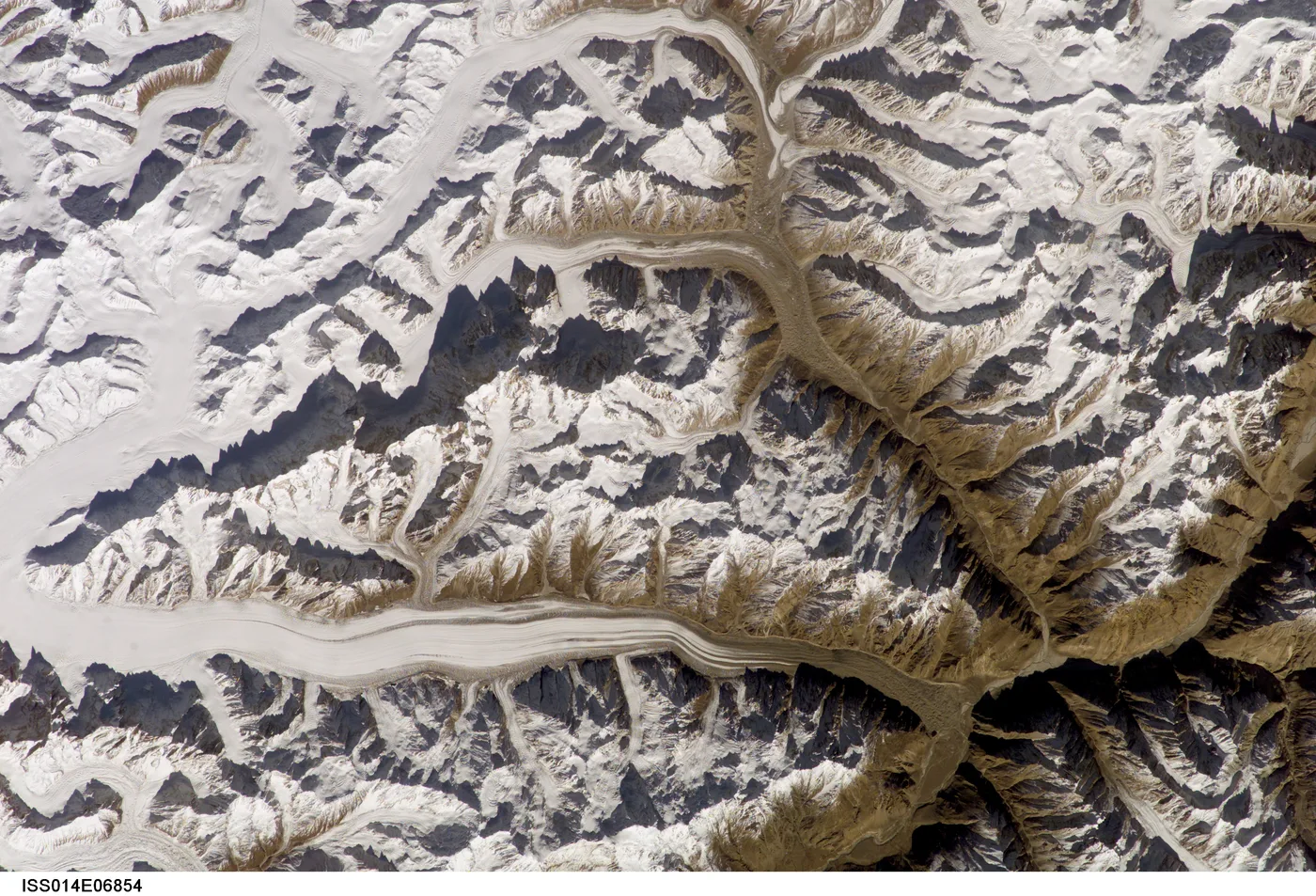
The original route on Baintha Brakk (The Ogre, 7,285m) tackles the complex South Face, the steep West Col, and the sheer vertical summit pyramid rising dramatically above the Biafo Glacier. Pioneers Doug Scott, Chris Bonington, Mo Anthoine, and Clive Rowland unlocked the route over weeks of demanding climbing on vertical Karakoram granite. On July 13, 1977, Scott and Bonington completed the summit push over technical 5.10 rock and A3 aid. On the very first abseil off the summit tower, Scott pendulum-swung across an icy corner, lost his footing, and snapped both legs just above the ankles. Bonington subsequently fractured his ribs on a later abseil. The epic eight-day retreat—during which Scott crawled on his hands and knees over jagged moraine and glaciers through a blizzard—stands as one of the greatest survival epics in human exploration.
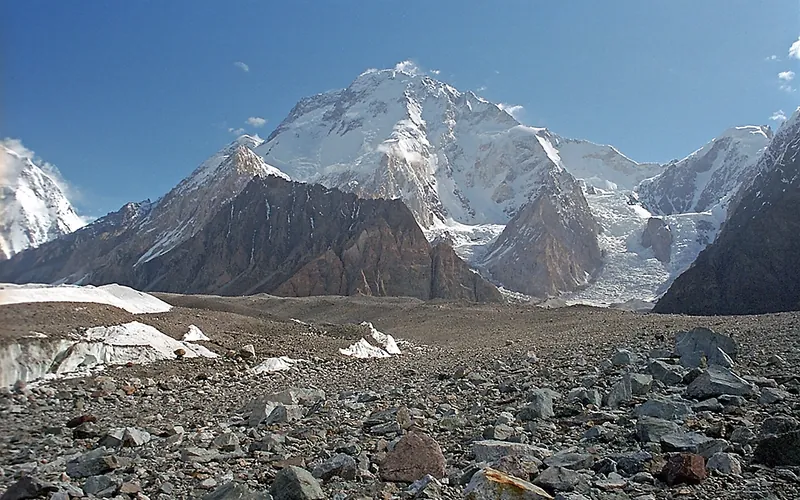
Normal Route (West Ridge & Northwest Face)
The Normal Route on Broad Peak ascends the rugged western spur from the Godwin-Austen Glacier, navigating steep mixed rock ribs before entering the upper glacial basin beneath the high saddle (the Col). From the Col at 7,800 meters, climbers enter the Death Zone to tackle the long, corniced summit ridge leading across the Foresummit to the true summit at 8,051 meters. First conquered in 1957 by an Austrian team in lightweight alpine style without bottled oxygen, and climbed in 1982 by Reinhold Messner, Nazir Sabir, and Sher Khan in a groundbreaking rapid alpine push.
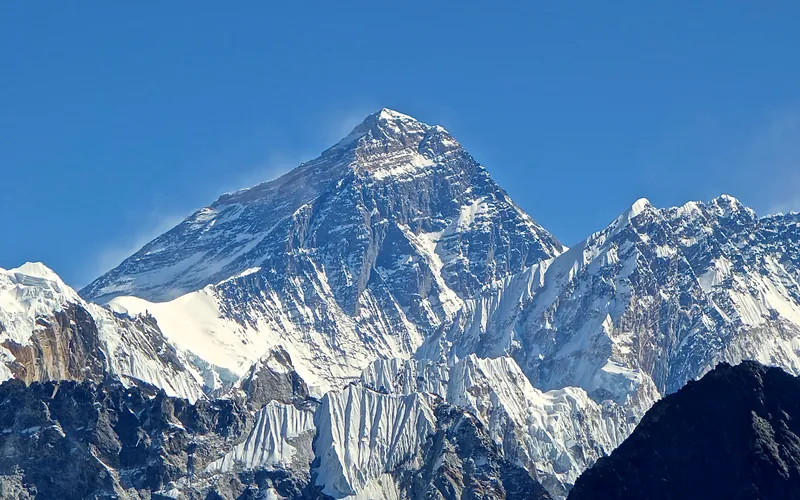
Mount Everest North Face (Hornbein Couloir Direct)
The North Face of Mount Everest via the Japanese Couloir and the sheer Hornbein Couloir is one of the most direct and formidable ice lines in the Himalayas. Rising 3,000 vertical meters from the Rongbuk Glacier to the summit, it funnels through a narrow 60-degree snow-and-ice cleft slicing straight through the Yellow Band and upper limestone cliffs of the North Face. In August 1986, Swiss alpinists Erhard Loretan and Jean Troillet executed one of the most audacious speed climbs in mountain history: climbing the entire face in a single 31-hour push at night without supplemental oxygen, tents, or fixed ropes. After summiting on August 30, they glissaded down the 3,000-meter face on their backs and buttocks in just 3.5 hours, completing the entire round trip in an astonishing 43 hours.
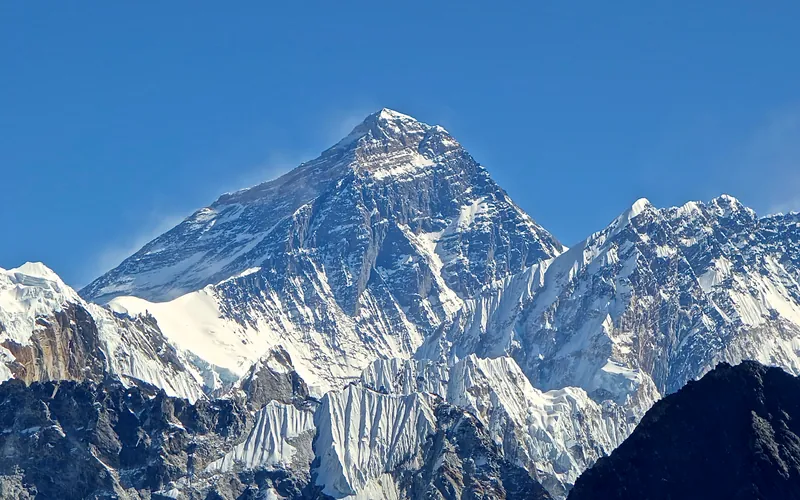
North Col & Northeast Ridge Route
The historic northern route on Mount Everest (8,848.86m), ascending from the Rongbuk and East Rongbuk glaciers to breach the icy wall of the North Col (7,020m). From the col, the route traverses the wind-blasted Northwest Ridge onto the North Face before joining the razor-like Northeast Ridge, navigating the notorious First, Second, and Third Steps in the Death Zone. This was the stage of George Mallory and Andrew Irvine's fateful 1924 climb and was first definitively surmounted on May 25, 1960, by Chinese climbers Wang Fuzhou, Qu Yinhua, and Gongbu.
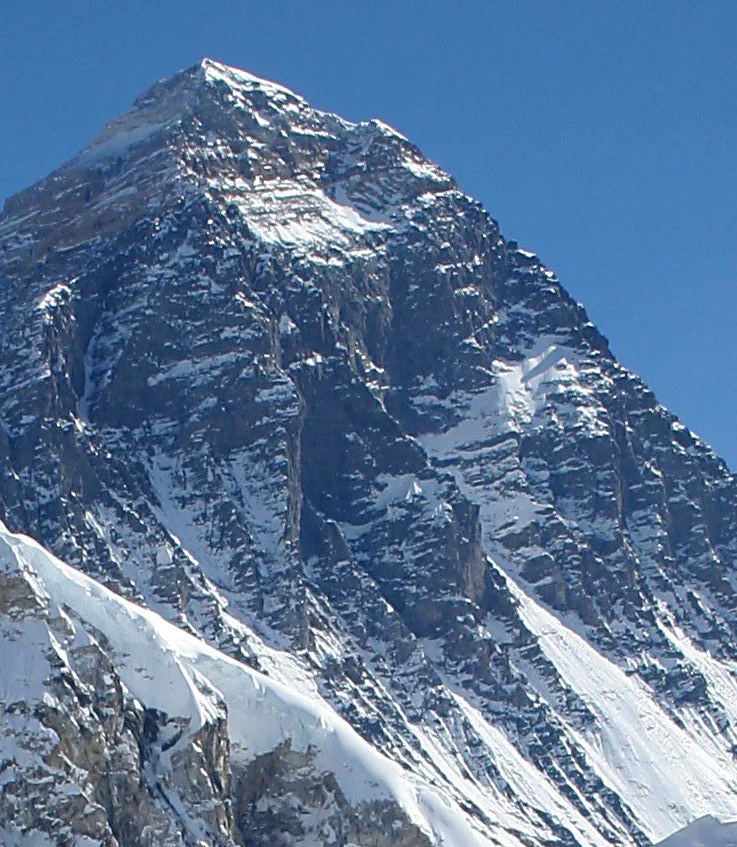
Mount Everest Southwest Face (Bonington Route)
The Southwest Face of Mount Everest (8,848.86m) rises 2,300 vertical meters from the Western Cwm to the summit, presenting one of the largest and most forbidding rock and ice faces in the world. Dominated by the vertical 300-meter 'Rock Band' at 8,200–8,500 meters, the face repelled six international attempts between 1969 and 1974. In autumn 1975, a legendary British expedition led by Chris Bonington breached the face when Paul Braithwaite and Nick Estcourt unlocked the key ramp through the Rock Band. On September 24, 1975, Doug Scott and Dougal Haston climbed to the South Summit and pushed on to the main summit, becoming the first Britons to conquer Everest. Trapped by nightfall during their descent, they survived an epic open bivouac at 8,760 meters without oxygen, sleeping bags, or frostbite.
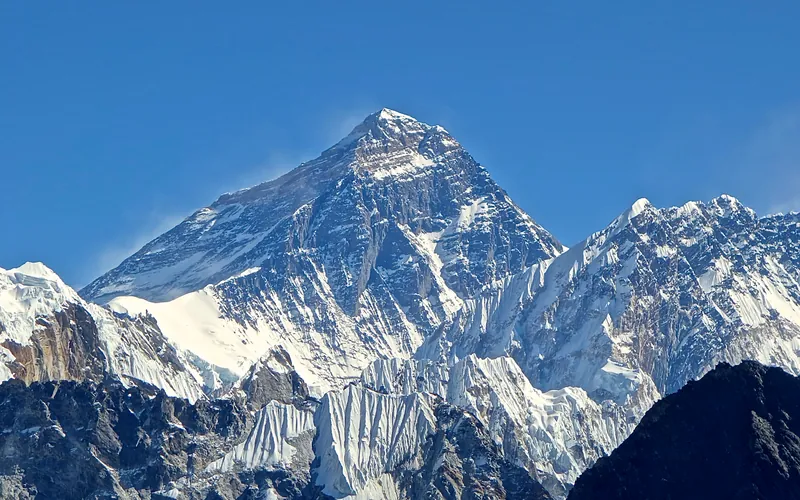
Mount Everest Complete West Ridge (Yugoslav Direct)
The Complete West Ridge of Mount Everest is one of the most formidable and sustained technical routes on the mountain. Pioneered in spring 1979 by an elite Yugoslav expedition led by Tone Škarja, the route tackles the integral knife-edge crest directly from the Lho La col (6,026m) all the way to the 8,848.86m summit. Unlike the 1963 American West Ridge route which diverted into the Hornbein Couloir from the North Face, the Yugoslav line stayed strictly along the razor-edge crest of the West Ridge, surmounting technical rock buttresses up to Grade V+ at extreme altitude before traversing around the Yellow Band. On May 13, 1979, Andrej Štremfelj and Nejc Zaplotnik achieved the first ascent of the complete ridge, followed two days later by Stane Belak, Marjan Manfreda, and Ang Phu Sherpa in one of the greatest feats in Himalayan history.
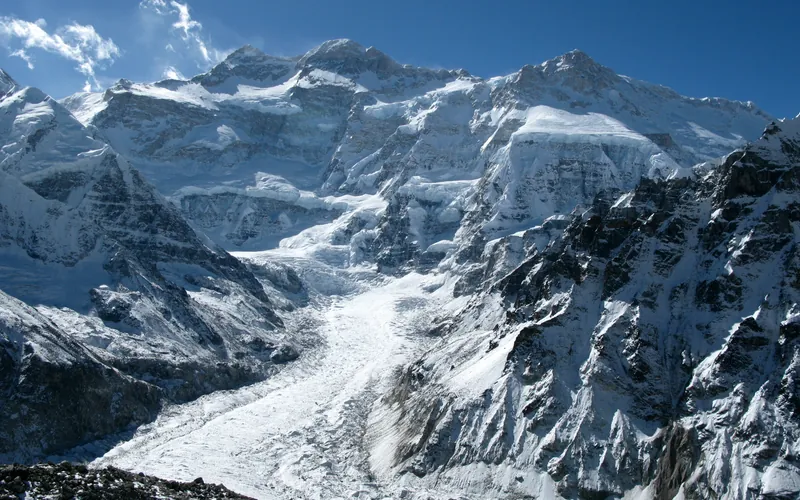
Kangchenjunga Southwest Face (Normal Route)
The Southwest Face route is the classic line of ascent on Kangchenjunga, climbing out of the Yalung Glacier cirque in eastern Nepal. First forged in 1955 by British mountaineers Joe Brown and George Band, the route negotiates heavily broken glacial icefalls, ascends the vast hanging snow terrace of The Great Shelf, and threads steep rock gullies in the Sickle Couloir before reaching the delicate summit crest.
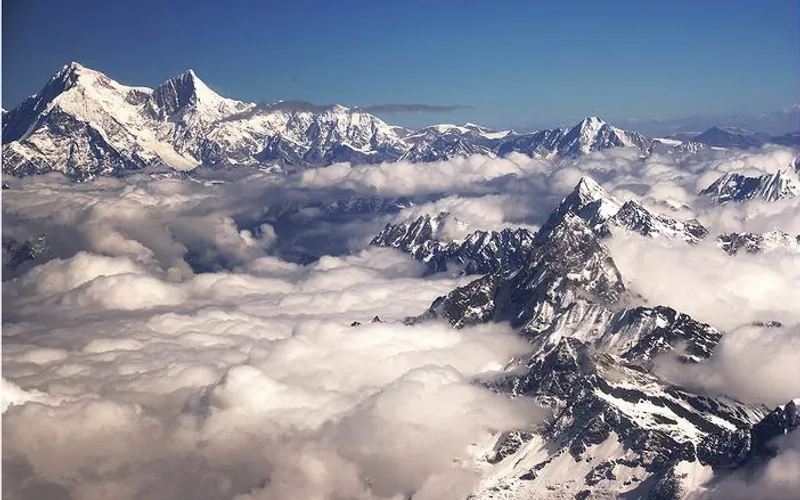
Shishapangma Northwest Ridge (Normal Route)
The Northwest Ridge is the standard route on Shishapangma, situated entirely in Tibet and first ascended by a Chinese expedition in 1964. Approached from the dry, high-altitude plateau of southern Tibet, the route climbs gently sloping glaciers to an upper plateau, gains the Central Peak (8,008m), and traverses a knife-edge snow arête with massive drop-offs to reach the true Main Summit at 8,027m.
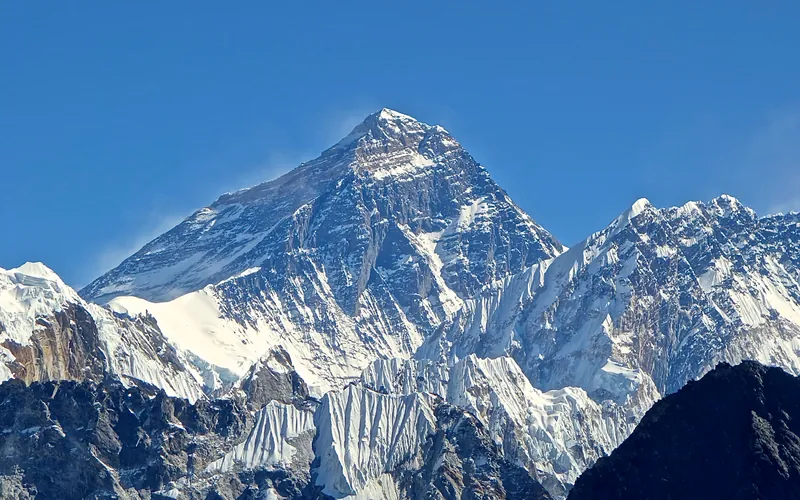
South Col & Southeast Ridge (Normal Route)
The South Col Route along the Southeast Ridge is the historic path of the 1953 first ascent and the most popular route on Mount Everest. Starting from Base Camp on the Khumbu Glacier in Nepal, climbers navigate the shifting seracs of the Khumbu Icefall into the Western Cwm. The route then scales the icy 45-degree slope of the Lhotse Face to the South Col at 7,925 meters, launching the final summit bid through the Balcony, South Summit, and Hillary Step to the summit of Earth at 8,848.86 meters.
Documented Expeditions (2)
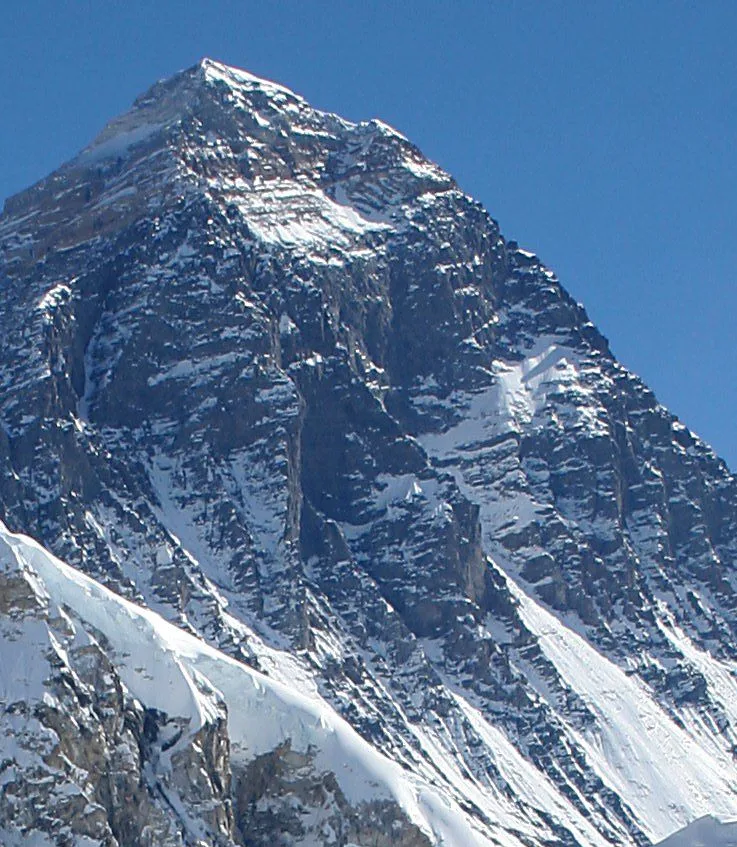
1975 British Mount Everest Southwest Face Expedition
The landmark autumn 1975 British expedition led by Chris Bonington that solved the 'Last Great Problem of the Himalayas' by conquering Mount Everest's colossal 2,300-meter Southwest Face, culminating in Doug Scott and Dougal Haston's summit and their legendary 8,760m survival bivouac.
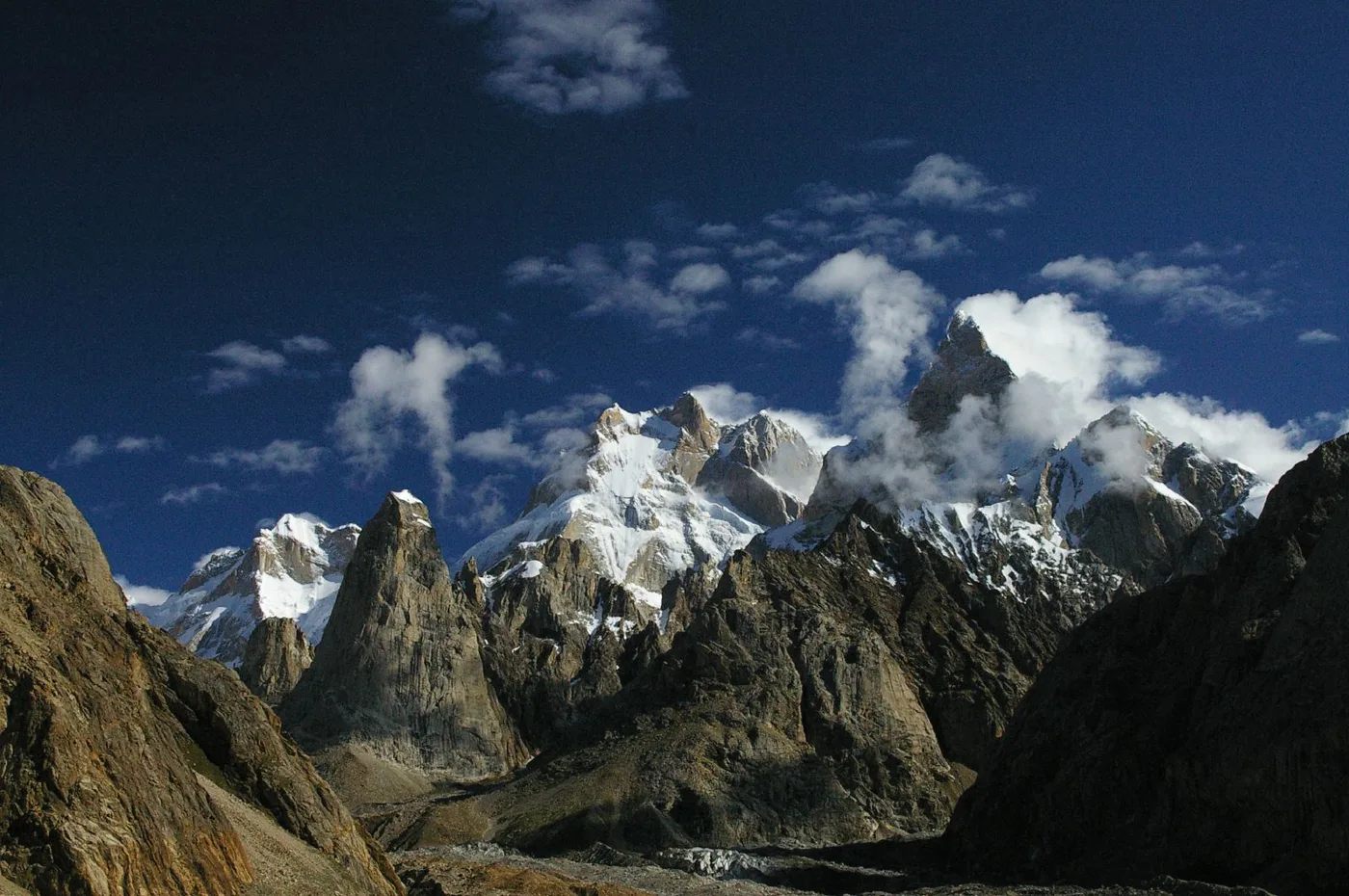
1977 British Baintha Brakk (The Ogre) Expedition
The legendary 1977 British expedition in which Doug Scott and Chris Bonington made the first ascent of Baintha Brakk (The Ogre, 7,285m), followed by Scott crawling on his hands and knees for eight days down the mountain with two shattered legs in one of mountaineering's greatest survival epics.
Associated Chronicles & Stories (2)
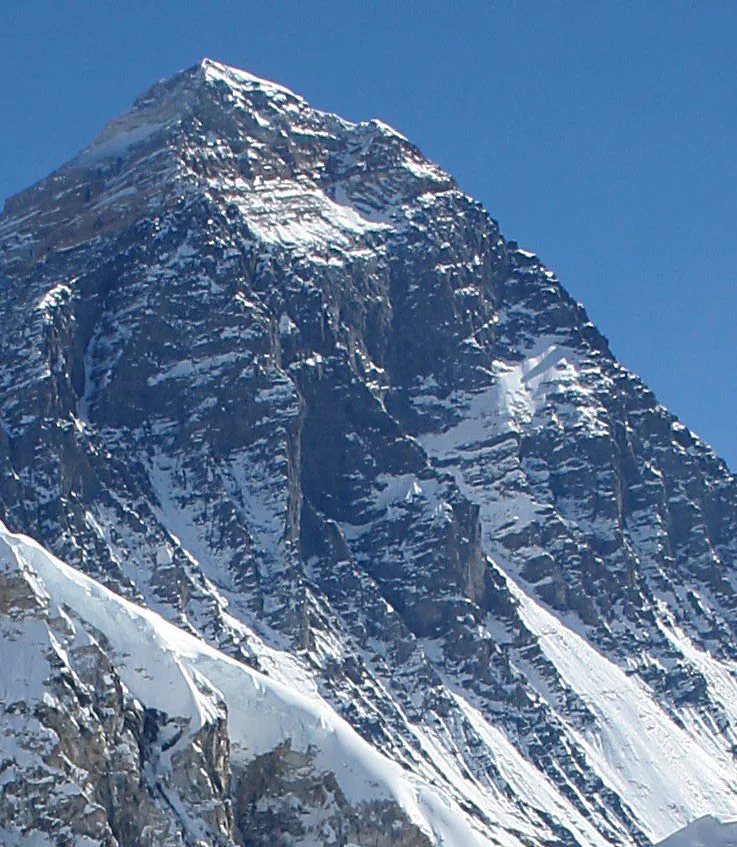
Everest 1975: The Southwest Face Rock Band and the 8,760m Survival Bivouac
On September 24, 1975, Doug Scott and Dougal Haston unlocked the vertical 300-meter Rock Band on Mount Everest's Southwest Face, standing atop the world and surviving a historic 8,760m open-air bivouac.
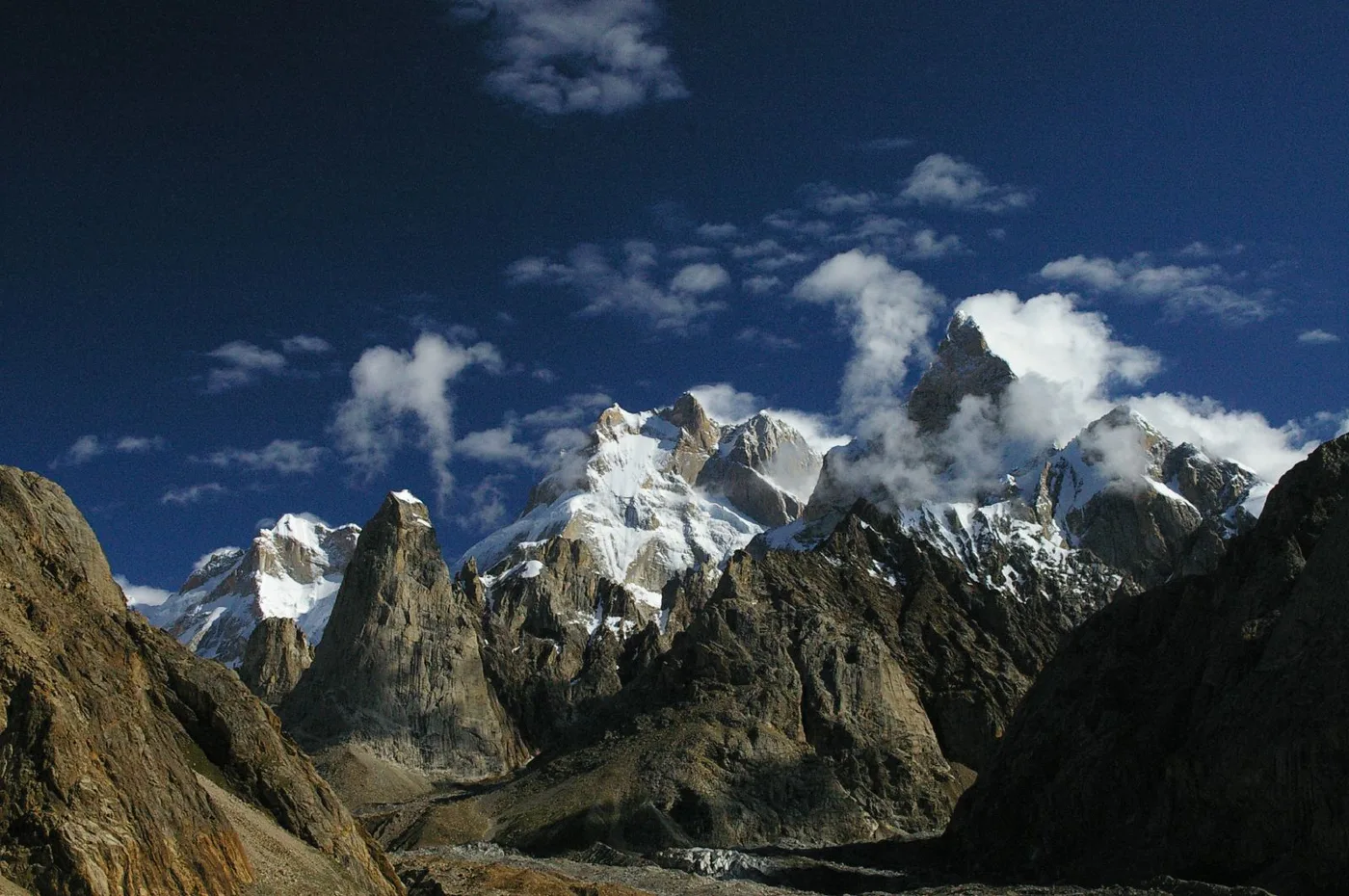
The Ogre 1977: Doug Scott's Heroic Eight-Day Crawl with Two Broken Legs
In July 1977, Doug Scott and Chris Bonington made the first ascent of Baintha Brakk (The Ogre). When Scott shattered both legs in an abseil accident, it triggered an epic eight-day crawl to survival.
Documented Sources & Archival Citations
- Up and About: The Hard Road to Everest(Doug Scott / Vertebrate Publishing)
Supporting claim: Autobiographical memoirs covering childhood, big-wall breakthroughs, and the 1975 Everest Southwest Face ascent
Accessed/Documented: 2015 - The Ogre: The Extraordinary Story of the First Ascent and Dramatic Descent(Doug Scott / Vertebrate Publishing)
Supporting claim: Detailed firsthand history of the 1977 Baintha Brakk expedition, summit, and eight-day crawl to survival
Accessed/Documented: 2017